Designing an Empowerment Model for School Counselors in the Field of Educational Guidance
Keywords:
School Counselor Empowerment, Educational Guidance, Psychological Well-being, School Counselors, Grounded TheoryAbstract
Objective: The aim of the present study was to design an empowerment model for school counselors in the field of educational guidance for ninth-grade students.
Methods and Materials: This qualitative study employed a grounded theory approach. The research population consisted of principals, counselors, and teachers working in lower secondary schools in District 10 of the Tehran Department of Education during the 2025–2026 academic year. Using purposive sampling, 30 participants, including 10 principals, 10 counselors, and 10 teachers who met the inclusion criteria, were selected. Semi-structured interviews were used for data collection. The data were analyzed based on the Strauss and Corbin (1998) grounded theory approach.
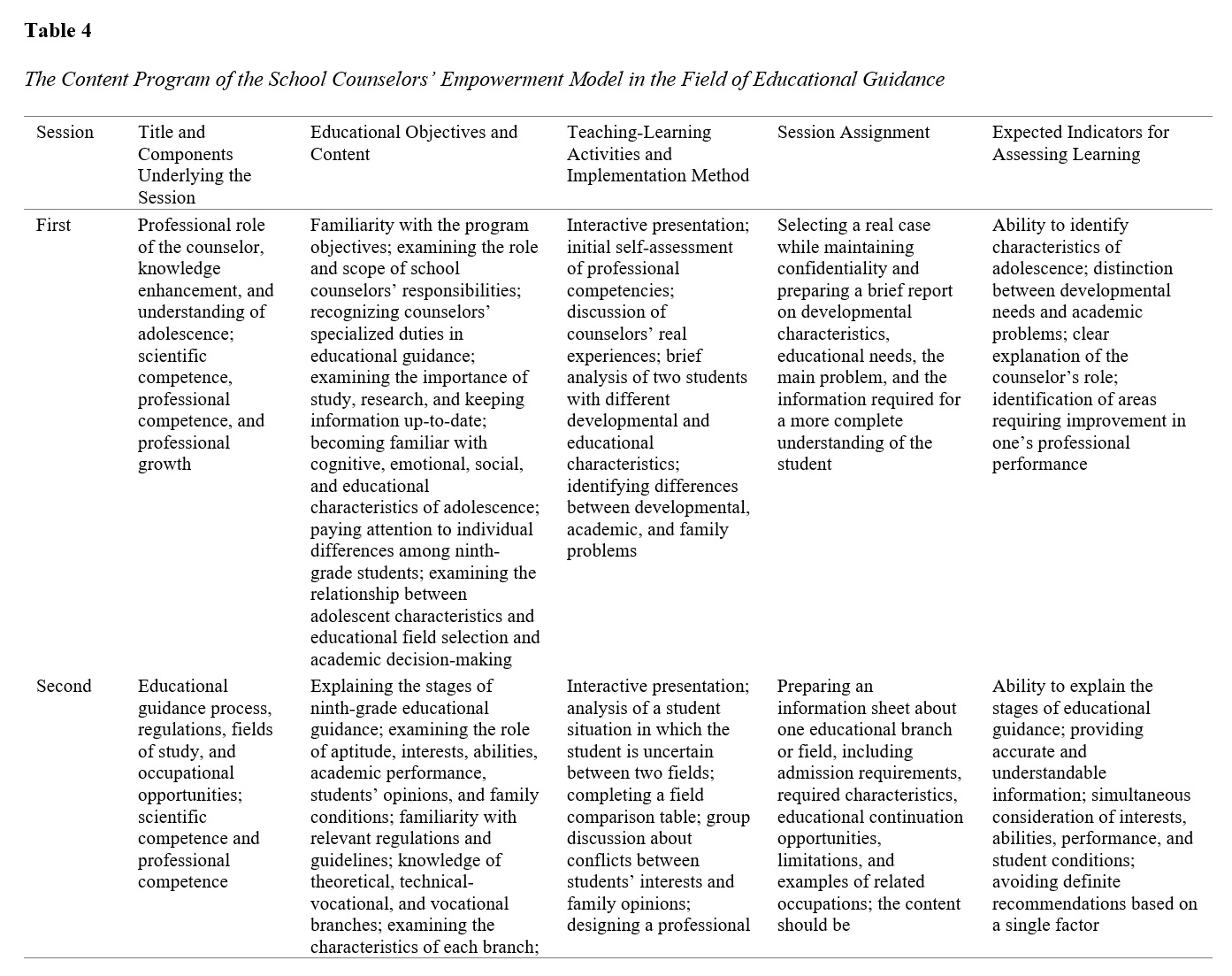
Findings: The findings from the perspectives of the three groups of participants revealed components including academic and professional competence, ethical competence, communication and professional skills, coordination with families and schools, cognitive and emotional maturity, psychological well-being, psychological hardiness, emotional intelligence, and an influential personality. Accordingly, an empowerment model was designed in the form of eight online training sessions covering counselors’ professional knowledge and roles, the educational guidance process, assessment and integration of information, interviewing and communication skills, professional ethics, decision-making and emotion regulation, coordination with schools and families, and the integrated application of acquired knowledge and skills. The content of the model was reviewed and approved by seven professors specializing in educational counseling.
Conclusion: The findings indicated that empowering school counselors in the field of educational guidance is a multidimensional process that, in addition to specialized knowledge and skills, requires strengthening ethical, communication, and psychological competencies, as well as the ability to interact and coordinate effectively with families and schools. Accordingly, the designed eight-session model can provide a comprehensive framework for enhancing counselors’ professional competence and improving the quality of the educational guidance process for ninth-grade students.
Downloads
References
Atici, M. (2014). Examination of school counselors’ activities: From the perspectives of counselor efficacy and collaboration with school staff. Educational Sciences: Theory & Practice, 14(6), 2107-2120.
Chaaban, Y., Alkhateeb, H., & Al-Ahmadi, A. (2025). Exploring supports and constraints to school counselors’ practices through Q-methodology research. International Journal for Educational and Vocational Guidance.
Chiang, C. F., & Hsieh, T. S. (2012). The impacts of perceived organizational support and psychological empowerment on job performance: The mediating effects of organizational citizenship behavior. https://doi.org/10.1016/j.ijhm.2011.04.011
Dodd, V., Hanson, J., & Hooley, T. (2022). Increasing students’ career readiness through career guidance: Measuring the impact with a validated measure. British Journal of Guidance & Counselling, 50(2), 260-272.
Falco, L. D., & Shaheed, C. (2021). Putting theory into practice: A conceptual framework for career group counseling in school settings. The Journal for Specialists in Group Work, 46(1), 6-19.
Fernandez, S., & Moldogaziev, T. (2015). Employee empowerment and job satisfaction in the U.S. federal bureaucracy: A self-determination theory perspective. The American Review of Public Administration, 45(4), 375-401. https://doi.org/10.1177/0275074013507478
Gati, I., & Saka, N. (2001). High school students’ career-related decision-making difficulties. Journal of Counseling & Development, 79(3), 331-340.
Haghshenas, S., & Abolmaali Alhoseini, K. (2022). Designing a conceptual model to explain the job success of school counselors. Counseling Culture and Psychotherapy, 13(49), 77-94.
Kang, M. M., Park, S., & Sorensen, L. C. (2022). Empowering the frontline: Internal and external organizational antecedents of teacher empowerment. Public Management Review, 24(11), 1705-1726. https://doi.org/10.1080/14719037.2021.1919185
Kekki, M., & Linde, J. (2024). Career counsellors’ professional agency when working with migrants. International Journal for Educational and Vocational Guidance, 24(2), 269-287.
Lambie, G. W., & Stickl Haugen, J. (2021). The assessment of school counseling competencies as a tool to support school counseling students, supervisors, and training programs. Professional School Counseling, 25(1), 2156759X20981050.
Lee, P. S., & Sung, Y. H. (2022). Using a Delphi technique to build a competency framework for full-time counselling teachers in Taiwan. British Journal of Guidance & Counselling, 50(6), 818-833.
Merlin-Knoblich, C., Dack, H., & Elizondo, J. A. (2024). A pre-experimental pilot study of school counselors completing an 8-month professional development program to improve self-efficacy. Counseling Outcome Research and Evaluation, 15(1), 21-36.
Monje-Amor, A., Xanthopoulou, D., Calvo, N., & Abeal Vázquez, J. P. (2021). Structural empowerment, psychological empowerment, and work engagement: A cross-country study. European Management Journal, 39(6), 779-789.
Naseri, F., Eslampanah, M., Mosavi, F., & Kaviani, E. (2023). Investigating the effect of empowering and increasing the awareness of teachers, parents and students on the academic guidance process. Journal of Adolescent and Youth Psychological Studies, 3(3), 430-440.
Naseri, M., Hosseinpour, R., & Shafiabady, A. (2022). Identifying the Competencies of Counselors in the Public Education System with an Islamic Approach. Research in Islamic Education Issues, 30(56), 11-57. https://dor.isc.ac/dor/20.1001.1.22516972.1401.30.56.1.0
Nazarinia, M., Safarnavadeh, M., Shafiei, N., & Esmaeilzadeh, Z. (2022). Designing a model of educational guidance for the first period of secondary school students: Tehran City case study. Iranian Evolutionary Educational Psychology Journal, 4(4), 232-242.
Novakovic, A., Patrikakou, E. N., & Ockerman, M. S. (2021). School counselor perceptions of preparation and importance of college and career readiness counseling. Professional School Counseling, 25(1), 2156759X21998391.
Pordelan, N., & Hosseinian, S. (2021). Online career counseling success: The role of hardiness and psychological capital. International Journal for Educational and Vocational Guidance, 21(3), 531-549.
Sadana, A., & Kumar, A. (2023). Exploring novice Indian school counsellors’ experiences collaborating with teachers and administrators. Journal of Psychologists and Counsellors in Schools, 33(2), 146-160.
Santilli, S., Ginevra, M. C., Di Maggio, I., Soresi, S., & Nota, L. (2022). In the same boat? An online group career counseling with a group of young adults in the time of COVID-19. International Journal for Educational and Vocational Guidance, 22(3), 623-641.
Shahsavāri, M., Mesrābādi, J., Habibi Kaleybar, R., & Farid, A. (2024). Representing the process of aptitude assessment in the academic guidance of students: A qualitative study. Journal of Educational Innovations, 23(2), 149-177. https://doi.org/10.22034/jei.2024.380192.2545
Shariatmadar, A., Hasanpour, F., & Kalantar Hormozi, A. (2021). Evaluation of burnout syndrome and occupational imbalance in school counselors: A qualitative study. Rooyesh, 10(6), 117-128. https://dor.isc.ac/dor/20.1001.1.2383353.1400.10.6.15.5
Vojdani Hemmat, M., & Ansarikia, H. (2025). Challenges of newly hired school counselors in the management of students' academic guidance. Counseling and Psychotherapy Culture, 16(62), 37-75. https://doi.org/10.22054/qccpc.2025.80733.3337
Wahyuni, F., Wiyono, B. B., Atmoko, A., & Hambali, İ. (2019). Assessing relationships between emotional intelligence, school climate and school counselors burnout: A structural equation model. Journal for the Education of Gifted Young Scientists, 7(4), 1361-1374. https://doi.org/10.17478/jegys.639397
Wang, D., & Wang, G. (2025). Improving career readiness in middle school students: A systematic review of intervention approaches. Frontiers in psychology, 16, 1582195.
Yaghoobi, A., Moradiani, F., & Roshanaei, M. (2025). Meta-Analysis of Educational-Psychological Interventions on Academic Enthusiasm of High School Students. New Educational Approaches, 20(2), 35-66. https://doi.org/10.22108/nea.2025.144435.2109
Downloads
Additional Files
Publication Timeline
- Submitted
- Revised
- Accepted