Structural Modeling of Generalized Anxiety Disorder Symptom Level Based on Positive and Negative Metacognitive Beliefs: The Mediating Role of Intolerance of Uncertainty among University Students
Keywords:
generalized anxiety disorder, metacognitive beliefs, intolerance of uncertainty, students, beliefs, positive metacognitive beliefs, negative metacognitive beliefs, structural equation modelingAbstract
Objective: The present study aimed to test a structural model of generalized anxiety disorder symptom level based on positive and negative metacognitive beliefs, with the mediating role of intolerance of uncertainty among university students.
Methods and Materials: This applied quantitative study used a descriptive-correlational design and structural equation modeling. The statistical population consisted of students at Islamic Azad University, Najafabad Branch, Iran. An initial sample of 300 students was selected using accessible purposive sampling, and 294 valid questionnaires were included in the final analysis. Data were collected using a demographic information form, the Metacognitions Questionnaire, the Intolerance of Uncertainty Questionnaire, and the Generalized Anxiety Disorder Scale. Data were analyzed using SPSS version 24 and AMOS version 24 through descriptive statistics, Pearson correlation coefficients, and structural equation modeling.
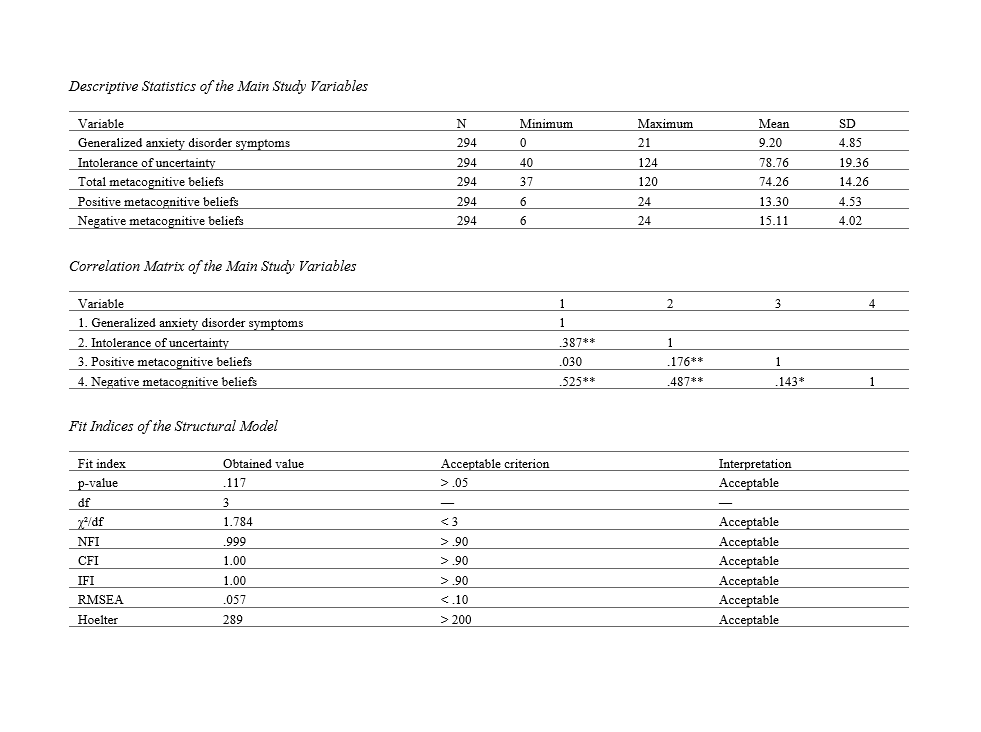
Findings: The structural model showed acceptable fit to the data: χ²/df = 1.784, NFI = .999, CFI = 1.00, IFI = 1.00, RMSEA = .057, and Hoelter = 289. Positive metacognitive beliefs did not have a significant direct effect on generalized anxiety disorder symptoms (β = -.036, p = .358), but they had a significant indirect effect through intolerance of uncertainty (β = .016, p = .050). Negative metacognitive beliefs had a positive and significant direct effect on generalized anxiety disorder symptoms (β = .220, p = .011) and also had a significant indirect effect through intolerance of uncertainty (β = .081, p = .050). Intolerance of uncertainty had a positive and significant direct effect on generalized anxiety disorder symptoms (β = .186, p = .019).
Conclusion: The findings support the mediating role of intolerance of uncertainty in the relationship between metacognitive beliefs and generalized anxiety disorder symptoms. Negative metacognitive beliefs appear to be a stronger direct predictor of generalized anxiety symptoms, whereas positive metacognitive beliefs may influence symptoms mainly through intolerance of uncertainty. These results highlight the importance of targeting dysfunctional metacognitive beliefs and intolerance of uncertainty in prevention and intervention programs for university students.
Downloads
References
Bailey, R., Oba, E. C., & Allen, R. (2025). The Role of Metacognitive Beliefs in Generalized Anxiety Disorder in Men Who Have Sex with Men Living with HIV in Nigeria. Journal of Health Psychology. https://doi.org/10.1177/13591053251314989
Counsell, A., Furtado, M., Iorio, C., Anand, L., Canzonieri, A., Fine, A., Fotinos, K., Epstein, I., & Katzman, M. A. (2024). Intolerance of Uncertainty, Social Anxiety, and Generalized Anxiety: Differences by Diagnosis and Symptoms. https://doi.org/10.32920/27637551.v1
Fathi Avali Gheshlaqi, A., & Najafi, M. (2023). A comparison of intolerance of uncertainty, cyberchondria, and health anxiety in individuals with obsessive-compulsive disorder, generalized anxiety disorder, depression, and normal individuals. Cultural Psychology Journal, 7(2), 46-64. https://jcp.samt.ac.ir/article_187000.html
Fortin Delisle, I., & Dugas, M. J. (2025). Tolerating Uncertainty: Short- and Long-Term Effects of Sudden Gains in Behavioral Experiments for Generalized Anxiety Disorder. Cognitive therapy and research, 1-14. https://doi.org/10.1007/s10608-025-10598-x
Hammersmark, A. T., Hjemdal, O., Hannisdal, M., Lending, H. D., Reme, S. E., Hodne, K., & Johnson, S. U. (2024). Metacognitive therapy for generalized anxiety disorders in group: A case study. Journal of Clinical Psychology, 80(4), 884-899. https://doi.org/10.1002/jclp.23615
Holaway, R. M., Heimberg, R. G., & Coles, M. E. (2023). A Comparison of Intolerance of Uncertainty in Analogue Obsessive-Compulsive Disorder and Generalized Anxiety Disorder. Journal of anxiety disorders, 20, 158-174.
Khalilnejad, M., Abbasi, Q., & Hadian Nejad, P. (2024). The Effectiveness of Metacognitive Therapy on the Believability of Thoughts and Anxiety Feelings in Patients with Generalized Anxiety Disorder: A Semi-Experimental Study. Journal of Rafsanjan University of Medical Sciences, 23(3), 250-263. https://doi.org/10.61186/jrums.23.3.150
Nordahl, H., Vollset, T., & Hjemdal, O. (2023). An empirical test of the metacognitive model of generalized anxiety disorder. Scandinavian journal of psychology, 64(3), 263-267. https://doi.org/10.1111/sjop.12884
Rawat, A. A. U. S. N., Khan, A., Faisal, S., Chand, A., & Yousaf, R. A. (2023). Comparison of Metacognitive Therapy Versus Cognitive Behavioral Therapy for Generalized Anxiety Disorder: A Meta-Analysis of Randomized Control Trials. Cureus, 15(5). https://doi.org/10.7759/cureus.39252
Riley, J. A., Wilson, E. J., Norton, A. R., & Abbott, M. J. (2026). Exploring the Role of Early Maladaptive Schemas and Intolerance of Uncertainty in Generalized Anxiety Disorder. British Journal of Clinical Psychology, 65(1), 199-217. https://doi.org/10.1111/bjc.70012
Sheikhepour, A., & Mostafaei, A. (2024). The role of emotion processing, tolerance of ambiguity, and metacognitive beliefs in predicting generalized anxiety disorder among nurses in Sardasht health network. Iranian Journal of Nursing Research (Majalleh-ye Pazhuhesh-e Parastari-ye Iran), 19(1), 33-43.
Sherafati, H., Taheri, E., & Amiri, M. (2023). Comparing the effectiveness of metacognitive therapy and Barlow transdiagnostic treatment on cognitive emotion regulation in patients with generalized anxiety disorder. Journal of Fundamentals of Mental Health, 25(2), 79-83. https://jfmh.mums.ac.ir/article_22150.html
Shipp, L., Leigh, E., Laverton, A., Percy, R., & Waite, P. (2024). Cognitive Processes in Adolescents With Generalised Anxiety Disorder: Exploring Intolerance of Uncertainty, Cognitive Avoidance, and Positive Beliefs About Worry. https://doi.org/10.31219/osf.io/hua6q
Shipp, L., Leigh, E., Laverton, A., Percy, R., & Waite, P. (2025). Cognitive Aspects of Generalised Anxiety Disorder in Adolescents: Exploring Intolerance of Uncertainty, Cognitive Avoidance, and Positive Beliefs about Worry. Child Psychiatry & Human Development, 1-10.
Uzun, D., & Yilmaz, A. E. (2026). Effectiveness of Metacognitive Therapy in the Treatment of Generalized Anxiety Disorder: A Systematic Review. Psikiyatride Guncel Yaklasimlar, 18(1), 332-353. https://doi.org/10.18863/pgy.1621073
Wilson, E. J., Abbott, M. J., Norton, A. R., Berle, D., & Rapee, R. M. (2025). Exploring pathways from intolerance of uncertainty to worry in adults with generalised anxiety disorder. Cognitive behaviour therapy, 1-21.
Wilson, E. J., Abbott, M. J., Norton, A. R., Berle, D., & Rapee, R. M. (2026). Exploring pathways from intolerance of uncertainty to worry in adults with generalised anxiety disorder. Cognitive behaviour therapy, 55(1), 96-116. https://doi.org/10.1080/16506073.2025.2478246
Ye, H., Li, Y., Huang, Y., Zhang, Y., Zhang, J., Wang, J., Liu, K., Yao, Y., Shi, X., Liu, Y., & Fan, F. (2025). Bidirectional Relationships Between Intolerance of Uncertainty and Generalized Anxiety Among Adolescents: Insights From Cross-Lagged Panel Network Analysis. Child and adolescent psychiatry and mental health, 19(1). https://doi.org/10.1186/s13034-025-00912-6
Yu, H., Shi, Z., & Zhao, M. (2024). The Relationship between Metacognition, Rumination, and Sleep in University Students with a Tendency toward Generalized Anxiety Disorder. Behavioral Sciences, 14(6), 444. https://doi.org/10.3390/bs14060444
Downloads
Additional Files
Publication Timeline
- Submitted
- Revised
- Accepted