Development and Psychometric Evaluation of the Digital Native Identity Scale among Upper Secondary School Students in Tehran
Keywords:
identity formation, digital natives, secondary school students, graded response model, psychometric propertiesAbstract
Objective: The present study aimed to develop and analyze the psychometric properties of the Digital Native Identity Scale among upper secondary school students in Tehran.
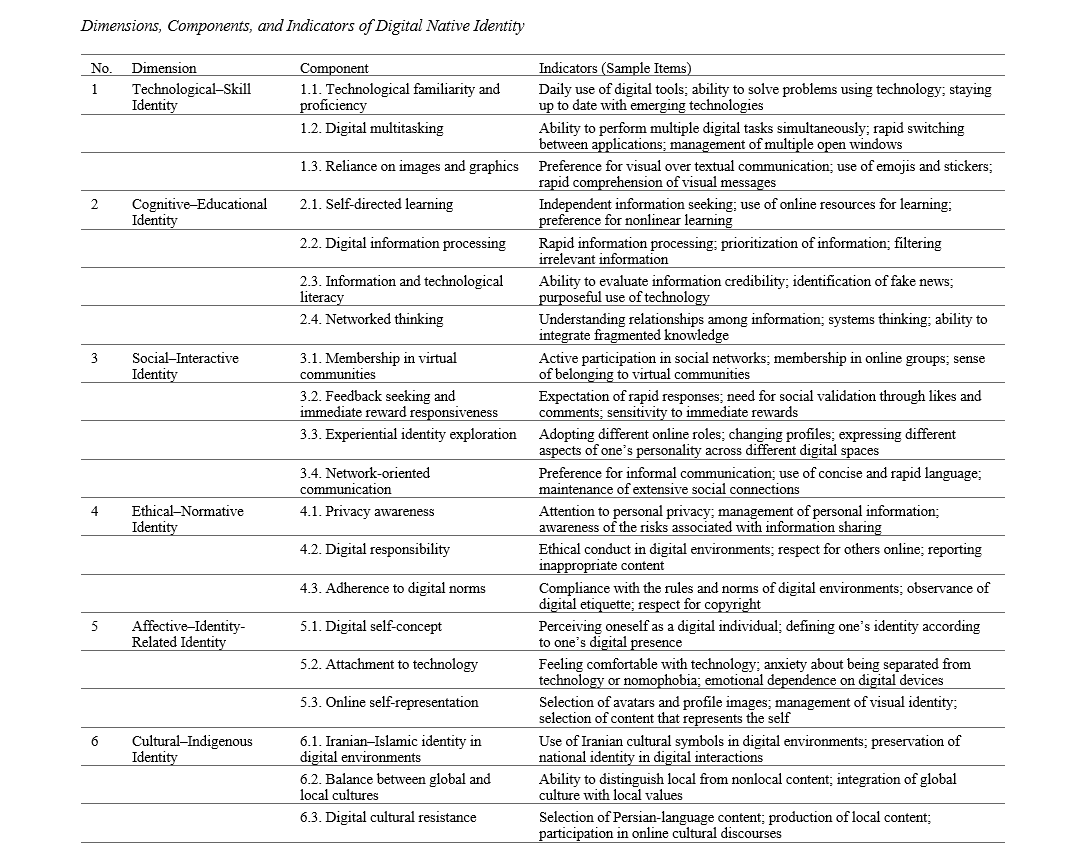
Methods and Materials: This study employed an exploratory sequential mixed-methods design and was conducted in two qualitative and quantitative phases. In the qualitative phase, semi-structured interviews were conducted with 24 experts in educational sciences, psychology, sociology, and information technology. Thematic analysis was used to identify the dimensions and components of digital native identity, based on which a 21-item scale comprising six dimensions was developed. In the quantitative phase, data were collected from 402 students, including 206 girls and 196 boys, who were selected through multistage cluster sampling. The data were analyzed using confirmatory factor analysis, Cronbach’s alpha and McDonald’s omega coefficients, and the graded response model within the framework of item response theory.
Findings: The findings indicated that the six-factor model was confirmed with satisfactory goodness-of-fit indices (CFI = 0.942, TLI = 0.935, RMSEA = 0.054, and SRMR = 0.047), and all factor loadings ranged from 0.63 to 0.81. The reliability coefficients for the total scale (α = 0.91 and ω = 0.93) and the reliability coefficients for its dimensions, which ranged from 0.78 to 0.86, indicated excellent internal consistency. The graded response model analysis showed that 17 of the 21 items demonstrated an adequate fit to the model. The item discrimination parameters ranged from 1.56 to 2.12, indicating good to excellent discrimination. The information functions confirmed that the scale provided high levels of information across a broad range of the latent trait continuum. Differential item functioning analysis by gender showed that only one item exhibited minor DIF, indicating that the scale was essentially free from gender bias. Furthermore, comparison of the unidimensional and multidimensional item response theory models demonstrated the significant superiority of the multidimensional model.
Conclusion: Based on the findings, the Digital Native Identity Scale possesses satisfactory validity, reliability, and measurement information and can be used as a valid instrument for assessing different dimensions of identity formation among Iranian adolescents.
Downloads
References
Aral, N., & Kadan, G. (2018). Social Development. In N. Aral & Z. F. Temel (Eds.), Child development (pp. 236-262). Hedef Publications.
Chillakuri, B. (2020). Understanding Generation Z Expectations for Effective Onboarding. Journal of Organizational Change Management. https://doi.org/10.1108/JOCM-02-2020-0058
Ghanbari Baghestan, A., Hosseinzadeh, F., & Gholami, F. (2023). Social Media and the Process of Identity-Formation Among Z Generation: Case of the Mashhad City. Cultural Studies & Communication, 19(71), 135-162. https://doi.org/10.22034/jcsc.2023.2014283.2704
Gibbons, S. (2007). Redefining the Roles of Information Professionals in Higher Education to Engage the Net Generation Educause Australasia,
Gimbergsson, E., & Lundberg, S. (2016). Work Values of Generation Z: A Quantitative Study Explaining Different Groups of Generation Z's Work Values
Harris, K. (2020). A New Generation of Workers: Preparing for Generation Z in the Workplace University of South Carolina].
Izadi, M. (2021). The Generation of Digital Natives: Unique Opportunities for Technology-Assisted Education. Educational Technology Growth, 36(7).
Iziy, M., Aliabadi, K., Nili, M. R., & Delavar, A. (2019). A Generation Analysis of Electronic Textbook Preferences in Students with Digital Native Features. University Textbooks, Research and Writing, 23(44), 99-117. https://sid.ir/paper/240857/en
Jang, J. Y., Han, K., Lee, D., Jia, H., & Shih, P. C. (2016). Teens Engage More with Fewer Photos: Temporal and Comparative Analysis on Behaviors in Instagram Proceedings of the 27th ACM Conference on Hypertext and Social Media, https://doi.org/10.1145/2914586.2914602
Kadan, G., & Aral, N. (2021). The Digital Identity of the Z Generation and Their Use of Digital Technology. In Academic Researches in (pp. 256).
Kanani, M. A., Mousavi, S. H., & Beygzadeh, Z. (2019). Media as a Generational Object: Investigating the Role of Media Consumption on Generational Identity. Strategic Research on Social Problems, 8(3), 35-56. https://doi.org/10.22108/srspi.2020.121075.1491
Khajeheian, D., Salavatian, S., Kolli, S., & Soltani, T. (2020). Motivations and Hashtag Patterns of Iranian Digital Natives on Instagram. New Media Studies, 6(23), 155-188. https://doi.org/10.22054/nms.2021.47908.861
Khajeheian, D., Salavatian, S., Kolli, S., & Yazdani, A. (2020). Behavior Pattern of Iranian Digital Natives on Instagram: A Data Mining of Social Networks. Communication Research, 27(101), 9-32. https://doi.org/10.22082/cr.2020.117695.1961
Kitchen, P. J., & Proctor, T. (2015). Marketing Communications in a Postmodern World. Journal of Business Strategy, 36(5), 34-42. https://doi.org/10.1108/JBS-06-2014-0070
Kravchenko, A. A., Lipin, M., Krasilnikova, O., & Husieva, N. (2025). The Digital Era as a New Stage of Sociocultural Transformation: A Philosophical View on Changing Values. International Journal on Culture History and Religion, 7(SI1), 717-744. https://doi.org/10.63931/ijchr.v7iSI1.337
McKenna, B., & Vodanovich, S. (2016). Digital Native Identity Development in Virtual Worlds.
Nemeti, F., Boland, H., & Sayadi, A. (2022). Investigating the Mediating Role of Identity Crisis and Family Cohesion in Determining the Relationship Between Social Networks Participation with Body Image Issues Among Students. Journal of counseling research, 21(81), 256-280. https://doi.org/10.18502/qjcr.v21i81.9499
Prensky, M. (2001). Digital Natives, Digital Immigrants. On the Horizon, 9(5), 1-6. https://doi.org/10.1108/10748120110424816
Rosenberg, H., Blondheim, M., & Sabag-Ben Porat, C. (2025). Who in the World Is Generation Z? The Rise of Mobile Natives and Their Socio-Technological Identity. Societies, 15(11), 314. https://doi.org/10.3390/soc15110314
Ruiller, C., & Van Der Heijden, B. I. (2016). Socio-Emotional Support in French Hospitals: Effects on French Nurses' and Nurse Aides' Affective Commitment. Applied Nursing Research, 29, 229-236. https://doi.org/10.1016/j.apnr.2015.06.006
Saneapour, M. (2012). Identity in the Age of Digital Media. Interdisciplinary Studies in Media and Culture, 1(2), 115-130.
Santrock, J. W. (2016). Life-Span Development. Nobel Publications.
Tas, H. Y., & Kacar, S. (2019). Management Styles of X, Y and Z Generation Employees and a Business Example. OPUS: International Journal of Society Researches, 11(18), 643-675. https://doi.org/10.26466/opus.554751
Teo, T. (2013). An Initial Development and Validation of a Digital Natives Assessment Scale (DNAS). Computers & Education, 67, 51-57. https://doi.org/10.1016/j.compedu.2013.02.012
Downloads
Additional Files
Publication Timeline
- Submitted
- Revised
- Accepted