Structural Relationships Between Perceived Parenting Styles and Propensity for Addiction Among Upper Secondary School Students: The Mediating Roles of Mental Toughness and Self-Efficacy
Keywords:
Perceived parenting styles, addiction propensity, mental toughness, self-efficacy, adolescents, structural equation modelingAbstract
Objective: This study aimed to examine the structural relationships between perceived parenting styles and propensity for addiction among upper secondary school students, with mental toughness and self-efficacy as mediating variables.
Methodology: This fundamental, descriptive-correlational study used structural equation modeling. The statistical population consisted of approximately 46,000 upper secondary school students in Qazvin County. Using multistage cluster random sampling, 260 students were selected from public and non-public schools; after excluding four incomplete or invariant-response questionnaires, data from 256 students were analyzed. Data were collected using the Grolnick Perceived Parenting Questionnaire, Iranian Addiction Potential Scale, Sherer General Self-Efficacy Scale, and 48-item Mental Toughness Questionnaire. Descriptive statistics, Pearson correlation coefficients, and structural equation modeling were performed using SPSS version 27 and AMOS version 30.
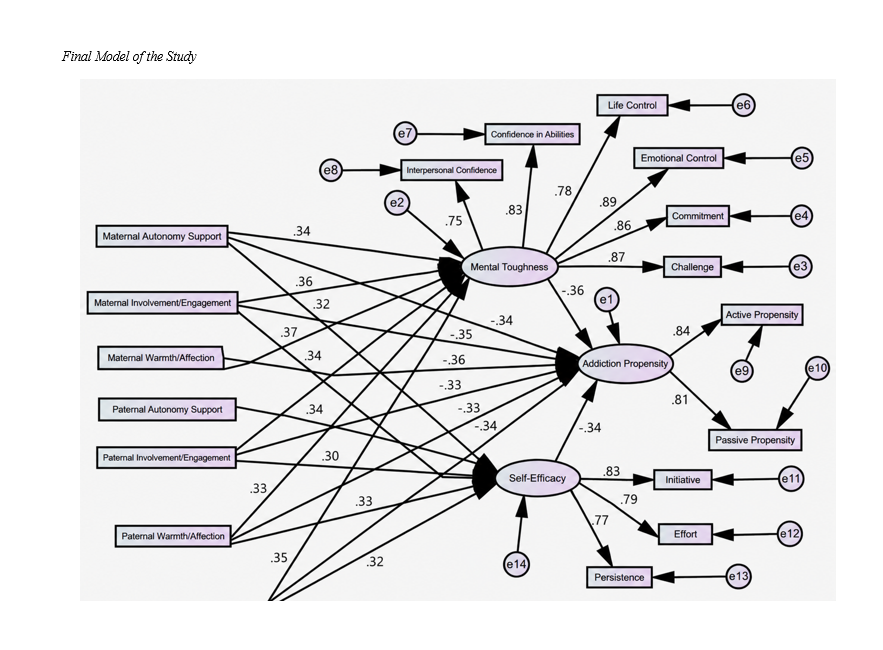
Findings: All dimensions of perceived parenting had significant negative direct effects on addiction propensity (β = −0.33 to −0.36, p < .001) and significant positive direct effects on mental toughness (β = 0.31 to 0.37, p < .001) and self-efficacy (β = 0.30 to 0.35, p < .001). Mental toughness (β = −0.36, p < .001) and self-efficacy (β = −0.34, p < .001) significantly and negatively predicted addiction propensity. Bootstrap analysis showed significant negative indirect effects of all parenting dimensions through mental toughness (β = −0.11 to −0.13, p < .001) and self-efficacy (β = −0.10 to −0.12, p < .001). The model demonstrated good fit: χ²/df = 2.219, RMSEA = 0.047, CFI = 0.951, TLI = 0.938, and IFI = 0.952.
Conclusion: Supportive parenting characterized by involvement, autonomy support, and warmth may reduce students’ propensity for addiction both directly and indirectly by strengthening mental toughness and self-efficacy.
Downloads
References
Alves, D. d. M., Pompeo, D. A., Sacardo, Y., Eid, L. P., Lourencao, L. G., & Andre, J. C. (2024). Influence of self-efficacy beliefs on the health and well-being of university students in COVID-19. Revista Gaúcha De Enfermagem. https://doi.org/10.1590/1983-1447.2024.20230346
Bahmani, T., Naseri, N. S., & Fariborzi, E. (2023). Relation of parenting child abuse based on attachment styles, parenting styles, and parental addictions. Current Psychology, 42, 12409-12423. https://doi.org/10.1007/s12144-021-02667-7
Bogdanovic, M. N., Brozan, S., Kastelan, A., & Petric, D. (2025). Substance abuse: A growing issue in adolescent population. European Psychiatry, 68(S1), S539. https://doi.org/10.1192/j.eurpsy.2025.1106
Bolat, E., Akcay, E., & Cop, E. (2025). Retarded catatonia in a 16-year-old male with schizo-obsessive disorder. European Psychiatry. https://doi.org/10.1192/j.eurpsy.2025.1106
Calderaro, M., Mastronardi, V., & Serban, I. V. (2025). Addictions not related to the use and abuse of substances and some assessment tools in the clinical-forensic field. BRAIN: Broad Research in Artificial Intelligence and Neuroscience, 16(2), 224. https://doi.org/10.70594/brain/16.2/17
Chikkapapanna, S., & Moncy, A. M. (2024). Parenting style and its correlates perceived among school-going adolescents. International Journal for Multidisciplinary Research, 6(2), 38-45.
Chukwu, R., Ezeh, C., Makinde, P., Folawewo, A., Eze, B., & Mgbeahurike, C. (2024). Prevalence and determinants of risky behaviors: Comprehensive review on substance use and sexual behaviours among adolescents. World Journal of Advanced Research and Reviews, 23(1), 2199. https://doi.org/10.30574/wjarr.2024.23.1.2199
Costanzo, V., Santoro, G., & Menti, D. (2023). Psychodynamic aspects of substance addiction: A clinical review. Journal of Addictive Diseases, 41(2), 145-158. https://doi.org/10.1080/10550887.2022.2119341
Cruise, K. R., Laird, R. D., & Pettit, G. S. (2022). Family structure and adolescent substance use outcomes. Journal of Child and Family Studies, 31(4), 987-1001. https://doi.org/10.1007/s10826-021-02189-4
Dali Braham, L., Kaddour, S., Brahimi, A., & Amokrane, S. (2024). Drug consumption: Analyzing a series of urine samples from Algiers addicts by GC-MS low cost derivatization method. Journal of Medical and Health Studies, 5(1). https://doi.org/10.32996/jmhs.2024.5.1.5
Fang, Y., Sun, Y., & Liu, Y. (2022). Neurobiological mechanisms and related clinical treatment of addiction: A review. Psychoradiology, 2(4), 180-189. https://doi.org/10.1093/psyrad/kkac021
Fatemisough, H., Moradi, A., Vahid Dastgerdi, M., & Fatemi, R. (2024). Relationship between parenting styles and tendency to addiction in Iran: A systematic review and meta-analysis. Iranian Journal of Public Health, 53(1), 131-140. https://doi.org/10.18502/ijph.v53i1.14684
Gupta, J., Bajaj, M. K., & Arun, P. (2023). Parenting style of mothers with generalized anxiety disorder and behavioral problems in their children. International Journal of Science and Research Archive, 8(1), 140-147.
Houshangi Shayan, S., & Salarifar, M. R. (2023). Predicting academic performance based on thinking-style functions and parental parenting styles with the mediation of students' responsibility. Rooyesh-e-Ravanshenasi, 12(3), 120-130.
Jayaswal, A., & Singh, P. (2025). Substance abuse and its addiction among young adults. International Journal of Professional Studies, 20, 171-177. https://doi.org/10.37648/ijps.v20i01.012
Jeong, M., & Cho, G. (2023). Mediating effect of covert narcissism in the relationship between parent-child communication, peer attachment, and smartphone addiction. Journal of Education for Educational Development, 43(2), 547-569. https://doi.org/10.22251/jlcci.2023.23.4.565
Jia, D., Zhang, K., & Xu, Y. (2023). The relationship between social support and relapse tendency among those who struggle with drug addiction: Multiple mediators of exercise self-efficacy and health-related quality of life. Journal of Drug Issues, 54(1). https://doi.org/10.1177/00220426231152912
Kalhoro, A., Asif, M., Kulsoom, U. E., Khanzada, U., Nohri, A. R., & Mangi, R. (2024). Parenting styles and mental health among adolescents of Nawabshah (SBA), Sindh. Journal of Health and Rehabilitation Research, 4(1), 630.
Kandhari, N., & Sharma, M. L. (2024). Relationship between perceived parenting style, perceived stress and emotional competence among young adults. Advanced International Journal of Multidisciplinary Research, 2(2), 45-54.
Kendal, K., Atac, A., & Kose, T. (2022). Effects of game addiction on musculoskeletal system discomfort and mental toughness in e-sport players. Addicta: The Turkish Journal On Addictions, 9(2), 212. https://doi.org/10.5152/ADDICTA.2021.21079
Li, J., Jiang, X., & Zhou, Y. (2024). Culture, emotion, and cognition: Understanding the psychological dynamics of Chinese sports with emotional regulation skills and cognitive reappraisal. Heliyon, 10(14).
Liu, L., Meng, W., & Liu, B. (2022). The mediating role of social support in the relationship between parenting styles and adolescent drug abuse identification. Frontiers in psychology, 12. https://doi.org/10.3389/fpsyg.2021.802408
Masoomi, M., Hosseinikolbadi, S., Saeed, F., Sharifi, V., Jalali Nadoushan, A. H., & Shoib, S. (2023). Stigma as a barrier to suicide prevention efforts in Iran. Frontiers in Public Health, 10, 1026451. https://doi.org/10.3389/fpubh.2022.1026451
Moniz-Lewis, D. I. K., Stein, E. R., & Witkiewitz, K. (2022). Self-efficacy as a potential mechanism of behavior change in mindfulness-based relapse prevention. Mindfulness, 13, 2175-2185. https://doi.org/10.1007/s12671-022-01931-9
Pelham, W. E., III, Racz, S. J., Davis, I. S., Aks, I. R., Patel, H., McMahon, R. J., & Brown, S. A. (2024). What is parental monitoring? Clinical Child and Family Psychology Review, 27(2), 576-601. https://doi.org/10.1007/s10567-023-00430-9
Pelham, W. E., III, Tapert, S. F., Gonzalez, M. R., Wade, N. E., Lisdahl, K. M., Guillaume, M., & Brown, S. A. (2023). Parental knowledge/monitoring and adolescent substance use: A causal relationship? Health Psychology, 42(12), 913. https://doi.org/10.1037/hea0001265
Pinquart, M., & Gochaliyev, Z. (2025). Associations of parental warmth with substance use in the offspring: A meta-analysis. International journal of mental health and addiction, 1-14. https://doi.org/10.1007/s11469-024-01136-6
Pourfahimi, F. (2024). Reliability and validity of the Grolnick parenting questionnaire among high-school students. Journal of Child and Adolescent Psychology.
Seo, J. H. (2024). Diet-related behaviors affecting health and substance use in children and adolescents. Clinical and Experimental Pediatrics, 67(12), 664-671. https://doi.org/10.3345/cep.2023.01634
Serna, C., Garcia-Perales, J., & Martinez, I. (2023). Protective and risk parenting styles for internet and online gambling addiction. Human Behavior and Emerging Technologies, 2023(1), 6674541. https://doi.org/10.1155/2023/6674541
Torkamani, H., Ghasemi Motlagh, M., Esmaeili Shad, B., & Mohammadipour, M. (2022). Predicting the mean score of tendency toward addiction based on parenting styles and students' cognitive emotion regulation. Disability Studies, 12(0), 0-0.
Wilson, J., Mills, K. L., Sunderland, M., Freeman, T. P., Keaveny, M., Haasnoot, K., & Marel, C. (2023). Long-term patterns of treatment use for opioid use disorder (OUD): Findings from the 18-20-year Australian Treatment Outcome Study. International Journal of Drug Policy, 120, 104187. https://doi.org/10.1016/j.drugpo.2023.104187
Xiang, J., Gao, J., & Gao, Y. (2024). The relationship between parenting style and the stigma of mental illness in adolescent athletes: The chain mediating role of self-esteem and mental toughness. Current Psychology, 43, 23130-23143.
Xu, Z. (2023). Research related to self-efficacy in substance use disorders. Journal of Education, Humanities and Social Sciences, 8(1), 22-35.
Zhang, R., & Meng, L. (2023). A study on self-efficacy and health behavior in stroke patients. MEDS Clinical Medicine, 4(8), 112-118.
Zheng, Y. (2023). Parenting styles and adolescents' depression, anxiety, and stress in Chinese culture: A test of the mediating effect of perfectionism. In Lecture Notes in Education Psychology and Public Media. https://doi.org/10.2991/assehr.k.211220.261
Zhu, D. T., Zhong, A., Ho, W. J., & Tamang, S. (2025). Disaggregating Asian-American mortality in drug-related overdoses and behavioral disorders: A cross-sectional study. Journal of Racial and Ethnic Health Disparities, 12(3), 1508-1516.
Downloads
Additional Files
Publication Timeline
- Submitted
- Revised
- Accepted