The Effectiveness of Emotion-Focused Therapy on Self-Criticism and Internalized Shame in Students Experiencing Failure in the University Entrance Exam
Keywords:
Emotion-Focused Therapy, Self-Criticism, Internal Shame, Konkoor Failure, Single-Case DesignAbstract
Objective: The present study aimed to investigate the effectiveness of Emotion-Focused Therapy (EFT) on reducing self-criticism and internal shame in female students who experienced failure in the university entrance exam (Konkoor).
Methods and Materials: This research was a single-case experimental design with a multiple baseline and one-month follow-up. The statistical population consisted of female Konkoor repeaters in Karaj with at least one unsuccessful attempt in the 2024-2025 national exam. Three participants were selected voluntarily based on inclusion and exclusion criteria and received the EFT protocol (Greenberg, 2004) in 8 individual 90-minute sessions. Research instruments included the Levels of Self-Criticism Scale (Thompson & Zuroff, 2004) (Thompson & Zuroff, 2004) and the Internalized Shame Scale (Cook, 2013) (Cook, 1998). Data were analyzed using within-condition (median, mean, stability envelope, range, relative and absolute level change) and between-condition analyses (trend and level changes, PND, Tau-U, NAP, IRD) along with Hedges’ g effect size.
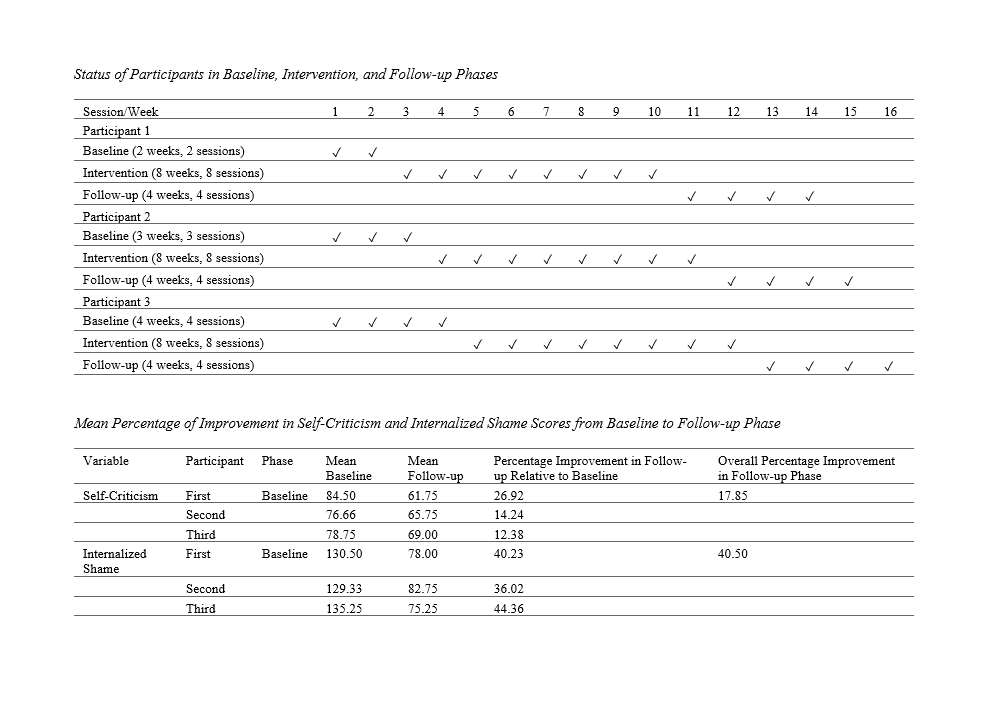
Findings: Results indicated that self-criticism and internal shame scores were high and highly stable during the baseline phase. Following the intervention, a sharp, stable, and consistent decrease was observed in both variables across all participants. The PND index was 100% for both variables in all three cases. The mean percentage of improvement in the follow-up phase was 17.85% for self-criticism and 40.50% for internal shame. Tau-U and Hedges’ g effect sizes were also very large and significant.
Conclusions: Findings suggest that Emotion-Focused Therapy is an effective and durable deep cognitive-experiential intervention for reducing self-criticism and internal shame resulting from Konkoor failure in female students. It is recommended that this approach be applied in academic counseling centers.
Downloads
References
Abdollahi, M., Darbani, S., & Parsakia, K. (2022). Structural equations the effect of logical-critical thinking style with academic achievement with the mediating role of action control in high school students. Journal of Assessment and Research in Applied Counseling, 4(3), 64-78. https://ensani.ir/file/download/article/1683539068-10443-13-5.pdf
Aghaei, F., Abbasi, G., & Hassanzadeh, R. (2024). The efficacy of schema therapy based on mindfulness on the emotion reactivity and internal shame of betrayed women. Journal of Psychological Science, 23(144), 141-158. https://doi.org/10.61186/jps.23.144.8
Barta, T., & Kiropoulos, L. (2023). The mediating role of stigma, internalized shame, and autonomous motivation in the relationship between depression, anxiety, and psychological help-seeking attitudes in multiple sclerosis. International Journal of Behavioral Medicine, 30(1), 133-145. https://doi.org/10.1007/s12529-022-10078-6
Bidima, J. G. (2024). Criticisms and Self-Criticisms: The Decolonial Question and Some Unthinkables in Francophone Experiences. Routledge.
Campbell, J. M. (2004). Statistical comparison of four effect sizes for single-subject designs. Behav Modif, 28(2), 234-246. https://doi.org/10.1177/0145445503259264
Cunha, M., Silva, P., Ferreira, C., & Galhardo, A. (2021). Measuring shame in adolescents: Validation studies of the External and Internal Shame Scale in a community sample. Child & Youth Care Forum. https://www.semanticscholar.org/paper/Measuring-Shame-in-Adolescents%3A-Validation-Studies-Cunha-Silva/122d194bc47ceb9d48c9f0433eb3dd10bddcf8db
Damri, R. (2026). Trait neuroticism as a mediator between metacognitions about self-critical rumination and future anxiety in young adults. Jurnal Ilmiah Psikologi Terapan, 14(1), 28-36.
Del Rosario, P. M., & White, R. M. (2006). The Internalized Shame Scale: Temporal stability, internal consistency, and principal components analysis. Personality and Individual Differences, 41(1), 95-103. https://doi.org/https://doi.org/10.1016/j.paid.2005.10.026
Goldman, R. N. (2019). History and overview of emotion-focused therapy.
Gottschlich, D., Turner, S., & Anderson, M. (2025). Internalized Shame as a Mediator Between Emotional Neglect and Self-Harming Behavior. Jarac, 7(1), 240-249. https://doi.org/10.61838/kman.jarac.7.1.28
Greenberg, L. S. (2024). Shame in Psychotherapy. American Psychological Association.
Greenberg, L. S., & Goldman, R. N. (2019). Clinical Handbook of Emotion-Focused Therapy. American Psychological Association.
Ha, H. J., & Yang, H. C. (2025). The Effects of Internalized Shame on Marital Intimacy Among Newlyweds: The Sequential Mediation Effect of Relationship Authenticity and Perceived Marital Support. Korean Academy Welfare Counseling, 14(1), 75-101. https://doi.org/10.20497/jwce.2025.14.1.75
Halamova, J., Mihalo, J., & Bakos, L. (2022). The impact of emotion-focused training for emotion coaching delivered as mobile app on self-compassion and self-criticism. Frontiers in psychology, 13, 1047022. https://doi.org/10.3389/fpsyg.2022.1047022
Hojatkhah, S., Mesbah, I., & Golmohammadian, M. (2018). The effectiveness of acceptance and commitment therapy on improving parent-child relationship in mothers of children with intellectual disability. Clinical Psychology and Counseling Research, 8(2), 84-100. https://tpccp.um.ac.ir/article_33114.html
Hojatkhah, S., Mesbah, I., & Golmohammadian, M. (2018). The effectiveness of acceptance and commitment therapy on improving parent-child relationship in mothers of children with intellectual disability. Clin Psychol Couns Res, 8(2), 84-100. https://tpccp.um.ac.ir/article_33114.html
Homayouni, S., Taghavi, M. R., Goodarzi, M. A., & Hadianfard, H. (2022). The efficacy of emotion focused therapy on worry and self-criticism in individuals with generalized anxiety disorder. Journal of Psychological Science, 21(109), 1-18. https://doi.org/10.52547/jps.21.109.1
Kratochwill, T. R., Altschaefl, M. R., Bice-Urbach, B. J., & Kawa, J. M. (2014). Single-case-design intervention research: Applications in the learning disabilities field. https://doi.org/https://psycnet.apa.org/record/2013-16874-032
Lassri, D., Luyten, P., Fonagy, P., & Shahar, G. (2018). Undetected scars? Self-criticism, attachment, and romantic relationships among otherwise well-functioning childhood sexual abuse survivors. Psychological Trauma: Theory, Research, Practice, and Policy, 10(1), 121-129. https://doi.org/10.1037/tra0000271
Ledford, J. R., Gast, D. L. (2018). Single Case Research Methodology: Applications in Special Education and Behavioral Science. London: Routhledge. https://doi.org/https://doi.org/10.4324/9781315150666
Malekpour, N., Behrozian, F., Najafi, N., & Mousavi, A. E. (2024). Investigating the mediating role of shame and self-criticism in the relationship between early life experiences and paranoid ideation in Iranian college students. http://ijpcp.iums.ac.ir/article-1-4203-fa.html
Matos, M., Galhardo, A., Moura-Ramos, M., Steindl, S. R., Bortolon, C., Hiramatsu, Y., & Ferreira, C. (2023). Measuring shame across five countries: Dimensionality and measurement invariance of the external and internal shame scale. Current Psychology, 42(9), 7161-7170. https://research.ulusofona.pt/en/publications/measuring-shame-across-five-countries-dimensionality-and-measurem/
Mousavi, A., & Ghorbani, N. (2006). Self-awareness, self-criticism and mental health. Quarterly Journal of Psychological Studies, 2(3), 75-91.
Norder, S. J., Visvalingam, S., Norton, P. J., & Norberg, M. M. (2023). A scoping review of psychosocial interventions to reduce internalised shame. Psychotherapy Research, 33(2), 131-145. https://doi.org/10.1080/10503307.2022.2082340
Rogier, G., Muzi, S., Morganti, W., & Pace, C. S. (2023). Self-criticism and attachment: A systematic review and meta-analysis. Personality and individual differences, 214, 112359. https://doi.org/10.1016/j.paid.2023.112359
Rose, A. V., & Rimes, K. A. (2018). Self-criticism self-report measures: Systematic review. Psychology and Psychotherapy: Theory, Research and Practice, 91(4), 450-489. https://doi.org/10.1111/papt.12171
Shahar, B. (2020). New developments in emotion-focused therapy for social anxiety disorder. Journal of clinical medicine, 9(9), 2918.
Tabesh Mofrad, N., & Mansouriyeh, N. (2023). The effectiveness of compassion-based therapy in regulating emotion, self-criticism and anger in male students second secondary level. Journal of Psychological Science, 22(130), 93-110. http://psychologicalscience.ir/article-1-2107-fa.html
Taj Iliayifar, S. G., Alipanah, S., Majidpour, Z., Ghanbarnezhad, M., Aghayee, N., & Pourmohammad ghouchani, K. (2025). The Effectiveness of Schema Therapy on Frustration Tolerance and Internalized Shame in Individuals with Borderline Personality Disorder. Quarterly of Experimental and Cognitive Psychology, 1(4), 103-116. https://doi.org/10.61838/qecp.5844
Thompson, R., & Zuroff, D. C. (2004). The Levels of Self-Criticism Scale: Comparative self-criticism and internalized self-criticism. Personality and Individual Differences, 36(2), 419-430. https://doi.org/https://doi.org/10.1016/S0191-8869(03)00106-5
Timulak, L., & Keogh, D. (2022). Emotional vulnerability: The focus of transdiagnostic therapy. In (pp. 13-32). https://doi.org/10.1037/0000253-002
Tolibdjanovna, A. Z. (2024). Psychological factors in the manifestation of aggressive behavior in adolescence. Ijtimoiy Fanlarda Innovasiya Onlayn Ilmiy Jurnali, 4(2), 122-125. https://procediaonline.org/index.php/philosophy/article/view/714
Yamaguchi, A., & Kim, M.-S. (2013). Effects of self-criticism and its relationship with depression across cultures. International Journal of Psychological Studies, 5(1), 1. https://ideas.repec.org/a/ibn/ijpsjl/v5y2013i1p1.html
Downloads
Additional Files
Publication Timeline
- Submitted
- Revised
- Accepted