Designing and Validating an Effective Leadership Competency Model for Digital Marketing in the Iraqi Banking Sector
Keywords:
Effective Leadership, Leadership Competency, Digital Marketing Competency, Competency Model, bankingAbstract
Objective: This study aimed to design and validate a comprehensive model of effective leadership competencies for digital marketing in the Iraqi banking sector.
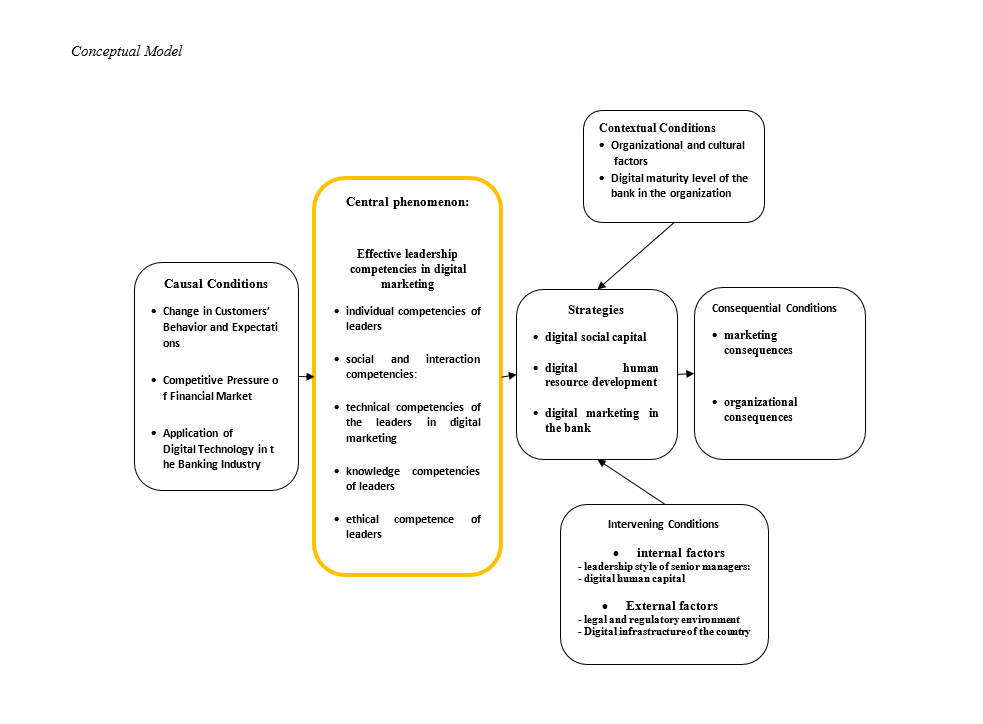
Methods and Materials: This applied study employed an exploratory sequential mixed-methods design. In the qualitative phase, grounded theory based on the Strauss and Corbin approach was used, and data were collected through semi-structured interviews with 19 experts and senior managers with expertise in banking, digital marketing, and digital transformation, selected through purposive and theoretical sampling until theoretical saturation. Data were analyzed through open, axial, and selective coding. Based on the qualitative findings, a questionnaire was developed for the quantitative phase and administered to 161 banking professionals. The proposed model was evaluated using partial least squares structural equation modeling (PLS-SEM), including assessment of the measurement model, structural model, predictive relevance, effect sizes, and overall model fit.
Findings: Structural model analysis showed that causal conditions had a significant positive effect on the central phenomenon (β = 0.761, Z = 16.542). The central phenomenon significantly predicted strategies (β = 0.570, Z = 5.970), and intervening conditions also had a significant positive effect on strategies (β = 0.241, Z = 2.213). In contrast, contextual conditions did not significantly affect strategies (β = 0.048, Z = 0.569). Strategies exerted a strong significant positive effect on consequences (β = 0.707, Z = 16.375). The model explained 57.9% of the variance in the central phenomenon, 62.0% in strategies, and 50.0% in consequences. Predictive relevance values were Q² = 0.279, 0.327, and 0.290, respectively, and the overall model demonstrated acceptable fit (SRMR = 0.091).
Conclusion: The validated model indicates that effective digital marketing leadership competencies in Iraqi banks are shaped primarily by causal and intervening conditions and are translated into favorable marketing and organizational outcomes through strategic mechanisms.
Downloads
References
Aldboush, H. H., & Ferdous, M. (2023). Building Trust in Fintech: An Analysis of Ethical and Privacy Considerations in the Intersection of Big Data, AI, and Customer Trust. International Journal of Financial Studies, 11(3), 90. https://doi.org/10.3390/ijfs11030090
Andrade, C. R. O., Gonçalo, C. R., & Santos, A. M. (2022). Digital Transformation with Agility: The Emerging Dynamic Capability of Complementary Services. RAM. Revista de Administração Mackenzie, 23, eRAMD220063. https://doi.org/10.1590/1678-6971/eramd220063.en
Bandara, R., Fernando, M., & Akter, S. (2021). Managing Consumer Privacy Concerns and Defensive Behaviours in the Digital Marketplace. European Journal of Marketing, 55(1), 219-246. https://doi.org/10.1108/EJM-06-2019-0515
Bawany, S. (2023). Leadership in Disruptive Times: Negotiating the New Balance. Business Expert Press. https://doi.org/10.4128/9781637422359
Cetinkaya, B., & Surucu, L. (2025). The Influence of Digital Culture and Digital Leadership on Innovative Work Behavior. Studies in Media and Communication, 13(3), 236-247. https://doi.org/10.11114/smc.v13i3.7709
Chavarnakul, T., Xu, L. D., Bi, Z., Shankar, A., Dhiman, G., Viriyasitavat, W., & Hoonsopon, D. (2025). A Systematic Literature Review on Resilient Digital Transformation, Examining How Organizations Sustain Digital Capabilities. Hightech and Innovation Journal, 6(2). https://doi.org/10.28991/HIJ-2025-06-02-021
Cheng, L., Guo, H., & Lin, H. (2020). The Influence of Leadership Behavior on Miners' Work Safety Behavior. Safety Science, 132, 104986. https://doi.org/10.1016/j.ssci.2020.104986
Chowdhury, R. H. (2025). Digital Leadership and Organizational Learning: Technologies for Business Transformation and Operational Excellence. Deep Science Publishing. https://doi.org/10.70593/978-93-49910-03-4
Darmawan, D., & Gardi, B. (2024). Digital-Oriented Leadership and Organizational Transformation: Fostering Operational Efficiency, Team Collaboration, and Innovation in the Digital. International Journal of Service Science, Management, Engineering, and Technology, 5(1), 37-42.
Del Sarto, N., Bocchialini, E., Gai, L., & Ielasi, F. (2025). Digital Banking: How Social Media Is Shaping the Game. Qualitative Research in Financial Markets, 17(2), 348-369. https://doi.org/10.1108/QRFM-12-2023-0314
Denysenko, M., Khudoliy, L., & Laptiev, S. (2024). Digital Skills in a Digital Society: Requirements and Challenges. Scientific Center of Innovative Research OÜ.
Du, X., Wang, N., Lu, S., Zhang, A., & Tsai, S. B. (2025). Sustainable Competitive Advantage under Digital Transformation: An Eco-Strategy Perspective. Chinese Management Studies, 19(3), 758-782. https://doi.org/10.1108/CMS-01-2024-0077
Fan, W., Shao, B., & Dong, X. (2022). Effect of E-Service Quality on Customer Engagement Behavior in Community E-Commerce. Frontiers in psychology, 13, 965998. https://doi.org/10.3389/fpsyg.2022.965998
Gade, K. R. (2021). Data-Driven Decision Making in a Complex World. Journal of Computational Innovation, 1(1).
George, A. S. (2024). Finance 4.0: The Transformation of Financial Services in the Digital Age. Partners Universal Innovative Research Publication, 2(3), 104-125.
Gilli, K. (2023). Leadership Competencies for Digital Transformation Free University of Bozen-Bolzano].
Gupta, S., Leszkiewicz, A., Kumar, V., Bijmolt, T., & Potapov, D. (2020). Digital Analytics: Modeling for Insights and New Methods. Journal of Interactive Marketing, 51(1), 26-43. https://doi.org/10.1016/j.intmar.2020.04.003
Guzmán, V. E., Muschard, B., Gerolamo, M., Kohl, H., & Rozenfeld, H. (2020). Characteristics and Skills of Leadership in the Context of Industry 4.0. Procedia Manufacturing, 43, 543-550. https://doi.org/10.1016/j.promfg.2020.02.167
Halbusi, H. A., Ismail, M. N., & Omar, S. (2019). Examining the Impact of Ethical Leadership on Employees' Ethical Behavior: The Role of Organizational Justice and Employees' Moral Identity. Journal of Technology Management and Business, 6(2). https://doi.org/10.30880/jtmb.2019.06.02.004
Hollebeek, L. D., & Macky, K. (2019). Digital Content Marketing's Role in Fostering Consumer Engagement, Trust, and Value: Framework, Fundamental Propositions, and Implications. Journal of Interactive Marketing, 45(1), 27-41. https://doi.org/10.1016/j.intmar.2018.07.003
Ibrahim, M. A., Ahmed, D. A., & Saeed, Y. J. (2025). Developing Financial and Administrative Competencies in Light of Digital Transformation: An Applied Study in the Banking Sector. European Journal of Management, Economics and Business, 2(4), 3-14. https://doi.org/10.59324/ejmeb.2025.2(4).01
Ivančić, L., Vukšić, V. B., & Spremić, M. (2019). Mastering the Digital Transformation Process: Business Practices and Lessons Learned. Technology Innovation Management Review, 9(2). https://doi.org/10.22215/timreview/1217
Khesal, A. A., Vedadi, A., & Gholamzadeh, D. (2025). Design and Validation of a Competency Development Model for Digital Transformation Leadership in the Banking System. Management Strategies and Engineering Sciences, 7(2), 90-99. https://doi.org/10.61838/msesj.7.2.9
Kovács, I., & Zarándné, K. V. (2022). Digital Marketing Employability Skills in Job Advertisements—Must-Have Soft Skills for Entry-Level Workers: A Content Analysis. Economics & Sociology, 15(1), 178-192. https://doi.org/10.14254/2071-789X.2022/15-1/11
Liu, C. H., Chen, C. S., & Bawack, R. (2026). Digital Marketing Capabilities and Firm Performance: The Strategic Role of Digital Leadership in Chinese Firms. Journal of Enterprise Information Management, 1-30. https://doi.org/10.1108/JEIM-07-2025-0646
Lobo, C. A., Marinho, A., Santos Pereira, C., Azevedo, M., & Moreira, F. (2025). The Role of Leadership and Strategic Alliances in Innovation and Digital Transformation for Sustainable Entrepreneurial Ecosystems: A Comprehensive Analysis of the Existing Literature. Sustainability, 17(13), 6182. https://doi.org/10.3390/su17136182
Mavlutova, I., & Volkova, T. (2019). Digital Transformation of Financial Sector and Challengies for Competencies Development.
Minculete, G., Stan, S. E., Ispas, L., Virca, I., Stanciu, L., Milandru, M., & Bădilă, M. I. (2022). Relational Approaches Related to Digital Supply Chain Management Consolidation. Sustainability, 14(17), 10727. https://doi.org/10.3390/su141710727
Mwamba, J. (2023). Effective Leadership in Change Management: Ensuring Success in Organizational Transformation. Journal of Policy Options, 6(1), 28-38. https://resdojournals.com/index.php/jpo/article/view/280
Nalini, R. (2024). Transformative Power of Artificial Intelligence in Decision-Making, Automation, and Customer Engagement. In (pp. 189-208). IGI Global Scientific Publishing. https://doi.org/10.4018/979-8-3693-0712-0.ch009
Nourahmadi, M., & Rasti, F. (2025). Shaping Fintech through Regulations: Insights and Future Directions. Knowledge Economy Studies, 2(1), 35-57.
Nwachukwu, P. S., Chima, O. K., & Okolo, C. H. (2025). Digital Transformation in Banking: Impact of Technological Innovation and an Integrated Framework for Customer Relationship Success. Gulf Journal of Advance Business Research, 3(9), 1245-1283. https://doi.org/10.51594/gjabr.v3i9.158
Olejarova, A. (2025). Leadership Attributes Essential for Effective Leadership in Highly Digitalized Work Environments.
Papageorgiou, G., & Marneros, S. (2023). Developing a Framework Model for Cultivating Digital Marketing Competencies.
Phi, H. D., & Huong, D. P. (2023). Effect of Service Quality on Customer Loyalty: The Mediation of Customer Satisfaction, and Corporate Reputation in Banking Industry. Eurasian Journal of Business and Management, 11(1), 1-16. https://doi.org/10.15604/ejbm.2023.11.01.001
Przybylska, N., & Minga, Z. (2024). Essential Competencies in Digital Marketing: Empirical Exploration. Research on Enterprise in Modern Economy, 2(39), 5-27.
Rahman, M. M. (2024). Data-Driven Decision-Making Through Customer Relationship Management: A Systematic Literature Review in Modern Enterprises. American Journal of Advanced Technology and Engineering Solutions, 4(03), 30-59. https://doi.org/10.63125/vgr9th76
Schiuma, G., Santarsiero, F., Carlucci, D., & Jarrar, Y. (2024). Transformative Leadership Competencies for Organizational Digital Transformation. Business Horizons, 67(4), 425-437. https://doi.org/10.1016/j.bushor.2024.04.004
Schiuma, G., Schettini, E., Santarsiero, F., & Carlucci, D. (2021). The Transformative Leadership Compass: Six Competencies for Digital Transformation Entrepreneurship. International Journal of Entrepreneurial Behavior & Research, 28(5), 1273-1291.
Senadjki, A., Au Yong, H. N., Ganapathy, T., & Ogbeibu, S. (2024). Unlocking the Potential: The Impact of Digital Leadership on Firms' Performance through Digital Transformation. Journal of Business and Socio-Economic Development, 4(2), 161-177. https://doi.org/10.1108/JBSED-06-2023-0050
Seth, T., Keshari, N., & Jha, S. N. (2023). Exploring Digital Marketing in the Banking Sector: A Comprehensive Overview.
Shah, T. (2025). Leadership in Digital Transformation: Enhancing Customer Value through AI-Driven Innovation in Financial Services Marketing. International Journal of Science and Research Archive.
Shahzad, M. U. (2024). Core Competencies for Digital Leadership Development: A Perspective from the Lens of Paradox Theory. The Bottom Line, 37(4), 454-472. https://doi.org/10.1108/BL-10-2023-0278
Shateri, T., Amirkabiri, A., & Mandejin, M. R. (2025). Proposing a Structural Model of Digital Leadership in the Banking Industry. Digital Transformation and Administration Innovation, 1-12. https://doi.org/10.61838/dtai.6118
Șișu, J. A. (2023). Digital Leadership Competencies: A Systematic Literature Review. Revista de Management Comparat Internațional, 24(1), 69-77.
Sousa, M. J., & Rocha, Á. (2019). Digital Learning: Developing Skills for Digital Transformation of Organizations. Future Generation Computer Systems, 91, 327-334. https://doi.org/10.1016/j.future.2018.08.048
Sulistiana, I. N., & Darma, G. S. (2023). Digital Leadership, Work-Life Balance, Compensation, Job Satisfaction, and Employee Engagement. Quantitative Economics and Management Studies, 4(5), 981-993.
Vadivelu, V., Nachimuthu, P., Karthikeyan, P., & Ds, S. (2025). Leadership and Decision-Making: Strategic Guidance for Leveraging Data-Driven Insights. In. https://doi.org/10.1108/978-1-83708-460-920251004
van Diggele, C., Burgess, A., Roberts, C., & Mellis, C. (2020). Leadership in Healthcare Education. BMC Medical Education, 20(Suppl 2), 456. https://doi.org/10.1186/s12909-020-02288-x
Van Wart, M., Roman, A., Wang, X. H., & Liu, C. (2019). Operationalizing the Definition of E-Leadership: Identifying the Elements of E-Leadership. International Review of Administrative Sciences, 85(1), 80-97. https://doi.org/10.1177/0020852316681446
Verhoef, P. C., Broekhuizen, T., Bart, Y., Bhattacharya, A., Dong, J. Q., Fabian, N., & Haenlein, M. (2021). Digital Transformation: A Multidisciplinary Reflection and Research Agenda. Journal of Business Research, 122, 889-901. https://doi.org/10.1016/j.jbusres.2019.09.022
Wang, M. H., Chen, C. C., Chen, K. Y., & Lo, H. W. (2023). Leadership Competencies in the Financial Industry during Digital Transformation: An Evaluation Framework Using the Z-DEMATEL Technique. Axioms, 12(9), 855. https://doi.org/10.3390/axioms12090855
Yozi, K., & Mbokota, G. (2024). Adaptive Leadership Competencies for Hybrid Work Teams in the South African Banking Sector. South African Journal of Business Management, 55(1), 4060. https://doi.org/10.4102/SAJBM.v55i1.4060
Zaki, M. (2019). Digital Transformation: Harnessing Digital Technologies for the Next Generation of Services. Journal of Services Marketing, 33(4), 429-435. https://doi.org/10.1108/JSM-01-2019-0034
Downloads
Additional Files
Publication Timeline
- Submitted
- Revised
- Accepted