Developing a Knowledge Management Model for Intergenerational Entrepreneurs in Science and Technology Parks
Keywords:
Knowledge Management, Intergenerational Entrepreneurs, Science and Technology Parks, Knowledge Transfer, Entrepreneurial Ecosystem, Innovation, Intergenerational LearningAbstract
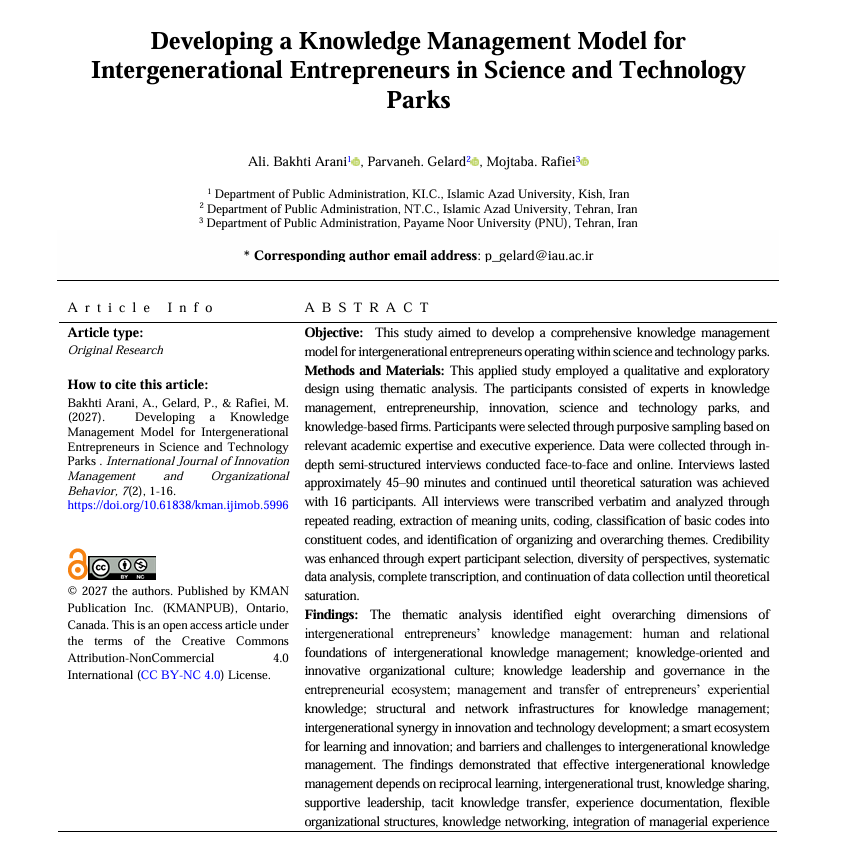
Objective: This study aimed to develop a comprehensive knowledge management model for intergenerational entrepreneurs operating within science and technology parks.
Methods and Materials: This applied study employed a qualitative and exploratory design using thematic analysis. The participants consisted of experts in knowledge management, entrepreneurship, innovation, science and technology parks, and knowledge-based firms. Participants were selected through purposive sampling based on relevant academic expertise and executive experience. Data were collected through in-depth semi-structured interviews conducted face-to-face and online. Interviews lasted approximately 45–90 minutes and continued until theoretical saturation was achieved with 16 participants. All interviews were transcribed verbatim and analyzed through repeated reading, extraction of meaning units, coding, classification of basic codes into constituent codes, and identification of organizing and overarching themes. Credibility was enhanced through expert participant selection, diversity of perspectives, systematic data analysis, complete transcription, and continuation of data collection until theoretical saturation.
Findings: The thematic analysis identified eight overarching dimensions of intergenerational entrepreneurs’ knowledge management: human and relational foundations of intergenerational knowledge management; knowledge-oriented and innovative organizational culture; knowledge leadership and governance in the entrepreneurial ecosystem; management and transfer of entrepreneurs’ experiential knowledge; structural and network infrastructures for knowledge management; intergenerational synergy in innovation and technology development; a smart ecosystem for learning and innovation; and barriers and challenges to intergenerational knowledge management. The findings demonstrated that effective intergenerational knowledge management depends on reciprocal learning, intergenerational trust, knowledge sharing, supportive leadership, tacit knowledge transfer, experience documentation, flexible organizational structures, knowledge networking, integration of managerial experience with technological expertise, and digital knowledge management. Conversely, unhealthy competition, knowledge hiding, generational conflict, and resistance to change were identified as major barriers.
Conclusion: Intergenerational knowledge management in science and technology parks is a multidimensional and ecosystem-based process in which relational, cultural, managerial, structural, technological, and experiential mechanisms interact. The proposed model suggests that sustainable innovation can be strengthened by integrating the accumulated managerial experience of older entrepreneurs with the technological agility and creativity of younger generations while simultaneously reducing barriers to knowledge sharing.
Downloads
References
Abbasi, Afsharnia, Cheshmgan, Z., & Saeideh. (2018). Examining Knowledge Management Processes and Approaches and Their Impact on Organizations and Educational Centers. Applied Studies in Management Sciences and Development, 10(3), 25-45.
Ahmad, S. M. F. S., Khairi, H., & Legino, R. (2025). Revitalizing Traditional Metal Crafts: A Knowledge Transfer Empowering Sustainability through Biomimicry Design. VIRAL: Journal of Visual Arts Practice and Literacy, 2(2), 103-115.
Ahmadi Kafshani, N., Pouria, & Talebi. (2018). Exploring the Knowledge Transfer Process in Family Businesses: A Grounded Theory Approach. Quarterly Journal of Entrepreneurship Development, 11(2), 201-220.
Al'Kedra, M. T. (2025). Linking Knowledge Transfer Impacts Between Multigenerational Employees and Organizations: A Qualitative Study [Doctoral dissertation, National University].
Aprilyandini, K., Rosnani, T., & Shalahuddin, A. (2025). Meningkatkan Efektivitas Knowledge Management dan Transfer Pengetahuan Antar Generasi ASN. Journal of Innovation in Management, Accounting and Business, 4(1), 48-55. https://doi.org/10.56916/jimab.v4i1.1132
Chaudhary, H. K., Ahmed, M. S. S., & Abidi, S. A. A. (2025). Multi-Generational Workforce Management: Fostering Collaboration, Knowledge Transfer, and Employee Satisfaction across Generations. Review Journal of Social Psychology & Social Works, 3(2), 813-820. https://doi.org/10.71145/rjsp.v3i2.238
Dai, Y., Han, R., Yao, Z., Yan, H., Liu, Z., Liu, X., & Xing, B. (2025). Intergenerational transfer of micro (nano) plastics in different organisms. Journal of Hazardous Materials, 137404. https://doi.org/10.1016/j.jhazmat.2025.137404
Devkota, K. R., & Hanemann, U. (2025). The role of literacy and language in the intergenerational transfer of traditional knowledge: insights from ethnographic research in Nepal. Compare: A Journal of Comparative and International Education, 55(1), 80-98. https://doi.org/10.1080/03057925.2023.2220069
Dongyang, W., Jie, Z., Jiachen, G., Li, L., & Xiaocai, G. (2025). True Heart for Knowledge: Intergenerational Contact Quality Impacts Mutual Knowledge Sharing Based on the Cross-Level Common Fate Model. Journal of Psychological Science, 48(1), 199.
Falckenthal, B., Au-Yong-Oliveira, M., & Figueiredo, C. (2025). Intergenerational Tacit Knowledge Transfer: Leveraging AI. Societies, 15(8), 213. https://doi.org/10.3390/soc15080213
Fasbender, U., & Gerpott, F. H. (2022). Knowledge transfer between younger and older employees: A temporal social comparison model. Work, Aging and Retirement, 8(2), 146-162. https://doi.org/10.1093/workar/waab017
Febrianty, R., Wibowo, M. A., & Hatmoko, J. U. D. (2025). The Strategy of Knowledge Transfer in the Rehabilitation Project of Immanuel Church (Bleduk), Semarang City. International Journal on Livable Space, 10(1), 47-62. https://doi.org/10.25105/ivas.v10i1.22594
García-Martín, S., Rodríguez-Gómez, D., Castro-Ceacero, D., & Cañón-Rodríguez, R. (2025). Intergenerational Learning in the Workplace. What About Academic Staff at Higher Education Institutions? International Journal of Training and Development. https://doi.org/10.1111/ijtd.70005
Ghorbanizadeh, V., Ghorbani, P., & Afrooz. (2023). Analysis of Research on Factors Affecting Knowledge Management Success in Iran. Scientific Journal, 19(3), 455-477.
Ibrahim, R., & Yuningsih, S. H. (2025). Dynamics of Intergenerational Transmission of Traditional Agricultural Knowledge in the Dayak Kenyah Community: Challenges and Opportunities for Strengthening Ethno-Sciences in the Modern Era. International Journal of Ethno-Sciences and Education Research, 5(3), 101-106. https://doi.org/10.46336/ijeer.v5i2.937
Ide, E. (2025). Automation, AI, and the Intergenerational Transmission of Knowledge. ArXiv.
Igoa-Iraola, E., & Díez, F. (2024). Procedures for transferring organizational knowledge during generational change: A systematic review. Heliyon. https://doi.org/10.1016/j.heliyon.2024.e27092
Klenke, K. (2018). Knowledge Transfer through Leadership Succession in Intergenerational Family Firms. International Leadership Journal, 10(1).
Kuyken, K., & Costanza, D. (2025). Because work is changing: A new paradigm for intergenerational workplace knowledge sharing. Journal of Intergenerational Relationships, 23(1), 91-107. https://doi.org/10.1080/15350770.2024.2302626
Leon, R. D. (2020). Intergenerational learning-a topic of discussion or a reality? Taking a closer look at the academics. Management Dynamics in the Knowledge Economy, 8(2), 111-123. https://doi.org/10.2478/mdke-2020-0008
Lotharp, T. M. (2025). Informal Intergenerational Learning and Its Influence on Knowledge Transfer Among Workers in the US Electrical Utility Industry [Doctoral dissertation, Wilmington University (Delaware)].
Luo, M., Xie, Y., Xie, P., & Liu, X. (2025). Intergenerational knowledge transfer in the construction industry: the role of digital intelligence and temporal social comparison. Engineering, Construction and Architectural Management. https://doi.org/10.1108/ECAM-11-2024-1528
Mustapha, M. L. A., & Okesina, F. A. (2025). The Potential for Counselling to Facilitate Intergenerational Dialogue and Knowledge Transfer Related to Land Rights, Traditional Practices and Sustainable Land Use in Nigeri. Journal of Law, Society and Development, 1-21. https://doi.org/10.25159/2520-9515/17092
Nkambule, B., & Mashiane-Nkabinde, B. (2025). Principals' Intergenerational Knowledge-Sharing Practices in a Professional Learning Community: A Case of a South African Education Circuit. Discourse and Communication for Sustainable Education, 16(1), 57-76. https://doi.org/10.2478/dcse-2025-0006
Pilvar, Badiezadeh, Hosseini, Zabeli, & Rouhollah. (2021). Presenting a Model for the Development of Corporate Entrepreneurship Based on Knowledge Management. Quarterly Journal of Management Development and Transformation, 13(45), 103-110.
Pourtahmasbi, Z. (2021). Key Success Factors in Implementing Knowledge and Technology Management Systems in Knowledge-Based Companies.
Putri, E., & Rajaguguk, S. A. (2025). Intergenerational technology adoption barriers in Indonesian family-owned MSME: A multi-level structural equation modeling analysis. Priviet Social Sciences Journal, 5(6), 14-29. https://doi.org/10.55942/pssj.v5i6.426
Rahmdel, N. (2021). Meta-Analysis of Knowledge Management and Entrepreneurship. Interdisciplinary Studies of Strategic Knowledge, 11(44), 203-231.
Rouhi Shalmaei, S., & Khandan, M. (2024). Designing an Intergenerational Knowledge Sharing Model in the Leasing Industry.
Rouhi Shalmaei, S., Khandan, M., & Shabani, A. (2024). Presenting an Intergenerational Knowledge Sharing Model for the Automotive Leasing Industry. Human Information Interaction, 11(2).
Rupčić, N. (2018). Intergenerational learning and knowledge transfer-challenges and opportunities. The Learning Organization, 25(2), 135-142. https://doi.org/10.1108/TLO-11-2017-0117
Seerangan, C., & Ravi, R. V. (2025). Intergenerational Knowledge Transfer in Agriculture: A Study in Kolli Hills.
Sepehrian, S., Ganji, F., Eslahi, M., & Gharadaghi Kosalari, H. (2023). Explaining Knowledge Management in Knowledge-Based Era Organizations.
Shayesteh, B., Ahmadi, R., & Mansouri, A. (2024). Examining the Relationship between Knowledge Management and Entrepreneurial Self-Efficacy with the Mediating Role of Entrepreneurial Leadership. Entrepreneurship Education and Management, 3(1), 45-64. https://doi.org/10.22126/eme.2023.8969.1024
Suman, S., Deb, A., Bhadra, P., & Prusty, A. K. (2025). Fading Echoes of Tradition: The Transformation of Intergenerational Farming Knowledge in Toto Tribal Communities. Indian Journal of Extension Education, 61(3), 31-36. https://doi.org/10.48165/IJEE.2025.61306
van Zundert, J. J. (2025). Co-Evolution in the Race for Technological Dominance: Intergenerational Knowledge Spillovers in Times of Transition [Doctoral dissertation, Tilburg University].
Wibowo, H., & Fatimah, R. A. (2025). Knowledge Transfer in Creative Industry Succession, A Case Comparison Study of Indonesian Architectural Design Firms.
Yadav, R. (2025). The Intergenerational Transfer of Environmental Knowledge and Leadership. In Generation Alpha and Next Generation Leadership for Greener Futures (pp. 237-254). IGI Global Scientific Publishing. https://doi.org/10.4018/979-8-3693-9281-2.ch012
Zahedi, M. (2023). Presenting a Model for Formulating Knowledge Management Strategy Based on Business Strategy. Innovation Management and Operational Strategies, 4(4), 337-354. https://doi.org/10.22105/imos.2024.434162.1327
Downloads
Additional Files
Publication Timeline
- Submitted
- Revised
- Accepted