The Effect of Transformational Leadership on Employees’ Readiness for Organizational Change: The Moderating Role of Organizational Transparency and the Mediating Role of Perceived Action Plan
DOI:
https://doi.org/10.61838/Keywords:
Transformational Leadership, Employee Readiness, Organizational Change, Organizational Transparency, Perceived Action PlanAbstract
Objective: This study aimed to examine the effect of transformational leadership on employees’ readiness for organizational change, considering the mediating role of perceived action plan and the moderating role of organizational transparency.
Methods and Materials: This applied study used a descriptive-survey design. The statistical population included all employees of Qazvin University of Medical Sciences, totaling 800 individuals. Based on Cochran’s formula, 259 participants were selected through simple random sampling. Data were collected using a standardized 50-item questionnaire. The quality of the instrument was assessed through content validity, construct validity, and reliability indices. Descriptive statistics were analyzed using SPSS, while the research hypotheses and conceptual model were tested at the inferential level through structural equation modeling using PLS software. The conceptual framework of the study was adapted from Al-Arifi et al. (2024).
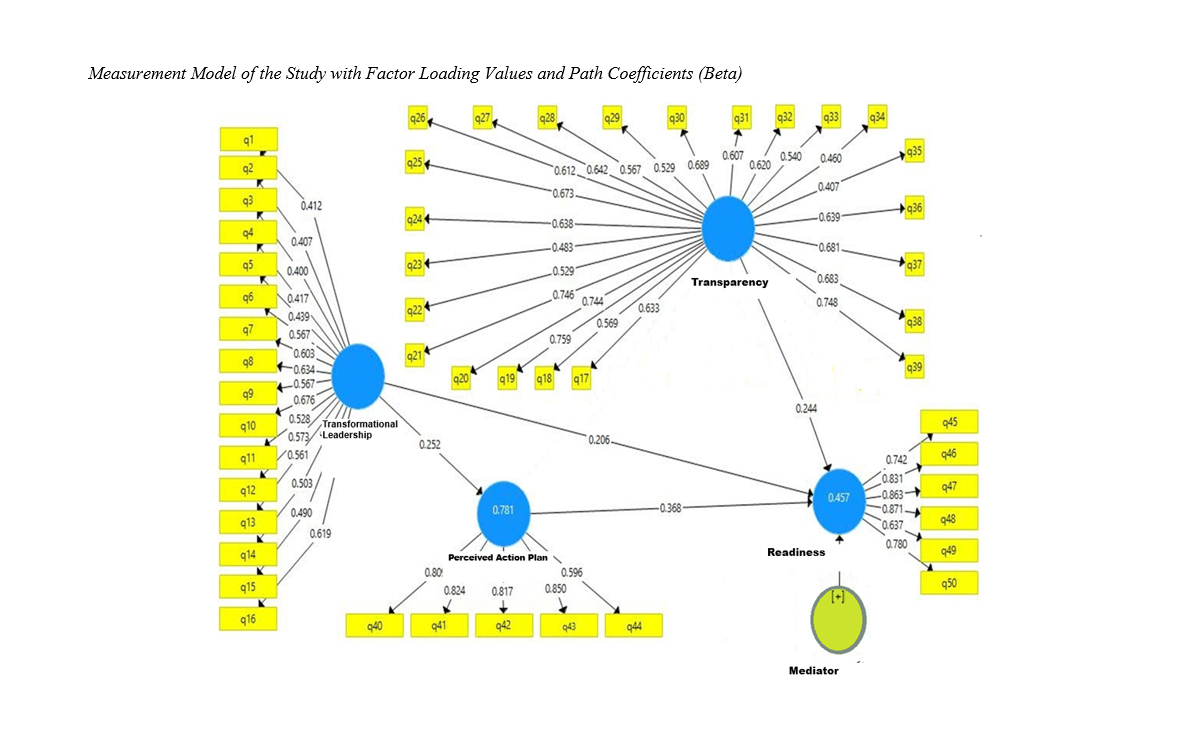
Findings: The results of path analysis indicated that transformational leadership had a significant indirect effect on readiness for organizational change through the mediating role of perceived action plan, with a t-value of 7.048. Transformational leadership also had a significant positive effect on perceived action plan, with a path coefficient of 0.252 and a t-value of 3.424. Moreover, transformational leadership significantly predicted readiness for organizational change, with a path coefficient of 0.206 and a t-value of 2.822. Perceived action plan had a significant positive effect on readiness for organizational change, with a path coefficient of 0.368 and a t-value of 5.125. In addition, organizational transparency significantly moderated the relationship between transformational leadership and readiness for organizational change, with a path coefficient of 0.244 and a t-value of 3.006.
Conclusion: The findings suggest that transformational leadership can enhance employees’ readiness for organizational change both directly and indirectly through perceived action plans. Furthermore, organizational transparency strengthens this relationship by creating a clearer and more trustworthy organizational environment for change implementation.
Downloads
References
Abrell-Vogel, C., & Rowold, J. (2014). Leaders' Commitment to Change and Their Effectiveness in Change: A Multilevel Investigation. Journal of Organizational Change Management, 27, 900-921. https://doi.org/10.1108/JOCM-07-2012-0111
Alarifi, A., AlThnayan, S., Bajaba, S., & Liu, Y. (2024). Illuminating the Way: The Role of Organizational Transparency in Preparing Employees for Change under Transformational Leadership. Current Psychology, 43, 17646-17663. https://doi.org/10.1007/s12144-024-05726-x
Babajani Mohammadi, S., & Takroosta, H. (2014). The Importance of Social Capital in Government Organizations. International Conference on Business Development and Excellence, Tehran.
Bakhtiari Fayanderi, M., Binesh, M., & Meshkati, A. (2016). Transformational Leadership in Educational Systems. International Conference on Modern Management in the 1404 Horizon, Tehran.
Bray, D. W. (2014). Personnel-Centered Organizational Diagnosis. In (pp. 152-171). Guilford Press.
Collins, J. C., & Porras, J. I. (2014). Built to Last: Successful Habits of Visionary Companies. Harper Business.
Engida, Z. M., Alemu, A. E., & Mulugeta, M. A. (2022). The Effect of Change Leadership on Employees' Readiness to Change: The Mediating Role of Organizational Culture. Future Business Journal, 8, 31. https://doi.org/10.1186/s43093-022-00148-2
Farashbandi, R., Habibi Dahaneh-Siri, Z., Sadeghzadeh, F., & Habibi Damaneh-Sari, Z. (2019). The Position and Role of Work Engagement in Organizations. First National Conference on Business Management, Entrepreneurship, and Accounting, Tehran.
Fitriadi, H., Isnurhadi, I., Zunaidah, Z., & Syathiri, A. (2026). Transformational Leadership in the Digital Era: A Systematic Literature Review on Employee Engagement. In Proceedings of the 24th Malaysia-Indonesia International Conference on Economics, Management, and Accounting in Conjunction with the 9th Sriwijaya Economics, Accounting, and Business Conference (pp. 248). Springer Nature. https://books.google.com/books?hl=en&lr=&id=xojCEQAAQBAJ&oi=fnd&pg=PA248
Ghoochani, F., Mohammadi Hosseiniyeh, J., & Abdollahi, M. (2017). Determining the Effect of Transformational Leadership on Employee Empowerment: Case Study of Agricultural Bank Employees. Annual Conference on New Management Paradigms in the Field of Intelligence, Tehran.
Heydarifard, R., Aghamohammadi, M., & Sadr, A. (2022). The Relationship Between Transformational Leadership Style and the Extent of Elementary School Teachers' Use of Electronic Teaching with the Mediating Role of Organizational Transparency. Monthly Journal of Modern Advances in Psychology, Educational Sciences, and Education, 5(53).
Ketprapakorn, N. (2019). Toward an Asian Corporate Sustainability Model: An Integrative Review. Journal of Cleaner Production, 239, 117995. https://doi.org/10.1016/j.jclepro.2019.117995
Khorshid, S., & Pashazadeh, A. (2014). The Effect of Transformational Leadership Style on Organizational Learning Capability Considering the Mediating Role of Organizational Intelligence. Transformation Management Research, 6(11), 1-28.
Maharti, Y., & Hassani Rad, P. S. (2016). Investigating the Effect of Innovation Speed on Performance: Case Study of Companies Located in Incubators and the Science and Technology Park of Mashhad. Fourth International Conference on Accounting and Management with an Approach to Modern Research Sciences, Tehran.
Mansouri, M. (2023). Examining the Relationship Between Transformational and Transactional Leadership Styles and Attitude Toward Organizational Change in Bandar Abbas Municipality. First International Conference on Law, Management, Educational Sciences, Psychology, and Educational Planning Management, Tehran.
Mekonnen, M., & Bayissa, Z. (2023). The Effect of Transformational and Transactional Leadership Styles on Organizational Readiness for Change among Health Professionals. Sage Open Nursing, 9, 23779608231185923. https://doi.org/10.1177/23779608231185923
Mohammadi Kia, A., & Pourjafar, D. (2024). The Effect of Adaptability on Organizational Change with the Moderating Role of Participatory Leadership Value among Employees of Tejarat Bank Branches in Hamedan. Twentieth National Conference on Economics, Management, and Accounting, Shirvan.
Odai, L. A., Xiao, Y., Korankye, B., & Ahakwa, I. (2026). Navigating digital transformation: the critical role of knowledge sharing and digital transformational leadership in boosting innovation capability in Sub-Saharan Africa. Business Process Management Journal, 32(2), 653-678.
Phairat, P., Kim‐Lim, T., Ting, H., Soonsan, N., & Tanticharatwarodom, P. (2026). Driving Idea Exploration to Implementation: The Role of Transformational Leadership in Fostering Innovative Work Behavior. Global Business and Organizational Excellence, 45(5), 545-559. https://doi.org/10.1002/joe.70034
Rahimi Khatounabad, M., & Sharifipour, A. (2022). Investigating the Effect of Information Technology Capabilities and Transformational Leadership on Readiness for Change with the Mediating Role of Knowledge Sharing: Case Study of Employees of Ayandeh Bank Branches in Mashhad. Fourth National Conference on Management and Tourism Industry, Tehran.
Rumijati, A., Irawati, S., & Novianti, K. R. (2022). The Role of Readiness to Change Between Transformational Leadership and Work Performance in Higher Education During COVID-19 Pandemic. In Social and Political Issues on Sustainable Development in the Post COVID-19 Crisis. https://doi.org/10.1201/9781003263586-14
Seyed Naghavi, M. A., & Shadan, S. (2010). The Effect of Social Capital on Complexity Leadership Functions in Complex Adaptive Systems. Second International Conference on Intellectual Capital Management, Zanjan.
Tizchang, M., & Houri, M. (2017). A Sociological Analysis of the Relationship Between Social Capital and Educational Effectiveness. New Research in Humanities, 3(20).
Torabi, S. A., Torabi, S. A., & Valizadeh Dastjerd, H. (2014). The Effect of Transformational Leadership on Creativity and Innovation of Organizational Employees. Second International Conference on Management Challenges and Solutions, Shiraz.
Vo, K. N., & Tran, M. H. P. (2026). Effects of Transformational Leadership on Employee Engagement through Job Satisfaction with Supervisors in Private Higher Education Institutions in Ho Chi Minh City. Discover Education. https://doi.org/10.1007/s44217-026-01374-4
Yen, T., Chau, T., & Pham, Q. T. (2025). Transformational Leadership and Firm Performance: The Mediating Roles of Innovation Capacity and Management Accounting Systems Usage. Sustainable Futures, 10, 1-11.
Zafari, H., Abedi, R., & Konfchian, M. (2017). The Effect of Leadership Styles on Competitive Advantage Considering the Mediating Role of Individual Creativity and Organizational Innovation: Case Study of Companies Located in the Science and Technology Park of the University of Tehran. Second International Conference on Management and Accounting, Tehran.
Downloads
Additional Files
Publication Timeline
- Submitted
- Revised
- Accepted