Identification of Strategic Human Capital Components and Examination of Its Impact on Innovative Work Behaviors with Job Embeddedness Moderation
DOI:
https://doi.org/10.61838/kman.ijimob.5.3.15Keywords:
Strategic Human Capital, Innovative Work Behavior, Job Embeddedness, Karbala Municipalities, Human Resource ManagementAbstract
Objective: This study aimed to identify the components of strategic human capital and its impact on employees' innovative work behaviors with the moderating role of job embeddedness in Karbala municipal offices.
Methodology: The present research adopted a mixed-method (qualitative and quantitative) approach, gathering data through systematic review, Delphi method, and questionnaires.
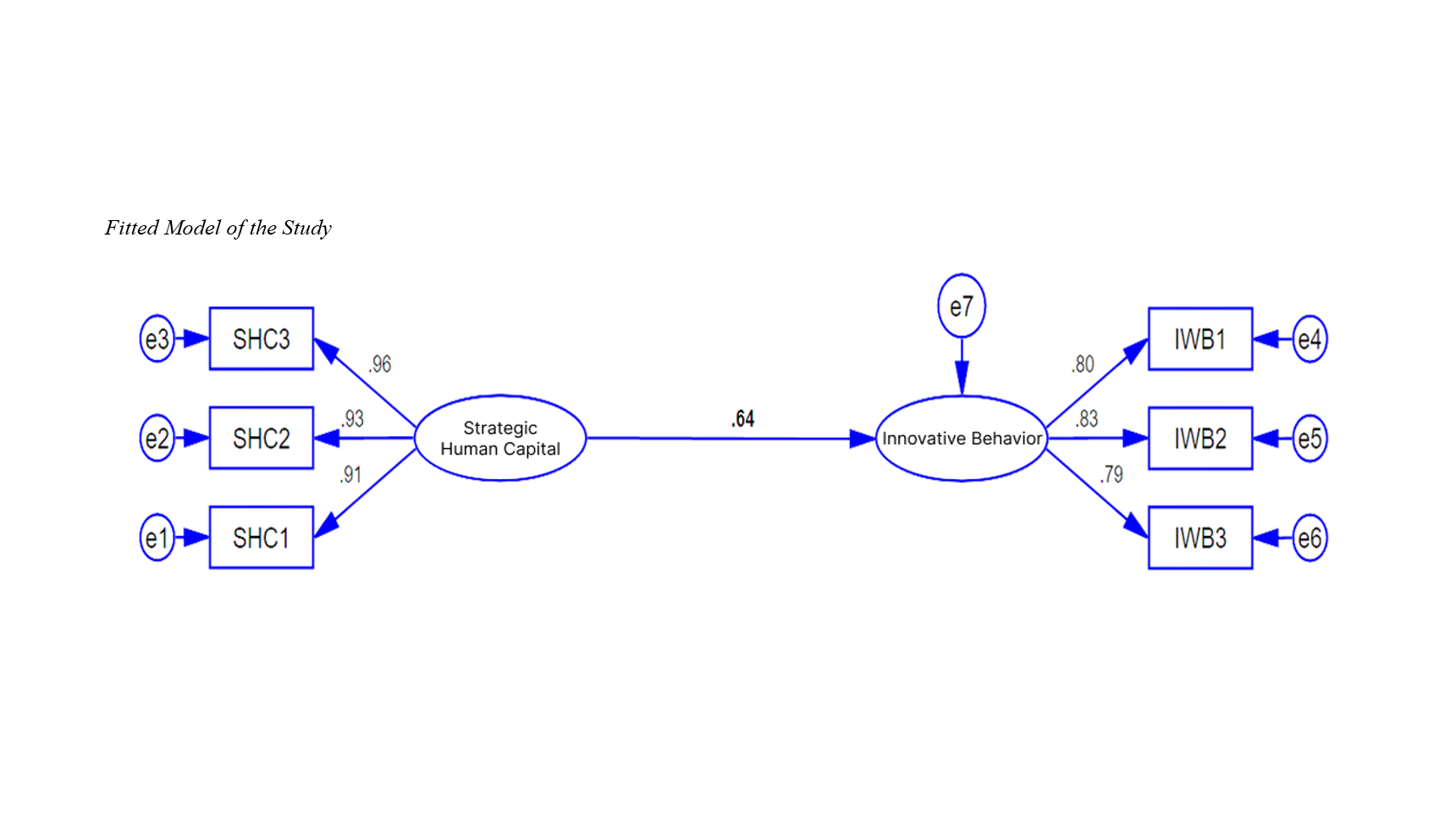
Findings: In the systematic review section, 27 primary indicators of strategic human capital were identified, from which, following Delphi surveys and exploratory factor analysis, three main components were extracted: "value creation and strategic competitiveness," "agility and strategic adaptability," and "alignment and strategic participation." In the quantitative phase, using structural equation modeling, the positive impact of strategic human capital on innovative work behaviors was confirmed, and the moderating role of job embeddedness in this relationship was found to be significant.
Conclusion: The results indicate that strategic human capital effectively enhances innovative behaviors and creates a conducive environment for improving organizational performance. By identifying the components of strategic human capital and examining its effective mechanisms, this study contributes to filling gaps in the research literature and provides practical suggestions for enhancing human resource management.
Downloads
References
Alam, M. M. (2022). The intelligent management and monitoring human capital asset model for network monitoring organization using machine learning model. 2022 International Interdisciplinary Humanitarian Conference for Sustainability (IIHC),
Amrutha, V. N., & Geetha, S. N. (2020). A systematic review on green human resource management: Implications for social sustainability. Journal of Cleaner Production, 247, 119131. https://doi.org/10.1016/j.jclepro.2019.119131
Bakker, A. B., Albrecht, S. L., & Leiter, M. P. (2011). Key questions regarding work engagement. European Journal of work and organizational psychology, 20(1), 4-28. https://doi.org/10.1080/1359432X.2010.485352
Barney, J. B. (1991). Firm resources and sustained competitive advantage. Journal of Management, 17(1), 99-120. https://doi.org/10.1177/014920639101700108
Barney, J. B., & Wright, P. M. (1998). On becoming a strategic partner: The role of human resources in gaining competitive advantage. Human Resource Management, 37(1), 31. https://doi.org/10.1002/(SICI)1099-050X(199821)37:1<31::AID-HRM4>3.0.CO;2-W
Boon, C., Eckardt, R., Lepak, D. P., & Boselie, P. (2018). Integrating strategic human capital and strategic human resource management. The International Journal of Human Resource Management, 29(1), 34-67. https://doi.org/10.1080/09585192.2017.1380063
Boxall, P. (1998). Achieving competitive advantage through human resource strategy: towards a theory of industry dynamics. Human Resource Management Review, 8(3), 265-288. https://doi.org/10.1016/S1053-4822(98)90005-5
Cabello-Medina, C., López-Cabrales, Á., & Valle-Cabrera, R. (2011). Leveraging the innovative performance of human capital through HRM and social capital in Spanish firms. The International Journal of Human Resource Management, 22(04), 807-828. https://doi.org/10.1080/09585192.2011.555125
Campbell, B. A., Kryscynski, D., & Olson, D. M. (2017). Bridging strategic human capital and employee entrepreneurship research: A labor market frictions approach. Strategic Entrepreneurship Journal, 11(3), 344-356. https://doi.org/10.1002/sej.1264
Choudhary, S., Memon, N. Z., & Mishra, K. (2020). Examining the influence of human capital on employees' innovative work behaviour: A moderated serial mediation model. South Asian Journal of Human Resources Management, 7(2), 189-213. https://doi.org/10.1177/2322093720942660
Delery, J. E., & Roumpi, D. (2017). Strategic human resource management, human capital and competitive advantage: is the field going in circles? Human Resource Management Journal, 27(1), 1-21. https://doi.org/10.1111/1748-8583.12137
Hitt, M. A., Bierman, L., Shimizu, K., & Kochhar, R. (2001). Direct and moderating effects of human capital on strategy and performance in professional service firms: A resource-based perspective. Academy of Management journal, 44(1), 13-28. https://doi.org/10.2307/3069334
Holtom, B. C., Mitchell, T. R., & Lee, T. W. (2006). Increasing human and social capital by applying job embeddedness theory. Organizational Dynamics, 35(4), 316-331. https://doi.org/10.1016/j.orgdyn.2006.08.007
Huang, Y. H., Lee, J., McFadden, A. C., Murphy, L. A., Robertson, M. M., Cheung, J. H., & Zohar, D. (2016). Beyond safety outcomes: An investigation of the impact of safety climate on job satisfaction, employee engagement and turnover using social exchange theory as the theoretical framework. Applied Ergonomics, 55, 248-257. https://doi.org/10.1016/j.apergo.2015.10.007
Janssen, O. (2000). Job demands, perceptions of effort‐reward fairness and innovative work behaviour. Journal of Occupational and Organizational Psychology, 73(3), 287-302. https://doi.org/10.1348/096317900167038
Jia, J., Yan, J., Jahanshahi, A. A., Lin, W., & Bhattacharjee, A. (2020). What makes employees more proactive? Roles of job embeddedness, the perceived strength of the HRM system and empowering leadership. Asia Pacific Journal of Human Resources, 58(1), 107-127. https://doi.org/10.1111/1744-7941.12249
Karatepe, O. M., & Vatankhah, S. (2014). The effects of high-performance work practices and job embeddedness on flight attendants' performance outcomes. Journal of Air Transport Management, 37, 27-35. https://doi.org/10.1016/j.jairtraman.2014.01.008
Kessel, M., Hannemann-Weber, H., & Kratzer, J. (2012). Innovative work behavior in healthcare: The benefit of operational guidelines in the treatment of rare diseases. Health policy, 105(2-3), 146-153. https://doi.org/10.1016/j.healthpol.2012.02.010
Kiazad, K., Holtom, B. C., Hom, P. W., & Newman, A. (2015). Job embeddedness: a multifoci theoretical extension. Journal of Applied Psychology, 100(3), 641. https://doi.org/10.1037/a0038919
Lee, J. Y., & Lee, Y. (2018). Job crafting and performance: Literature review and implications for human resource development. Human Resource Development Review, 17(3), 277-313. https://doi.org/10.1177/1534484318788269
Lukeš, M., & Stephan, U. (2017). Measuring employee innovation: A review of existing scales and the development of the innovative behaviour and innovation support inventories across cultures. International Journal of Entrepreneurial Behavior & Research, 23(1), 136-158. https://doi.org/10.1108/IJEBR-11-2015-0262
Movahedi, R., Samian, M., & Mohammadi-Mehr, S. (2017). Investigating the impact of intellectual capital on innovative behaviors of employees in the Agricultural Jihad Organization of Kermanshah Province. Iranian Journal of Agricultural Economics and Development Research, 48(1), 123-136. https://ijaedr.ut.ac.ir/article_62014.html?lang=en
Nyberg, A. J., Moliterno, T. P., Hale Jr, D., & Lepak, D. P. (2014). Resource-based perspectives on unit-level human capital: A review and integration. Journal of Management, 40(1), 316-346. https://doi.org/10.1177/0149206312458703
Oparaocha, G. O. (2016). Towards building internal social network architecture that drives innovation: A social exchange theory perspective. Journal of Knowledge Management, 20(3), 534-556. https://doi.org/10.1108/JKM-06-2015-0212
Ployhart, R. E. (2021). Resources for what? Understanding performance in the resource-based view and strategic human capital resource literatures. Journal of Management, 47(7), 1771-1786. https://doi.org/10.1177/01492063211003137
Ployhart, R. E., Nyberg, A. J., Reilly, G., & Maltarich, M. A. (2014). Human capital is dead; long live human capital resources! Journal of Management, 40(2), 371-398. https://doi.org/10.1177/0149206313512152
Reitz, O. E. (2014). The job embeddedness instrument: An evaluation of validity and reliability. Geriatric Nursing, 35(5), 351-356. https://doi.org/10.1016/j.gerinurse.2014.04.011
Shah, I. A., Csordas, T., Akram, U., Yadav, A., & Rasool, H. (2020). Multifaceted role of job embeddedness within organizations: development of sustainable approach to reducing turnover intention. Sage Open, 10(2), 2158244020934876. https://doi.org/10.1177/2158244020934876
Shela, V., Ramayah, T., & Noor Hazlina, A. (2023). Human capital and organisational resilience in the context of manufacturing: a systematic literature review. Journal of Intellectual Capital, 24(2), 535-559. https://doi.org/10.1108/JIC-09-2021-0234
Thuda, A., Sari, J., & Maharani, A. (2019). Employees Perception of Human Capital Practices, Employee's Productivity, and Company Performance. Integrated Journal of Business and Economics, 3(3), 240-250. https://doi.org/10.33019/ijbe.v3i3.188
Wojtczuk-Turek, A., & Turek, D. (2015). Innovative behaviour in the workplace: The role of HR flexibility, individual flexibility and psychological capital: the case of Poland. European Journal of Innovation Management, 18(3), 397-419. https://doi.org/10.1108/EJIM-03-2014-0027
Wood, S., & de Menezes, L. M. (2011). High involvement management, high-performance work systems and well-being. International Journal of Human Resource Management, 22(7), 1586-1610. https://doi.org/10.1080/09585192.2011.561967
Wright, P. M., & McMahan, G. C. (2011). Exploring human capital: putting 'human' back into strategic human resource management. Human Resource Management Journal, 21(2), 93-104. https://doi.org/10.1111/j.1748-8583.2010.00165.x
Downloads
Additional Files
Publication Timeline
- Submitted
- Revised
- Accepted
Issue
Section
License
Copyright (c) 2025 Hasan Hadi ALI Al-Luhaibi (Author); Ghasem Eslami (Corresponding Author); Fariborz Rahimnia , Ali Reza Khorakian (Author)

This work is licensed under a Creative Commons Attribution-NonCommercial 4.0 International License.