Designing a Competency Model for Administrative Managers in the Education Department of East Azerbaijan Province
DOI:
https://doi.org/10.61838/kman.ijimob.5.5.14Keywords:
Competency, competency model, senior managers, mid-level managers, junior managersAbstract
Objective: The objective of this study is to identify the key components of competency for administrative managers at various levels within the Ministry of Education to propose a model.
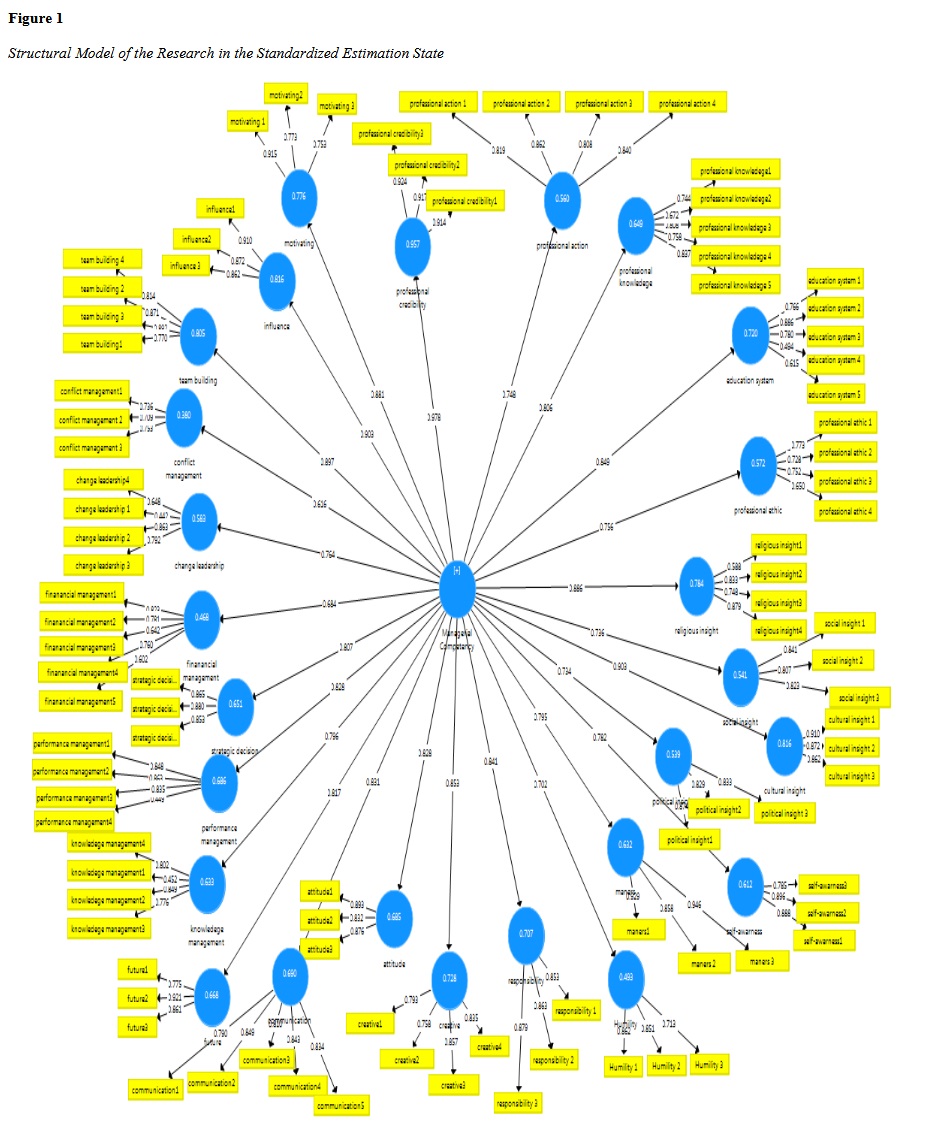
Methodology: To develop the research framework, the dimensions of the competency concept in the Education Department of East Azerbaijan Province were first extracted through document reviews, archival studies, and library research using card-based note-taking methods. Subsequently, the Delphi method was implemented in three stages, utilizing the insights of 29 experts familiar with the research topic to identify the most critical dimensions of competency within the Education Department of East Azerbaijan Province. A snowball sampling method was employed during this phase. In the next stage, after determining the sample size based on the Morgan table and applying simple random sampling, 218 administrative managers and staff (including experts and higher levels) from the Education Department of East Azerbaijan Province (encompassing one general department and five districts) were selected. Identified dimensions and factors were distributed to participants in the form of a questionnaire. Data were analyzed using structural equation modeling (SEM).
Findings: Finally, a competency model for administrative managers in the Education Department of East Azerbaijan Province was designed, comprising 27 critical competencies categorized into four domains: operational competencies, social competencies, cognitive competencies, and meta-competencies. The only difference lies in the varying degrees of importance of these competencies for senior, mid-level, and junior administrative managers.
Conclusion: The final proposed model can be utilized within the competency-based human resource management system of the Ministry of Education for training, recruitment, and performance evaluation of administrative managers at different levels.
Downloads
References
Ashiqi, H., Ghorbani, M., & Gholi Ghorchian, N. (2017). Identifying and explaining the dimensions, components, and indicators of competency development for banking industry managers. Education and Human Resource Development Quarterly, 4(14), 57-76. https://www.sid.ir/paper/255604/fa
Bahrad, A., Sabek Rou, M., & Tabatabaei Nasab, S. M. (2024). Designing a competency model for senior tax experts. Management Studies in Development and Evolution, 29(97), 103-131. https://doi.org/10.22054/jmsd.2020.42843.3331
Beheshti Zavareh, F., Soltani, I., & Nili Pour Tabatabaei, S. A. (2018). Designing a competency model for managers to enhance organizational profitability: A case study of Tehran Urban Railway. Management Accounting and Auditing Knowledge, 7(28), 149-166. https://www.jmaak.ir/article_13299.html
Dorji, K., Tejativaddhana, P., Siripornpibul, T., Cruickshank, M., & Briggs, D. (2019). Leadership and management competencies required for Bhutanese primary health care managers in reforming the district health system. Journal of Healthcare Leadership, 11, 13. https://doi.org/10.2147/JHL.S195751
Dziekoński, K. (2017). Project managers' competencies model for construction industry in Poland. Procedia Engineering, 182, 174-181. https://doi.org/10.1016/j.proeng.2017.03.157
Grillenberger, A., & Romeike, R. (2018). Developing a theoretically founded data literacy competency model. Proceedings of the 13th Workshop in Primary and Secondary Computing Education,
Haraqi, M., & Darvishi, A. (2019). Presenting a model for selecting professional managers in government organizations. Organizational Behavior Studies, 8(4), 51-86. https://www.sid.ir/paper/387504/fa
Hashemnia, S., Shirzad Kabria, B., Masoudi Hezarjaribi, S., & Hedayati Dezfuli, A. R. (2015). Studying ways to improve the professional competencies of managers and teachers in Babol education schools. International Conference on New Directions in Management, Economics, and Accounting,
Kandarani, A., Younesi, J., Zamanpour, E., Farrokhi, N., Salimi, M., & Moghaddamzadeh, A. (2025). Designing and Validating a Model of Specific Competencies for Managers of Iran's Oil Terminals Company. Educational Leadership Research Quarterly, 9(33), 229-258.
Kang, H. J., Chung, K. W., & Nam, K. Y. (2015). A competence model for design managers: A case study of middle managers in Korea. International Journal of design, 9(2). https://www.semanticscholar.org/paper/A-Competence-Model-for-Design-Managers-%3A-A-Case-of-Kang-Chung/1ace1b0c556728bb07d99e0fe6f2ca70cdb70453
Khanifar, H., Ebrahimi, S., Seifi, A., & Fayyazi, B. M. (2020). Designing a competency model for educational managers for use in assessment and development centers. School Management, 8(2), 118-139. https://www.sid.ir/paper/401486/fa
Mikła, A. (2025). Managerial Competencies Manage ment–A Practical Approach. Education Excellence and Innovation Management: A, 17909-17915. https://www.wir.ue.wroc.pl/docstore/download/UEWRa28f1d564846421fafea59840a4d5e57/Mikla_Managerial_Competencies_Management_A_Practical.pdf
Mousavi, S. A., Mohammadi, M., & Safian, M. (2020). Designing a competency model for managers of organizational universities (Case study: A university affiliated with a military organization). Management in Islamic University, 20(9), 217-240. https://doi.org/10.22034/miu.2021.980
Nawaz, M. (2013). The Professional Development of Employees in Banks of Pakistan: A comparative study of public and private banks in Punjab Pakistan. International Journal of Learning & Development, 3(5). https://doi.org/10.5296/ijld.v3i5.4520
Nwokah, N. G., & Augustine, I. (2018). Managerial Competencies and marketing effectiveness in corporate organization in Nigeria. Journal of Management Development, 27(8), 858-878. https://doi.org/10.1108/02621710810895677
Podmetina, D., Soderquist, K. E., Petraite, M., & Teplov, R. (2018). Developing a competency model for open innovation: From the individual to the organisational level. Management Decision. https://doi.org/10.1108/MD-04-2017-0445
Saeed Panah, M., Alvani, S. M., & Hashemi, S. Z. (2019). Designing an optimal combination model of general and specialized competencies for IT managers (Case study: Bank Mellat). Strategic Management Research, 25(75), 13-44. https://sanad.iau.ir/Journal/smr/Article/1095283/FullText
Saeed Panah, M., Alvani, S. M., & Hashemi, S. Z. (2020). Designing a model of fundamental and technological competencies for IT managers. Journal of Development and Transformation Management, 40, 1-8. https://jdem.qazvin.iau.ir/article_673410.html
Seyed Javadin, S. R., Saadat Nehad, M. H., Amiri, M., & Lasani Fesharki, M. A. (2021). Identifying the competencies of competent managers: A thematic research in the Holy Quran. Human Resource Management Research, 13(4), 85-114. https://www.sid.ir/paper/1046216/fa
Shum, C., Gatling, A., & Shoemaker, S. (2018). A model of hospitality leadership competency for frontline and director-level managers: Which competencies matter more? International Journal of Hospitality Management, 74, 57-66. https://doi.org/10.1016/j.ijhm.2018.03.002
Sinnot, G., Madison, G. H., & Pataki, G. E. (2022). Competencies: Report of the competencies workgroup, workforce and succession planning work groups. New York State Governor's Office of Employee Relations and the Department of Civil Service. https://www.researchgate.net/publication/363877474
Skorková, Z. (2016). Competency Models in Public Sector. Procedia - Social and Behavioral Sciences, 230. https://doi.org/10.1016/j.sbspro.2016.09.029
Staškeviča, A. (2019). The importance of competency model development. Acta Oeconomica Pragensia, 27(2), 62-71. https://doi.org/10.18267/j.aop.622
Tayebi, S. J., Fathi, M., Riahi, L., & Yousefi Nezhadi, T. (2010). The relationship between managers' competencies and the efficiency of educational hospitals of Tehran University of Medical Sciences. Scientific-Research Quarterly Journal of Medicine and Purification, 77, 17-24. https://journals.iau.ir/article_693808.html
Yargholi, B., Rafiei, M., & Akbarnejad, V. (2024). Identifying the Concept of Managerial Competency from the Perspective of Teachers in Maragheh. New Approaches in Educational Management Journal, 1(1), 12-32. https://ntea.urmia.ac.ir/article_121480.html?lang=en
Zaharov, D., & Kashtanova, Y. (2024). Leadership Management and Modern Profile of Key Competencies of a Manager. Management of the Personnel and Intellectual Resources in Russia, 13(1), 39-43. https://doi.org/10.12737/2305-7807-2024-13-1-39-43
Downloads
Additional Files
Publication Timeline
- Submitted
- Revised
- Accepted
Issue
Section
License
Copyright (c) 2025 Mehdi Khayyati, Davoud haghkhah, Masoumeh Danesh Shakib (Author)

This work is licensed under a Creative Commons Attribution-NonCommercial 4.0 International License.