Designing a Model for Enhancing the Symbolic Capital of Managers (Case Study: SAIPA Automotive Group)
DOI:
https://doi.org/10.61838/kman.ijimob.5.4.12Keywords:
Symbolic capital, symbolic capital in organizations, symbolic capital of managers, SAIPA Automotive GroupAbstract
Objective: This study aims to design a model for enhancing the symbolic capital of managers in the SAIPA Automotive Group.
Methods and Materials: The research method is qualitative and based on grounded theory. The statistical population of the study in the documents section includes articles, theses, books, and scientific documents related to the research topic between the years 2000-2024 and in the interview section includes three groups: academic experts, experienced specialists, and executive managers of the SAIPA Automotive Group. In this study, purposive and snowball sampling were used to select the sample, which was achieved based on the saturation rule by conducting 15 interviews. The data were analyzed using the seven-stage approach of Sandelowsky et al. (2007) grounded theory and MAXQDA2020 software.
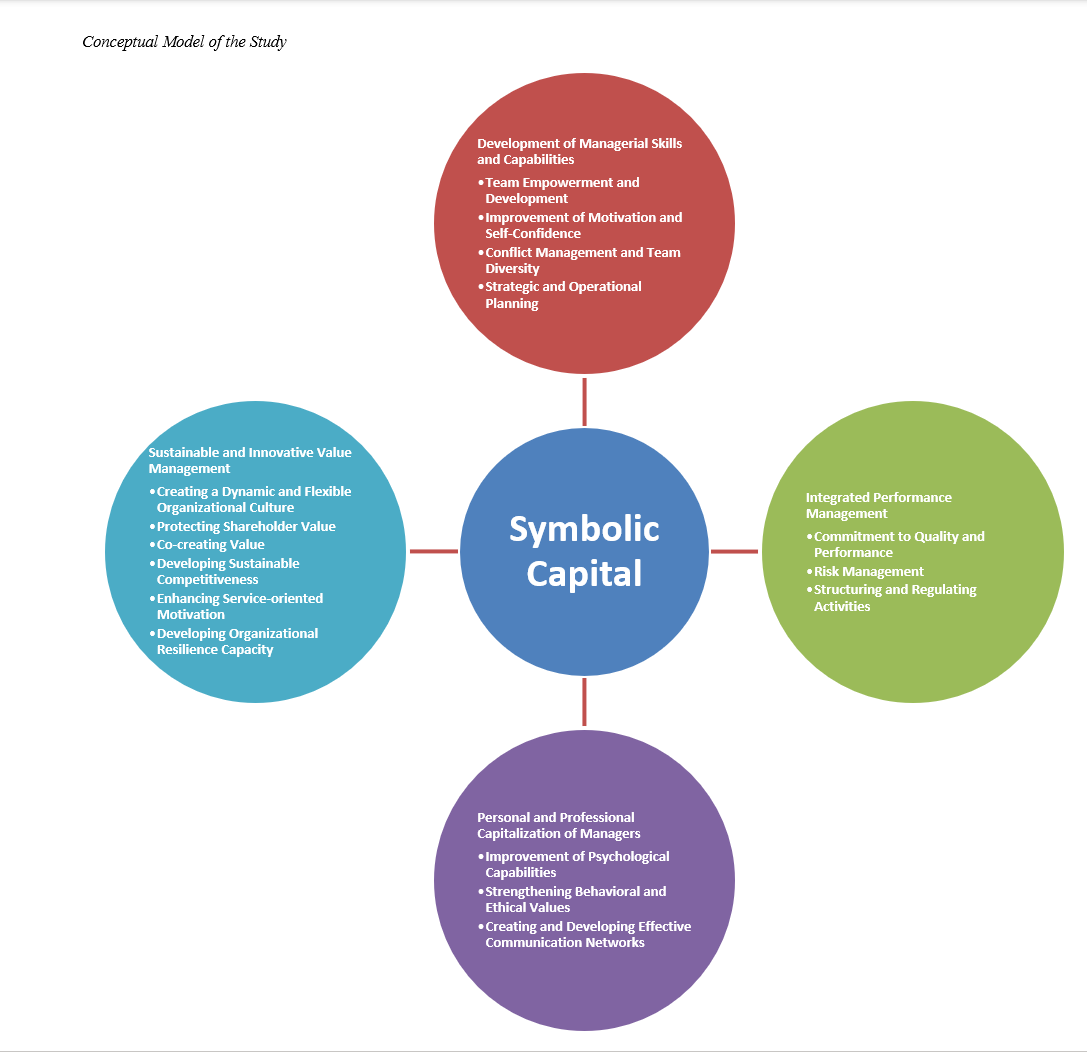
Findings: According to the analysis of the data obtained from the interviews, this study identified a total of 93 concepts within four main categories (development of managerial skills and capabilities, integrated performance management, personal and professional capitalization of managers, and sustainable and innovative value management), and sixteen subcategories (team empowerment and development, improvement of motivation and self-confidence, conflict management and team diversity, strategic and operational planning, commitment to quality and performance, risk management, structuring and regulating activities, improvement of psychological capabilities, strengthening behavioral and ethical values, creation and development of effective communication networks, creation of a dynamic and flexible organizational culture, protection of shareholder value, co-creation of value, sustainable competitive development, enhancement of service-oriented motivation, and development of organizational resilience capacity).
Conclusion: This study presents a model for enhancing the symbolic capital of managers in the SAIPA Automotive Group, focusing on key areas like managerial skills development, integrated performance management, and sustainable value creation.
Downloads
References
Bühlmann, F. (2023). Professional service firms and the manufacturing of the corporate nobility. Journal of Professions and Organization, 10(1), 36-49. https://doi.org/10.1093/jpo/joad003
Caldwell, R. (2011). HR directors in UK boardrooms: a search for strategic influence or symbolic capital? Employee Relations, 33(1), 40-63. https://doi.org/10.1108/01425451111091645
Conway, S., McDonagh, J., Farrell, M., & Kinsella, A. (2016). Cease agricultural activity forever? Underestimating the importance of symbolic capital. Journal of Rural Studies, 44, 164-176. https://doi.org/10.1016/j.jrurstud.2016.01.016
De Clercq, D., & Voronov, M. (2009). The role of cultural and symbolic capital in entrepreneurs' ability to meet expectations about conformity and innovation. Journal of Small Business Management, 47(3), 398-420. https://doi.org/10.1111/j.1540-627X.2009.00276.x
Demidova, M. V. (2024). The Place of Symbolic Capital in Metamodern Society: Values and Habitus Matrices. Intelligence. Innovations. Investments, 1(2), 66-74. https://doi.org/10.25198/2077-7175-2024-2-66
Efanov, A. A. (2023). The structure of symbolic capital in the modern communication environment: digital network progression. Digital Sociology, 6(2), 51-57. https://doi.org/10.26425/2658-347X-2023-6-2-51-57
Euflausino, M. A., & Ichikawa, E. Y. (2022). Subspecies of Symbolic Capital within Ordinary Management. Organizações & Sociedade, 29(102), 569-593. https://doi.org/10.1590/1984-92302022v29n0025en 10.1590/1984-92302022v29n0025pt
Ghorashi, A., Haghighatian, M., & Hashemian-Far, S. A. (2022). The relationship between types of interactions (discrete and continuous) and cultural and symbolic capital. Monthly Journal of Iranian Political Sociology, 5(8), 1583-1608. https://jou.spsiran.ir/article_155722.html
Kang, K., & Lee, J. (2024). The symbolic capital of the artist and the legitimacy of AI art: Focusing on Damien Hirst's [Beautiful Paintings]. Arts Management Research, 2(48), 37-64. https://doi.org/10.52564/JAMP.2024.71.37
Lavin, C. (2024). The Symbolic Capital of the Neoliberal University. Emancipations: A Journal of Critical Social Analysis, 3(1), 1-27. https://doi.org/10.55533/2765-8414.1066
Lizé, W. (2016). Artistic work intermediaries as value producers. Agents, managers, Tourneurs and the acquisition of symbolic capital in popular music. Poetics, 59, 35-49. https://doi.org/10.1016/j.poetic.2016.07.002
Nademi, A., Pirzadian, M., & Namdar Jowini, E. (2015). Examining the relationship between symbolic capital and entrepreneurial organizational culture. First International Conference on Accounting, Management, and Innovation in Business, Souma'eh-Sara.
Noordegraaf, M., & Schinkel, W. (2011). Professionalism as symbolic capital: Materials for a Bourdieusian theory of professionalism. Comparative Sociology, 10(1), 67-96. https://doi.org/10.1163/156913310X514083
Olesen, T. (2024). After the organization: Symbolic capital and negative expert knowledge in post-whistleblowing careers. Acta Sociologica. https://doi.org/10.1177/00016993241281461
Ostovar, M., & Ali Ramaei, N. (2024). The symbolic capital of Iranian intellectuals and the construction of revolutionary ideology: A case study of Jalal Al-e Ahmad and Ali Shariati. Quarterly Journal of Political Discourse of the Islamic Revolution, 3(1), 138-162. https://www.magiran.com/paper/2723329/the-symbolic-capital-of-iranian-intellectuals-and-the-construction-of-a-revolutionary-ideology-case-study-of-jalal-al-ahmad-and-ali-shariati?lang=en
Pret, T., Shaw, E., & Drakopoulou Dodd, S. (2016). Painting the full picture: The conversion of economic, cultural, social and symbolic capital. International Small Business Journal, 34(8), 1004-1027. https://doi.org/10.1177/0266242615595450
Rodrigues, J. (2022). Capital simbólico e família empresária. European Journal of Management and Marketing Studies, 7(1), 140-159. https://doi.org/10.46827/ejmms.v7i4.1307
Ryan, J., Silvanto, S., & Ozkaya, H. E. (2015). A contextual, theoretical and empirical analysis of the uses of university degrees as symbolic capital in self-initiated expatriation. European Journal of International Management, 9(5), 614-634. https://doi.org/10.1504/EJIM.2015.071536
Sadeghi, H., Abbas-Abadi, F., & Namdar Jowimi, E. (2015). Examining the relationship between symbolic capital and organizational citizenship behavior and knowledge sharing. Third International Conference on Accounting and Management, Tehran.
Salehi, H., Sepehvand, R., & Mousavi, S. N. (2021). Designing a model for reproducing symbolic capital for leaders in cultural organizations of the Islamic Republic of Iran using a structural-interpretive modeling approach. Quarterly Journal of Social Capital Management, 8(1), 71-97. https://jscm.ut.ac.ir/article_79757.html
Simakova, S. (2024). Practices of mastering the space of the memorial landscape as an element of the symbolic capital of Arkaim. Sign: a problematic field of media education(1), 103-107. https://doi.org/10.47475/2070-0695-2024-51-1-103-107
Sudakova, V. V. (2023). Symbolic capital of the territory as a resource for revitalization: identification methods. Bulletin of Omsk State Pedagogical University. Humanitarian studies, 2(39), 45-49. https://doi.org/10.36809/2309-9380-2023-39-45-49
Tully, P. (2023). Below the surface: power and professionalism in the further education sector. Research in Post-Compulsory Education, 28(1), 26-47. https://doi.org/10.1080/13596748.2023.2166691
Vlasic, G., Langer, J., & Krupka, Z. (2012). Driving the value premium through cultural, symbolic, economic and social capital management. AMA Summer Educators' Conference Proceedings,
Downloads
Additional Files
Publication Timeline
- Submitted
- Revised
- Accepted
Issue
Section
License
Copyright (c) 2024 Alireza Habibi (Author); Jafar Beikzad (Corresponding Author); Rahim Abdollahfam (Author)

This work is licensed under a Creative Commons Attribution-NonCommercial 4.0 International License.