Conflict Management Model Based on Behaviorism and Effective Communication in Social Security Treatment Management in Markazi Province
DOI:
https://doi.org/10.61838/kman.ijimob.5.5.4Keywords:
Conflict management, behaviorism, effective communicationAbstract
Objective: Human resource management is one of the most complex and challenging topics in contemporary organizations. One of the challenging aspects of this field is conflict management among organizational employees. The main goal of this study is to present a conflict management model based on behaviorism and effective communication in the Social Security Treatment Management of Markazi Province.
Methodology: The statistical population of this qualitative research consists of experts and managers from the Social Security Treatment Management of Markazi Province. Snowball sampling is used in this study. The sample size is set at 16 individuals. To collect qualitative data, interviews were conducted with experts. The data were analyzed using directed content analysis.
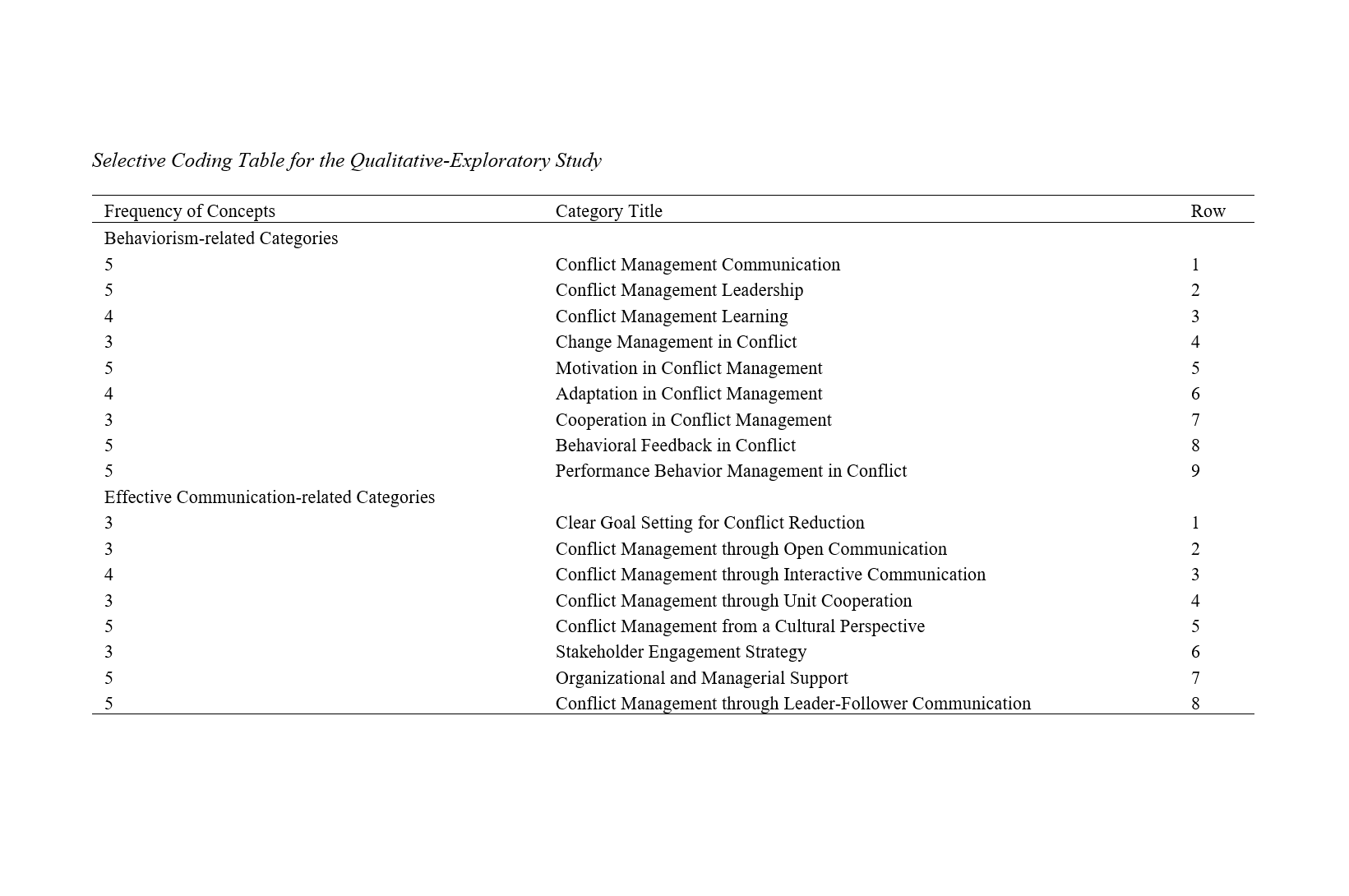
Findings: Ultimately, 58 subcategories were identified within 17 main categories, which were introduced as dimensions of conflict management in two sections: behaviorism and effective communication.
Conclusion: Therefore, based on these dimensions, successful implementation of conflict management models can be achieved in organizations.
Downloads
References
Andrade, C., & Neves, P. C. (2022). Perceived organizational support, coworkers' conflict and organizational citizenship behavior: The mediation role of work-family conflict. Administrative Sciences, 12(1), 20. https://doi.org/10.3390/admsci12010020
Andreoni, A., & Chang, H. J. (2019). The political economy of industrial policy: Structural interdependencies, policy alignment and conflict management. Structural Change and Economic Dynamics, 48, 136-150. https://doi.org/10.1016/j.strueco.2018.10.007
Anindo, J. (2021). Influence of conflict management strategies on performance of youth projects—a case of Amani Kibera Youth Community-based Organization, Nairobi County, Kenya University of Nairobi]. https://erepository.uonbi.ac.ke/handle/11295/156019
Aqqad, N., Obeidat, B., Tarhini, A., & Masa'deh, R. E. (2019). The relationship among emotional intelligence, conflict management styles, and job performance in Jordanian banks. International Journal of Human Resources Development and Management, 19(3), 225-265. https://doi.org/10.1504/IJHRDM.2019.100636
Cho, G. Y., Kim, N. K., & Seo, M. K. (2021). Correlation between conflict management style, communication competence and burnout in operating room nurses. 성인간호학회 학술대회,
Dagnes, J., Bazzoli, N., Barberis, E., & Carbone, D. (2021). Decision-making processes, conflict and coordination in Italian schools in the era of distance education. Decision-making processes, conflict and coordination in Italian schools in the era of distance education, 51-78. https://doi.org/10.3280/SO2021-001003
Dignath, D., Kiesel, A., & Eder, A. B. (2015). Flexible conflict management: conflict avoidance and conflict adjustment in reactive cognitive control. Journal of Experimental Psychology: Learning, Memory, and Cognition, 41(4), 975. https://doi.org/10.1037/xlm0000089
Hussein, B., Ibrahim, M. S., & Ismael, F. (2022). The influence of Perceived Leadership Styles on Employee Commitment: The Mediating Role of Conflict Management. International Journal of Humanities and Education Development (IJHED), 4(1), 43-60. https://doi.org/10.22161/jhed.4.1.6
Jimoh, U. U., & Wahab, B. (2022). AJAGBO: A TRADO-MUSICOLOGICAL DIMENSION TO CONFLICT MANAGEMENT SYSTEM IN INFRASTRUCTURE PLANNING AMONG THE AKOKO SPEAKING PEOPLE OF SOUTH-WESTERN NIGERIA. Wukari International Studies Journal, 6(1), 10. https://wissjournals.com.ng/index.php/wiss/article/view/11
John, S., & Niyogi, D. (2019). A Study on the Numerous Elements of Emotional Intelligence and Leadership Qualities and Its Impact on Conflict Management: A Review of Literature. Journal of Management (JOM), 6(2), 111-120. https://doi.org/10.34218/JOM.6.2.2019.014
Johnson, D. W., & Johnson, R. T. (1994). Constructive conflict in the schools. Journal of Social Issues, 50(1), 117-137. https://doi.org/10.1111/j.1540-4560.1994.tb02401.x
Kagwiria, B. E. A. T. R. I. C. E. (2019). Workplace conflict management strategies and performance of telecommunication industry in Kenya https://ir-library.ku.ac.ke/items/5f07596e-d760-4383-b163-895a3065bd8e
Macassi, S. (2019). Conflict management through media: Contributory and partisan frames in socioenvironmental conflict coverage. Conflict & Communication, 18(2). https://www.academia.edu/117237740/Conflict_management_through_media_Contributory_and_partisan_frames_in_socio_environmental_conflict_coverage
Najihah, A. (2024). Molding the Future: The Integral Role of Leadership Styles in Shaping Organizational Success. Historical, 3(1), 11-25. https://doi.org/10.58355/historical.v3i1.101
Nes, E., White, B. A. A., Malek, A. J., Mata, J., Wieters, J. S., & Little, D. (2022). Building communication and conflict management awareness in surgical education. Journal of Surgical Education, 79(3), 745-752. https://doi.org/10.1016/j.jsurg.2021.11.014
Rahim, M. A. (2017). Managing conflict in organizations. Routledge. https://doi.org/10.4324/9780203786482
Schiff, A. (2020). From Conflict Management to Multidimensional Conflict Resolution. Strategic Assessment, 23(4), 140-152. https://www.researchgate.net/publication/346080425_From_Conflict_Management_to_Multidimensional_Conflict_Resolution
Shakeel, U., & Khan, F. S. (2022). Role of Emotional Intelligence In Conflict Management as Part of Customer Relationship Management In Select Public and Private Sector Banks. Academy of Marketing Studies Journal, 26(S3). https://www.researchgate.net/publication/374700174_ROLE_OF_EMOTIONAL_INTELLIGENCE_IN_CONFLICT_MANAGEMENT_AS_PART_OF_CUSTOMER_RELATIONSHIP_MANAGEMENT_IN_SELECT_PUBLIC_AND_PRIVATE_SECTOR_BANKS
Sinskey, J. L., Chang, J. M., Thornton, K. C., Boscardin, C. K., & Sullivan, K. R. (2021). Conflict management education for anesthesiology residents: bridging the gap in interpersonal and communication skills competency. A&A Practice, 15(10), e01524. https://doi.org/10.1213/XAA.0000000000001524
Smith, B., Johnson, P., & Williams, E. (2018). Understanding interpersonal conflicts in organizations. Journal of Applied Communication Research, 30(4), 450-467.
Soorani, F., & Ahmadvand, M. (2019). Determinants of consumers' food management behavior: Applying and extending the theory of planned behavior. Waste Management, 98, 151-159. https://doi.org/10.1016/j.wasman.2019.08.025
Thomas, K. W. (1992). Conflict and conflict management: Reflections and update. Journal of Organizational Behavior, 265-274. https://doi.org/10.1002/job.4030130307
Wang, D., & Liu, Y. (2021). The effect of political skill on relationship quality in construction projects: The mediating effect of cooperative conflict management styles. Project Management Journal, 52(6), 563-576. https://doi.org/10.1177/87569728211037503
Winata, L. R. W. (2024). The Influence of Organizational Culture, Situational Leadership and Emotional Intelligence on Organizational Commitment Through Job Satisfaction at PDAM Tirta Ardhia Rinjani, Central Lombok Regency. Journal of Economics Finance and Management Studies, 07(05). https://doi.org/10.47191/jefms/v7-i5-17
Downloads
Additional Files
Publication Timeline
- Submitted
- Revised
- Accepted
Issue
Section
License
Copyright (c) 2024 Gholamreza Mirzaei (Author); Morteza Ghasemi (Corresponding Author); Maryam Majidi, Mohammad Mehtari Arani (Author)

This work is licensed under a Creative Commons Attribution-NonCommercial 4.0 International License.