Identifying Key Competitive Factors in Industrial Enterprises Producing and Supplying Chemical Products in the Northwest Region of the Country Using Thematic Analysis
DOI:
https://doi.org/10.61838/kman.ijimob.5.4.1Keywords:
Active industrial enterprises, thematic analysis method, key competitive factors, chemical productsAbstract
Objective: This article aims to identify the key competitive factors in industrial enterprises involved in the production and supply of chemical products in the northwest region of the country using the thematic analysis method.
Methodology: The research method is qualitative and exploratory. Data were collected using thematic analysis and through purposeful and in-depth interviews with 20 experts and specialists in the fields of market management and competition. Initial coding and the definition of sub-themes and main themes facilitated the identification of factors affecting the competitiveness of active industrial enterprises.
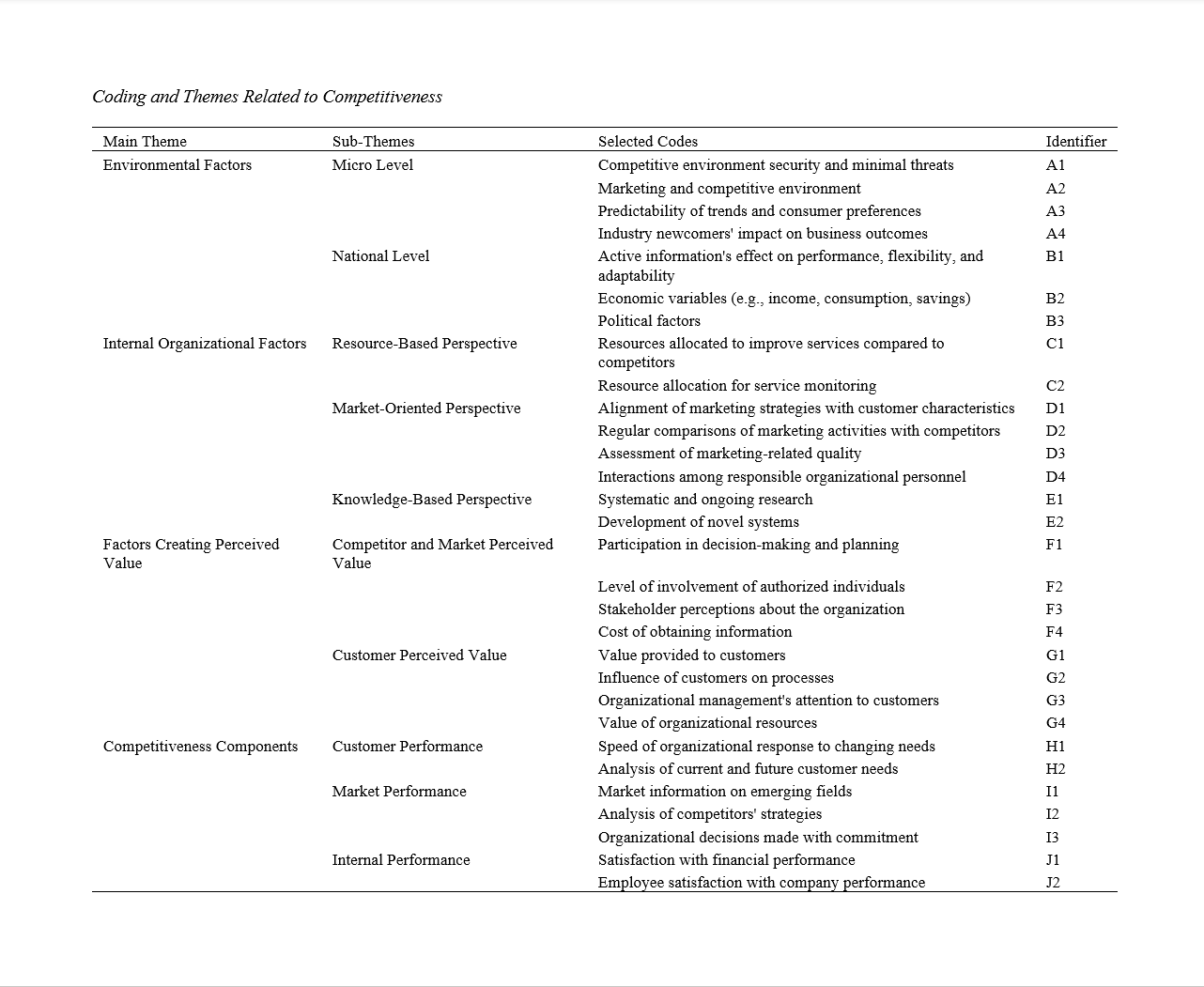
Findings: Data extracted from in-depth interviews were analyzed using thematic analysis in three stages: open coding, axial coding, and selective coding. In the initial coding stage, 82 keywords were identified. During the second stage, 56 concepts were extracted, and in the third stage, the analysis resulted in the extraction of 30 basic codes, 10 sub-themes, and 4 main themes.
Conclusion: The results of the study indicate that the key competitive factors in industrial enterprises engaged in the production and supply of chemical products in the northwest region include: environmental factors (micro and national levels), internal organizational factors (market-oriented perspective, knowledge-oriented perspective, and resource-based perspective), factors creating perceived value (perceived value of competitors and the market towards the enterprise, perceived value of customers towards the enterprise), and competitiveness components (internal performance of the enterprise, enterprise performance regarding customers, enterprise performance in the market).
Downloads
References
Ahmedova, S. (2015). Factors for Increasing the Competitiveness of Small and Medium-Sized Enterprises (SMEs) in Bulgaria. Procedia - Social and Behavioral Sciences, 195, 1104-1112. https://doi.org/10.1016/j.sbspro.2015.06.155
Andrades, L., & Dimanche, F. (2017). Destination competitiveness and tourism development in Russia: Issues and challenges. Tourism Management, 62, 360-376. https://doi.org/10.1016/j.tourman.2017.05.008
Asikin, M. Z., Fadilah, M. O., Saputro, W. E., Aditia, O., & Ridzki, M. M. (2024). The Influence Of Digital Marketing On Competitive Advantage And Performance of Micro, Small And Medium Enterprises. International Journal of Social Service and Research, 4(03), 963-970. https://doi.org/10.46799/ijssr.v4i03.749
Booth, E. M., & Philip, G. (2013). Technology, competencies and competitiveness: The case for reconfigurable and flexible strategies. Journal of Business Research, 41, 29-40. https://doi.org/10.1016/S0148-2963(97)00009-X
Buckley, P. J., & Prescott, K. (2014). Measures of international competitiveness: A critical survey. Journal of Marketing, 4, 175-200. https://doi.org/10.1080/0267257X.1988.9964068
D'Cruz, J., & Rugman, A. (2017). New concepts for Canadian competitiveness. Journal of Marketing Research, 1, 127-154. https://www.scirp.org/reference/referencespapers?referenceid=1191621
Demeter, K. (2016). Analysis of management strategy and competitiveness. International Journal of Production Economics, 81, 205-213. https://doi.org/10.1016/S0925-5273(02)00353-5
Feurer, R., & Chaharbaghi, K. (2013). Defining competitiveness: A holistic approach. Management Decision, 32(2), 49-58. https://doi.org/10.1108/00251749410054819
Gonzalez, A. (2017). Leveraging Trade Facilitation Reforms for Increased SME Competitiveness. Small and Medium-Sized Enterprises in International Economic Law, 38. https://doi.org/10.1093/acprof:oso/9780198795650.003.0003
Kwilinski, A. (2019). Mechanism for assessing the competitiveness of an industrial enterprise in the information economy. Research Papers in Economics and Finance, 3(1), 7-16. https://doi.org/10.18559/ref.2018.1.1
Li, F. (2023). Research on the Formation Mechanism and Competitive Advantage Effect of Enterprise Informatization Leader. https://doi.org/10.4108/eai.19-5-2023.2334312
Luh, Y. H., Jiang, W. J., & Huang, S. C. (2016). Trade-related spillovers and industrial competitiveness: Exploring the linkages for OECD countries. Economic Modelling, 54, 309-325. https://doi.org/10.1016/j.econmod.2016.01.002
Meier, A., Eller, R., & Peters, M. (2025). Creating competitiveness in incumbent small-and medium-sized enterprises: A revised perspective on digital transformation. Journal of Business Research, 186, 115028. https://doi.org/10.1016/j.jbusres.2024.115028
Murths, T. P. (2016). Country capabilities and the strategic state: How national political institutions affect MNC strategies. Strategic management journal, 15, 113-129. https://doi.org/10.1002/smj.4250151008
Olazo, D. B. (2023). Marketing competency, marketing innovation and sustainable competitive advantage of small and medium enterprises (SMEs): a mixed-method analysis. Asia Pacific Journal of Marketing and Logistics, 35(4), 890-907. https://doi.org/10.1108/APJML-01-2022-0050
Phittayanon, C., & Rungreunganun, V. (2019). Analyzing Factors Influencing Industrial Competitiveness of Thai Silver Jewelry Industry Using Analytic Hierarchy Process. International Journal of Mechanical Engineering and Technology, 10(3). https://papers.ssrn.com/sol3/papers.cfm?abstract_id=3453022
Pooramini, Z., & Ebrahimpour, H. (2023). A Conceptual Model of Employability Skill for Technology and Knowledge-Based Enterprise. Journal of Entrepreneurship Development, 16(3), 47-65. https://www.magiran.com/paper/2660548
Salarzehi, H., & Dezhkam, J. (2012). Identifying and Prioritizing Factors Affecting the Competitiveness of Industrial Cluster Businesses in the Fisheries Sector of Sistan and Baluchestan Province Using the Analytic Network Process. Industrial Management Studies Quarterly, 9(24), 13-115.
Scott, B. (2017). Competitiveness: Self-help for a worsening problem. Harvard business review, 6, 115-121. https://www.sid.ir/paper/601614/fa
Shahiki Tash, M. N., Mahmoudpour, K., & Mohseni, H. (2014). Investigating the influencing factors on the competitiveness index of countries with an emphasis on Iran's economy. Financial and Economic Policies, 3(11), 155-188. http://qjfep.ir/browse.php?a_code=A-10-226-1&slc_lang=fa&sid=1
Smith, S. (2015). Word-class competitiveness. Managing Service Quality, 5(4), 36-42. https://doi.org/10.1108/09604529510100387
Vashghani Farahani, S. (2018). Dissection of Porter's diamond and its role in determining competitiveness. Second International Conference on Management, Industrial Engineering, Economics and Accounting, Tbilisi-Georgia.
Vlados, C., & Chatzinikolaou, D. (2019). Challenges of industrial policy to enhance competitiveness. Journal of Economics Library, 6(2), 83-96. https://papers.ssrn.com/sol3/papers.cfm?abstract_id=3422953
Von, H. K., & Mutahashi, T. P. (2017). Country capabilities and the strategic state: How national political institutions affect MNC strategies. Strategic management journal, 15, 113-129. https://doi.org/10.1002/smj.4250151008
Wongsansukcharoen, J., & Thaweepaiboonwong, J. (2023). Effect of innovations in human resource practices, innovation capabilities, and competitive advantage on small and medium enterprises' performance in Thailand. European Research on Management and Business Economics, 29(1), 100210. https://doi.org/10.1016/j.iedeen.2022.100210
Zaverbnyj, A., & Pushak, Y. (2023). Theoretical and Applied Principles of Strategic Management of Competitive Advantages of Enterprises in the Context of Digitalization. Economic Herald of the Donbas(4 (74)), 26-31. https://doi.org/10.12958/1817-3772-2023-4(74)-26-31
Downloads
Additional Files
Publication Timeline
- Submitted
- Revised
- Accepted
Issue
Section
License
Copyright (c) 2025 Amin Sonboli (Author); Alireza Bafande Zendeh (Corresponding Author)

This work is licensed under a Creative Commons Attribution-NonCommercial 4.0 International License.