Identification, Weighting, and Prioritization of Components and Indicators Determining the Circular Economy with a Marketing Approach
DOI:
https://doi.org/10.61838/kman.ijimob.5.3.12Keywords:
Circular economy, marketing approach, sustainable development, cultural changesAbstract
Objective: The goal of this study is to identify the components and indicators determining the circular economy with a marketing approach.
Methodology: This study utilized a multi-criteria decision analysis (MCDA) approach, employing pairwise comparisons to assess the relative importance of different criteria and sub-criteria. The MCDA process was conducted using expert judgments gathered through structured questionnaires. The experts included professionals and academics from various fields related to business management, sustainability, and marketing. The weights and rankings of the criteria were determined using the Analytic Hierarchy Process (AHP) method, with consistency ratios calculated to ensure the reliability of the results. The findings were then analyzed and discussed in light of existing literature.
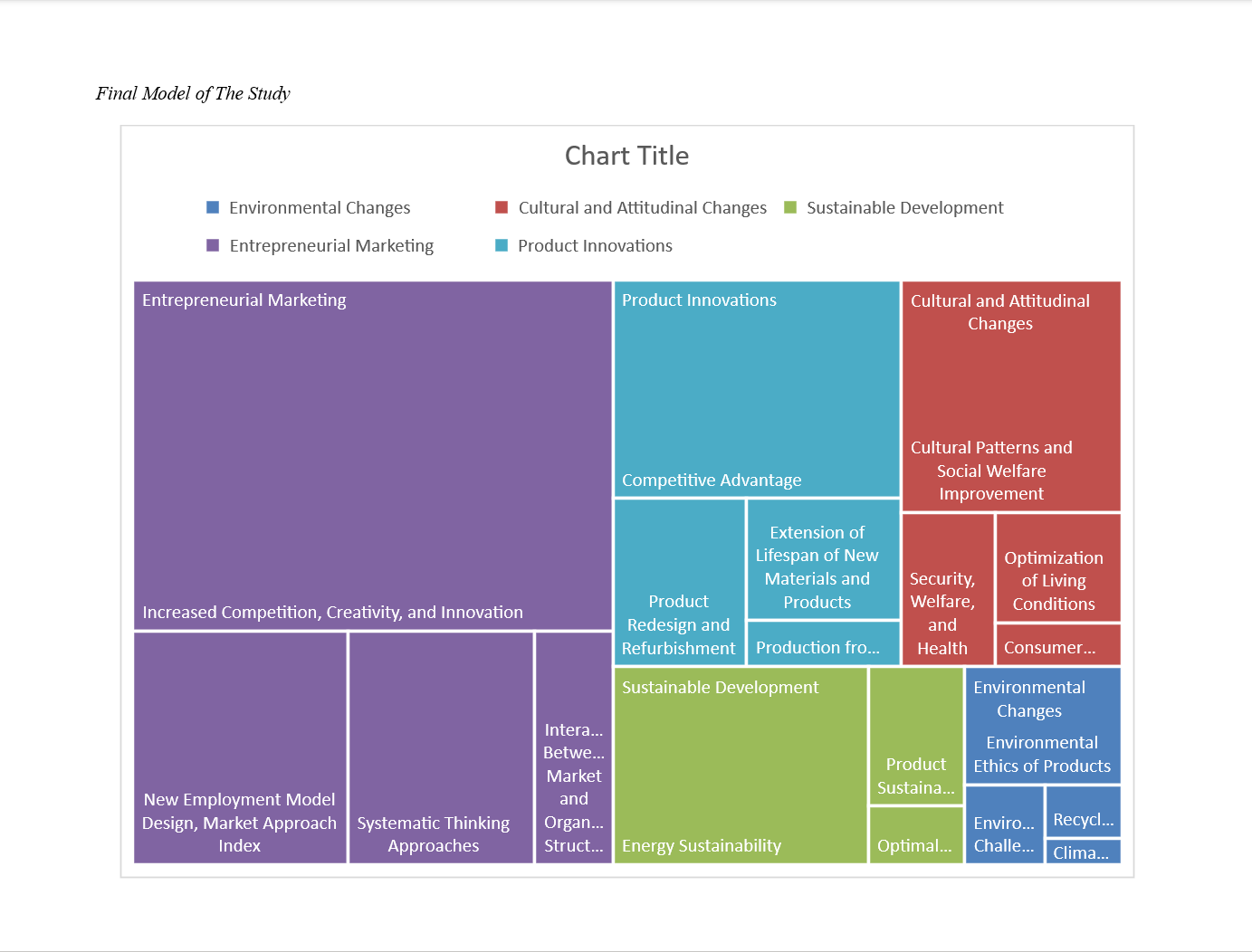
Findings: The results revealed that among the criteria, entrepreneurial marketing (weight = 0.486) and product innovations (weight = 0.193) were identified as the most influential in enhancing organizational performance. Within entrepreneurial marketing, the sub-criterion increased competition, creativity, and innovation (weight = 0.601) was ranked highest. Sustainable development and cultural and attitudinal changes were also found to play significant roles, with energy sustainability (weight = 0.727) and cultural patterns and social welfare improvement (weight = 0.602) being the top-ranked sub-criteria. Environmental changes, though important, ranked lower in comparison.
Conclusion: This study highlights the central role of entrepreneurial marketing and product innovations in organizational success, followed by sustainability efforts and cultural changes. The findings suggest that businesses should prioritize innovation, competition, and sustainability to remain competitive in a rapidly changing global market.
Downloads
References
Abidin, Z. U., Qammar, R., & Gill, F. L. (2023). Circular Economy and Opportunities for Small and Medium Enterprises in Lather Industry of Sialkot Pakistan. Journal of Business and Social Review in Emerging Economies. https://doi.org/10.26710/jbsee.v9i1.2531
Alonso-Almeida, M. D., Rodríguez-Antón, J. M., Bagur-Femenías, L., & Perramon, J. (2020). Sustainable development and circular economy: The role of institutional promotion on circular consumption and market competitiveness from a multistakeholder engagement approach. Journal of Business Strategy and The Environment, 29(6), 2803-2814. https://doi.org/10.1002/bse.2544
Anser, M. K., Zhang, Z., & Kanwal, L. (2018). Moderating Effect of Innovation on Corporate Social Responsibility and Firm Performance in Realm of Sustainable Development. Corporate Social Responsibility and Environmental Management. https://doi.org/10.1002/csr.1495
Appiah, M. K., Odei, S. A., Kumi-Amoah, G., & Yeboah, S. A. (2022). Modeling the impact of green supply chain practices on environmental performance: the mediating role of ecocentricity. African Journal of Economic and Management Studies, 13(4), 551-567. https://doi.org/10.1108/AJEMS-03-2022-0095
Atisa, G. A., & Zemrani, M. W. (2021). Decentralized governments: local empowerment and sustainable development challenges in Africa. Environment, Development and Sustainability, 23(3), 3349-3367. https://doi.org/10.1007/s10668-020-00722-0
Avrampou, A., Skouloudis, A., Iliopoulos, G., & Khan, N. (2019). Advancing the Sustainable Development Goals: Evidence From Leading European Banks. Sustainable Development. https://doi.org/10.1002/sd.1938
Babanyara, Y. Y., Usman, H. A., & Saleh, U. F. (2010). An overview of urban poverty and environmental problems in Nigeria. Journal of Human Ecology, 31(2), 135-143. https://doi.org/10.1080/09709274.2010.11906304
Bressanelli, G., Perona, M., & Saccani, N. (2018). Challenges in supply chain redesign for the Circular Economy: A literature review and a multiple case study. International Journal of Production Research, 57(23), 7395-7422. https://doi.org/10.1080/00207543.2018.1542176
Bui, M. H. (2005). Environmental Marketing: a Model of Consumer Behavior. Proceedings of the Annual Meeting of the Association of Collegiate Marketing Educators,
Chamberlin, L., & Boks, C. (2018). Marketing Approaches for a Circular Economy: Using Design Frameworks to Interpret Online Communications. Sustainability, 10(6). https://doi.org/10.3390/su10062070
Chaudhuri, R., Chatterjee, S., Vrontis, D., & Thrassou, A. (2021). Adoption of Robust Business Analytics for Product Innovation and Organizational Performance: The Mediating Role of Organizational Data-Driven Culture. Annals of Operations Research, 339(3), 1757-1791. https://doi.org/10.1007/s10479-021-04407-3
Cuvero, M., Granados, M. L., & Pilkington, A. (2022). The Effects of Knowledge Spillovers and Accelerator Programs on the Product Innovation of High-Tech Start-Ups: A Multiple Case Study. Ieee Transactions on Engineering Management, 69(4), 1682-1695. https://doi.org/10.1109/tem.2019.2923250
De Oliveira Santini, F., Lugo, D. B., Junior Ladeira, W., Akhtar, S., Rocha, L. d. S., & Sott, M. K. (2024). Corporate social responsibility as a moderator of loyalty antecedents in the Brazilian banking context. International Journal of Bank Marketing, ahead-of-print(ahead-of-print). https://doi.org/10.1108/IJBM-12-2023-0667
Douvis, J., & Kyriakis, V. (2022). Corporate Social Responsibility, Governance, and Sport Marketing: An International Review. In Corporate Social Responsibility and Governance (pp. 224-249). https://doi.org/10.4324/9781003152750-15
Dovgal, O., Borko, T., Miroshkina, N., Surina, H., & Konoplianyk, D. (2024). Circular economy as an imperative for sustainable development. Scientific Bulletin of Mukachevo State University. Series "Economics", 1(11), 19-28. https://doi.org/10.52566/msu-econ1.2024.19
Frey, B. S., & Briviba, A. (2021). Two Types of Cultural Economics: Institutions and Norms. SSRN. https://doi.org/10.2139/ssrn.3814747
Galarza‐María, J., Díaz de Junguitu, A., & Labaien, I. (2024). Social dimension of the circular economy: Impact categories through fuzzy Delphi method. Sustainable Development. https://doi.org/10.1002/sd.2933
Ghaithan, A. M., Alshammakhi, Y., Mohammed, A., & Mazher, K. M. (2023). Integrated Impact of Circular Economy, Industry 4.0, and Lean Manufacturing on Sustainability Performance of Manufacturing Firms. International journal of environmental research and public health, 20(6), 5119. https://doi.org/10.3390/ijerph20065119
Gilmore, A. (2011). Entrepreneurial and SME marketing. Journal of Research in Marketing and Entrepreneurship, 13(2), 137-145. https://doi.org/10.1108/14715201111176426
Hills, G. E., & Hultman, C. M. (2011). Academic roots: The past and present of entrepreneurial marketing. Journal of Small Business & Entrepreneurship, 24(1), 1-10. https://doi.org/10.1080/08276331.2011.10593521
Hosseinpour, A. K., Ghorbanpour, A., & Shahbandarzadeh, H. (2024). Evaluating the efficiency of the circular economy in the Gulf Cooperation Council countries regarding urban solid waste management. Quantitative Economics Journal, 21(1), 87-106.
Jones, R., & Rowley, J. (2011). Entrepreneurial marketing in small businesses: A conceptual exploration. International Small Business Journal, 29(1), 25-36. https://doi.org/10.1177/0266242610369743
Kraus, S., Filser, M., Eggers, F., Hills, G. E., & Hultman, C. M. (2012). The entrepreneurial marketing domain: a citation and co-citation analysis. Journal of Research in Marketing and Entrepreneurship, 14(1), 6-26. https://doi.org/10.1108/14715201211246698
Lei, W. (2024). Global Spillovers of China's Monetary Policy. China & World Economy, 32(3), 1-30. https://doi.org/10.1111/cwe.12530
Liu, Y., Wu, W., & Wang, Y. (2020). The Impacts of Technology Management on Product Innovation: The Role of Technological Capability. IEEE Access, 8, 210722-210732. https://doi.org/10.1109/ACCESS.2020.3038927
Lu, H., Zhao, G., & Liu, S. (2024). Integrating circular economy and Industry 4.0 for sustainable supply chain management: A dynamic capability view. Production Planning & Control, 35(2), 170-186. https://doi.org/10.1080/09537287.2022.2063198
Miles, M., Gilmore, A., Harrigan, P., Lewis, G., & Sethna, Z. (2015). Exploring entrepreneurial marketing. Journal of Strategic Marketing, 23(2), 94-111. https://doi.org/10.1080/0965254X.2014.914069
Miller, J. G. T. (2003). Environmental Science: Working With the Earth. Brooks/Cole. https://books.google.de/books/about/Environmental_Science.html?id=73NkjyHGAZkC&redir_esc=y
Murat Ar, I. (2012). The impact of green product innovation on firm performance and competitive capability: the moderating role of managerial environmental concern. Procedia - Social and Behavioral Sciences, 62, 854-864. https://doi.org/10.1016/j.sbspro.2012.09.144
Owolabi, O. S. (2024). Integration of Decentralized Finance (DeFi) in the U.S. Supply Chain Finance: Opportunities, Challenges, and Future Prospects. International Journal of Computer Science and Information Technology, 16(3), 121-141. https://doi.org/10.5121/ijcsit.2024.16310
Sahoo, S., & Jakhar, S. K. (2024). Industry 4.0 deployment for circular economy performance-Understanding the role of green procurement and remanufacturing activities. Business Strategy and the Environment, 33(2), 1144-1160. https://doi.org/10.1002/bse.3542
Santos, V. d., Beuren, I. M., Bernd, D. C., & Fey, N. (2022). Use of Management Controls and Product Innovation in Startups: Intervention of Knowledge Sharing and Technological Turbulence. Journal of Knowledge Management. https://doi.org/10.1108/jkm-08-2021-0629
Singh, R., Khan, S., & Dsilva, J. (2022). A framework for assessment of critical factor for circular economy practice implementation. Journal of Modelling in Management. https://doi.org/10.1108/JM2-06-2021-0145
Soltani Nejad, M., & Vosoughi, L. (2015). An Examination of Entrepreneurship Capacities in Kerman Province Tourism. National Conference on Tourism Culture and Urban Identity,
Whalen, P. S., & Akaka, M. A. (2015). A dynamic market conceptualization for entrepreneurial marketing: the co-creation of opportunities. Journal of Strategic Marketing, 24(1), 61-75. https://doi.org/10.1080/0965254X.2015.1035040
Yu, H., Zahidi, I., Fai, C. M., Liang, D., & Madsen, D. Ø. (2024). Mineral waste recycling, sustainable chemical engineering, and circular economy. Results in Engineering, 21, 101865. https://doi.org/10.1016/j.rineng.2024.101865
Downloads
Additional Files
Publication Timeline
- Submitted
- Revised
- Accepted
Issue
Section
License
Copyright (c) 2025 Seyed Mojtaba Mousavizadeh (Author); Shahnaz Nayebzadeh (Corresponding Author); Seyed Hassan Hataminasab, Zohreh Tabatabaie Nasab (Author)

This work is licensed under a Creative Commons Attribution-NonCommercial 4.0 International License.