Determining the Impact of System Alignment and Agile Methods on Agile Management
DOI:
https://doi.org/10.61838/kman.ijimob.5.3.9Keywords:
System Alignment , Agile Methods, Agile Management, Organizational Agility, Strategic Alignment, Fidar Steel Company, Organizational AdaptabilityAbstract
Objective: The objective of this study is to examine the impact of system alignment and agile methods on agile management within the organizational context of Fidar Steel Company.
Methodology: The study employed a descriptive-survey research design, collecting data from all 41 managers and employees of Fidar Steel Company using a standardized Organizational Agility questionnaire developed by Zhang and Sharifi (2000). The questionnaire included subscales for system alignment and agile methods, with responses measured on a five-point Likert scale. Data analysis was conducted using multiple regression analysis with SmartPLS software to test the relationships between the variables and assess the research model’s fit.
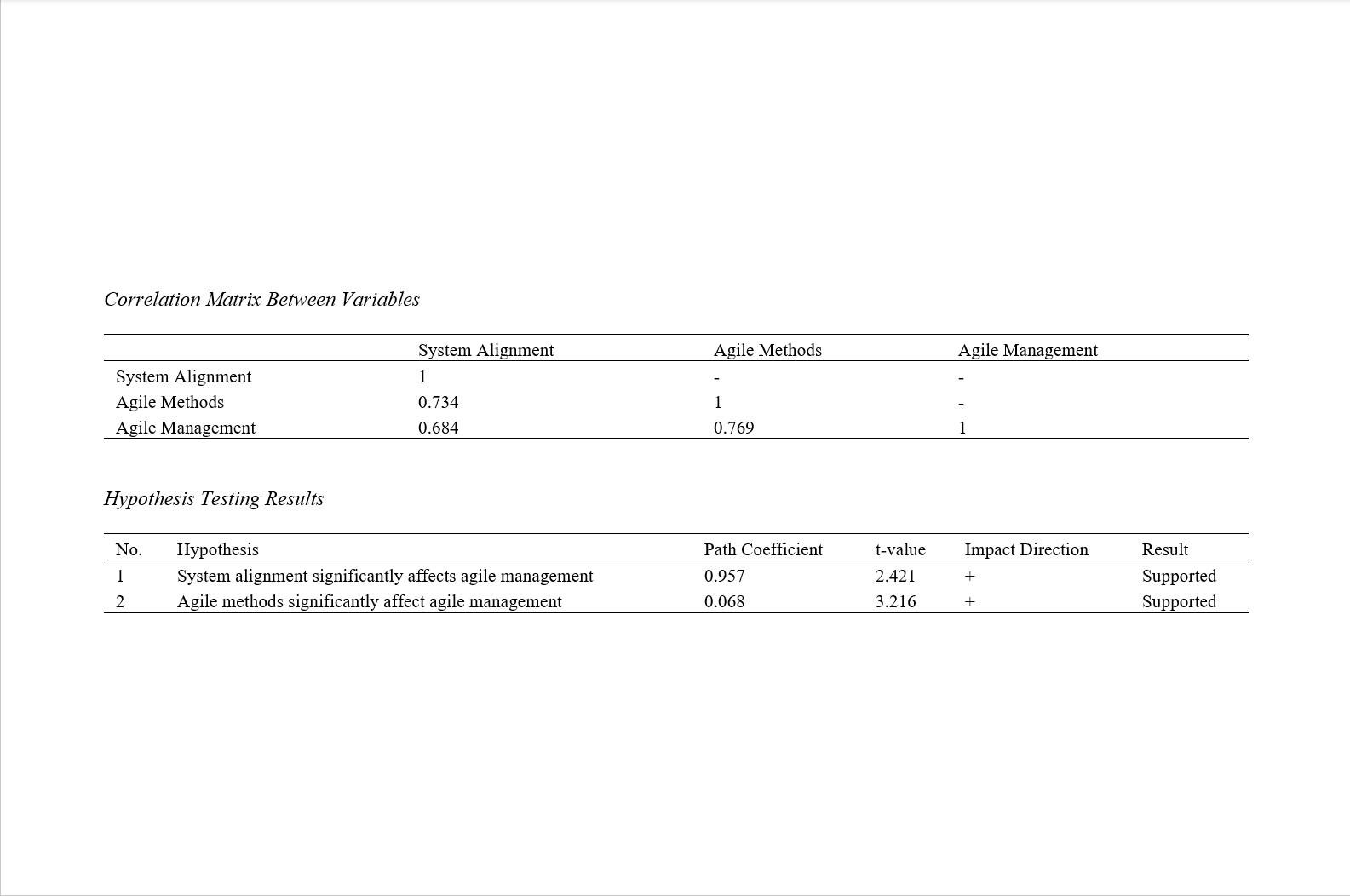
Findings: The results indicated that both system alignment and agile methods have significant positive effects on agile management. System alignment exhibited a strong path coefficient, suggesting that well-aligned organizational systems facilitate agile management. Similarly, agile methods showed a significant positive impact, demonstrating that adopting adaptive and iterative practices enhances organizational responsiveness. The model fit indices confirmed the robustness of the research model, and correlation analysis revealed strong interrelationships among the variables. These findings align with previous studies highlighting the importance of strategic alignment and agile practices in promoting organizational agility.
Conclusion: The study concludes that system alignment and agile methods are critical drivers of agile management, enabling organizations to remain adaptable and competitive. Organizations should focus on strategically aligning their systems and integrating agile practices to foster an environment that supports rapid response to change. These insights contribute to the broader understanding of organizational agility and offer practical recommendations for enhancing agile management.
Downloads
References
Abbasi, H., & Fattahian, N. (2018). The Impact of Strategic Learning on Organizational Performance with the Mediating Role of Strategic Agility (Case Study: Sports and Youth Departments of Hamadan and Kermanshah Provinces). Contemporary Research Journal in Sports Management(15), 29-43. https://smms.basu.ac.ir/article_2442.html
Aghaei Ghaleche, S. (2023). Maintenance of Employees and Its Impact on Organizational Performance with the Moderation of Sustainable Competitive Advantage. Dynamic Management and Business Analysis, 1(1), 45-58. https://doi.org/10.22034/dmbaj.2024.2022641.1012
Ahang, F., Ghafari, H., Mehdi, M., & Mohammadpour, S. (2020). Investigating the drivers of human resource agility development in military organizations. Defensive Future Studies, 5(18), 63-86. https://doi.org/10.22034/dfsr.2021.521717.1459
Aldiabat, B. (2022). The Mediating Role of Strategic Intelligence in the Relationship Between Organizational Agility and Organizational Excellence in Jordanian Telecommunications Companies. Problems and Perspectives in Management, 20(4), 496-506. https://doi.org/10.21511/ppm.20(4).2022.37
Amiri, M., Amirnezhad, G., & Makvandi, F. (2021). Explain the effective factors of human resource management agility with structural equation modeling approach (A case study: ministry of petroleum). iieshrm, 13(49), 91-111. http://iieshrm.ir/article-1-1233-en.html
Atkinson, P. M., Hizaji, M., Nazarian, A., & Abasi, A. (2020). Attaining Organisational Agility Through Competitive Intelligence: The Roles of Strategic Flexibility and Organisational Innovation. Total Quality Management & Business Excellence, 33(3-4), 297-317. https://doi.org/10.1080/14783363.2020.1842188
Boudelayi, H., Kenarrudi, M. H., Ebadi, H., & Bahmani, A. (2021). Digital human resource management: An approach to creating organizational agility in the public sector in the era of the digital economy (Case study: National banks of Iran). Public Administration, 13(4), 766-785. https://jipa.ut.ac.ir/article_86531.html
Chandra, Y. (2021). Social Capital as a Tool for Managing Human Resources in Agile Entrepreneurial Organisations. In Managing Human Resources in SMEs and Start-ups (Vol. Volume 5, pp. 207-222). WORLD SCIENTIFIC. https://doi.org/10.1142/9789811239212_0010
Elgamel, M. (2018). Dynamic organizational capabilities: the joint effect of agility, resilience and empowerment. Journal of Human Resource Management, 6(2), 44-49. https://doi.org/10.11648/j.jhrm.20180602.11
Ganji Bidmeshk, O., & Hosseini Seno, S. A. (2016). Proposing and Testing the Model of Aligning the Marketing Information Security Policy with Strategic Information Systems Plan (Case Study: Ferdowsi University of Mashhad). New Marketing Research Journal, 5(4), 73-98. https://nmrj.ui.ac.ir/article_17825.html
Gonçalves, D., Bergquist, M., Bunk, R., & Alänge, S. (2020). Cultural Aspects of Organizational Agility Affecting Digital Innovation. Journal of Entrepreneurship Management and Innovation, 16(4), 13-46. https://doi.org/10.7341/20201641
Khan, A., Talukder, M. S., Islam, Q. T., & Islam, A. K. M. N. (2022). The impact of business analytics capabilities on innovation, information quality, agility and firm performance: the moderating role of industry dynamism. VINE Journal of Information and Knowledge Management Systems, ahead-of-print(ahead-of-print). https://doi.org/10.1108/VJIKMS-01-2022-0027
Malmir, A., & Norouzzadeh, A. (2021). The mediating role of organizational agility in relation to knowledge management and organizational development. Journal of Police Organizational Development, 18(1), 101-120. https://www.magiran.com/paper/2327060
Mesri, M., Ghafarzadeh, M., & Panahi, B. (2021). Investigating the Effect of Human Resource Leadership Agility on Reducing the Phenomenon of Invisible Employees through Knowledge Sharing. Journal of Development of Logistics and Human Resoure Management, 16(59), 22-45. https://www.magiran.com/paper/2273279
Norouzi Ali, A. (2021). Examining the Role of Organizational Learning and Knowledge Management on Organizational Agility (Case Study: Social Security Organization of Shahroud). Accounting and Management Perspectives, 4(42), 9-21. https://www.jamv.ir/article_131250.html
Piran, F., Shahraki, A., & Banihashemi, S. A. (2022). The Effect of Social Capital and Collective Knowledge on Business Intelligence and Organizational Agility: The Case Study of Melli Bank Branches of Zahedan City. Social Capital Management, 9(3), 359-380. https://doi.org/10.22059/jscm.2022.344497.2305
Rashidi, H., Tosizadeh, s., & Jokar, a. (2021). Identifying the factors that create agility in Sepah Bank in Khuzestan province with a mixed approach. Journal of Advertising and Sales Management, 2(2), 54-69. https://doi.org/10.52547/jabm.2.2.54
Ribeiro, V. (2024). Procurement Outsourcing Strategies and Organizational Agility: A Comparative Analysis of Pharmaceutical Companies in Brazil. Global Journal of Purchasing and Procurement Management, 3(1), 28-41. https://doi.org/10.47604/gjppm.2468
Rowzan, S. M. (2018). Designing a Hybrid System Dynamic Model for Analyzing the Impact of Strategic Alignment on Project Portfolio Selection. Simulation Modelling Practice and Theory. https://www.sciencedirect.com/science/article/pii/S1569190X18301473
Rožman, M., Tominc, P., & Štrukelj, T. (2023). Competitiveness Through Development of Strategic Talent Management and Agile Management Ecosystems. Global Journal of Flexible Systems Management, 24(3), 373-393. https://doi.org/10.1007/s40171-023-00344-1
Sadeghimoghaddam, A., Ashraf Ganjouei, F., & Tojari, F. (2021). The Correlation Model of E-Government and Organizational Agility with the Mediating Role of Social Responsibility in the staff of the Ministry of Sports and Youth [Research]. Journal of Health Promotion Management, 10(1), 91-102. http://jhpm.ir/article-1-1264-en.html
Shabani Bahar, G., Maghsoudi, H. R., Godarzi, M., & Honari, H. (2018). Development of structural equation models of Strategical Thinking and Organizational Agility in Selected Iranian Sports Federations. Sport Management and Development, 7(1), 52-65. https://doi.org/10.22124/jsmd.2018.2970
Shokri, M., Shabani Bahar, G., & Soleimani, M. (2020). The Effect of Organizational Architecture on Performance Management with the Mediating Role of Organizational Agility in Physical Education Departments of Medical Sciences Universities. Ergonomics, 8(2), 72-82. https://doi.org/10.30699/jergon.8.2.72
Zastempowski, M., & Cyfert, S. (2023). A New Angle on SMEs' Competitiveness. How Do Agility Capabilities Affect a Firm's Competitive Position? Journal of Organizational Change Management, 36(4), 635-662. https://doi.org/10.1108/jocm-09-2022-0255
Downloads
Additional Files
Publication Timeline
- Submitted
- Revised
- Accepted
Issue
Section
License
Copyright (c) 2025 Mohammad Moarefi (Corresponding Author); Gelareh Mortezaei (Author)

This work is licensed under a Creative Commons Attribution-NonCommercial 4.0 International License.