Design and Validation of an Innovative University Model in Iraq Universities
DOI:
https://doi.org/10.61838/kman.ijimob.5.3.8Keywords:
Validation, Innovative University, Model, Iraq UniversitiesAbstract
Objective: The present study was conducted to design and validate an innovative university model in Iraq universities.
Methodology: This research adopts an exploratory sequential mixed-method approach (quantitative and qualitative). The study population in the qualitative phase included key experts, faculty members, and university administrators, while in the quantitative phase, it comprised all faculty members and administrators of Iraq universities. The qualitative sample included 10 participants selected through purposive sampling until theoretical saturation was achieved, while in the quantitative phase, 385 participants were randomly selected. Data were collected through semi-structured interviews and analyzed using content analysis with coding, resulting in a model designed with 5 dimensions and 79 items.
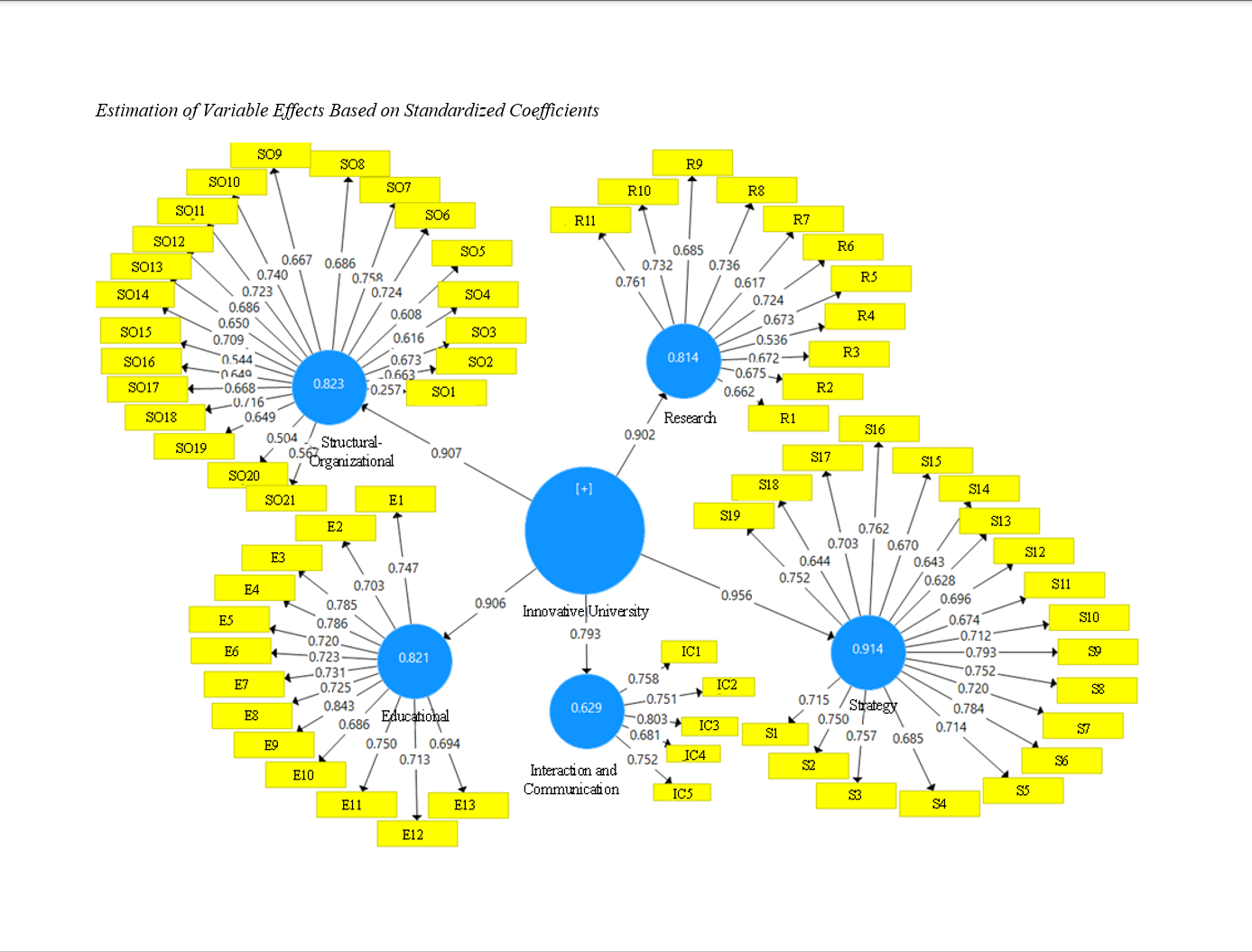
Findings: For model validation, a questionnaire was initially designed, and after assessing face and content validity, 10 questions were removed, leaving 69 questions. The results indicated that all questions had a factor loading above 0.4, convergent validity above 0.5, reliability for both criteria (Cronbach’s alpha, composite reliability) for all dimensions above 0.8, and acceptable discriminant validity. Ultimately, the model fit index exceeded 0.36, suggesting strong validity, reliability, and model fit.
Conclusion: Policymakers and planners can utilize the findings of this research as a guide to strengthen and develop universities, transforming them into innovative universities.
Downloads
References
Abdoli, L., Moradi, H., Pardakhtchi, M. H., & Ahmadi, G. (2024). A Model of University Innovation and the Interactions of Its Communication Components (Case Study: Islamic Azad Universities in Tehran). Scientific-Research Bimonthly on New Approaches in Educational Management. https://jedu.marvdasht.iau.ir/m/article_6349.html?lang=en
Abdulkarem, H. A., & Hasan, A. M. (2024). Investing in Education and Scientific Research for Growth of Iraq: Exploring the Main Dimensions, Success Factors, and Government Policies. journal of Economics And Administrative Sciences, 30(141), 406-421. https://doi.org/10.33095/q0kdja17
Ahmadzadeh, S., & Shokouh, Z. (2020). The Role of Social Capital in Achieving Organizational Innovation and Organizational Citizenship Behavior with the Mediating Role of Sustainable Human Resource Management. Innovation Management in Defense Organizations, 3(3), 151-178. https://www.qjimdo.ir/article_119851.html?lang=en
Alipour, A. (2022). The Value-Innovative University: Moving Towards the Generation of Soft Technologies. Scientific Quarterly of Islamic Iranian Progress Model Studies, 10(2). https://www.ipoba.ir/article_152042.html?lang=en
Alwali, J. (2024). Innovative work behavior and psychological empowerment: the importance of inclusive leadership on faculty members in Iraqi higher education institutions. Journal of Organizational Change Management, 37(2), 374-390. https://doi.org/10.1108/JOCM-03-2023-0084
Barzegar, Q. a., Nadergholi, & Taqipour, Z. (2020). Presenting a Model for Creating Innovation Capacities in Academic Management in Iran. Management and Planning in Educational Systems, 14(1), 43-70. https://doi.org/10.52547/MPES.14.1.43
Berestova, T. (2009). From innovative projects to an innovative university. Scientific and Technical Information Processing, 36(3), 180-185. https://doi.org/10.3103/S0147688209030095
Budur, T., Demirer, H., & Rashid, C. A. (2024). The effects of knowledge sharing on innovative behaviours of academicians; mediating effect of innovative organization culture and quality of work life. Journal of Applied Research in Higher Education, 16(2), 405-426. https://doi.org/10.1108/JARHE-08-2022-0257
Gholipour, A., Roya, Ghorbani, & Hafezian. (2024). Designing an Innovative University Model Using a Qualitative Approach (Case Study: Islamic Azad Universities of North Khorasan). Innovation and Creativity in Humanities, 49(13), 35-69. https://journals.iau.ir/article_690642.html
Goyal, A., & Akhilesh, K. B. (2007). Interplay among innovativeness, cognitive intelligence, emotional intelligence and social capital of work teams. Team Performance Management, 13(7/8), 206-226. https://doi.org/10.1108/13527590710842538
Jafarzadeh Ghadimi, R., Enayati, T., & Salehi, M. (2018). Identifying Dimensions of an Innovative University to Provide a Model (Case Study: Islamic Azad University). Iranian Journal of Sociology of Education, 1(8), 115-135. https://iase-idje.ir/article-1-187-en.html
Javanmardi, S., & Abbaspour, A. (2022). Identifying Factors Related to an Innovative University. New Educational Ideas, 18(2), 107-135. https://jontoe.alzahra.ac.ir/article_5675.html
Javanmardi, S., Abbaspour, A., Khorsandi, T., & Ghayasi, N. (2017). Designing an Innovative University Model within the Framework of the Innovation Ecosystem in Iran. Iranian Higher Education Journal, 10(4), 137-170. https://ihej.ir/browse.php?a_id=1186&sid=1&slc_lang=en
Javanmardi, S., Mousavi, T., & Iranpour Mobarakeh, R. (2018). Innovation and the University: Reflections on the Formation and Development of an Innovative University. Industry and University Journal(39-40). http://jiu.ir/Article/212/FullText
Kazemi, A., & Shakiba, A. (2014). Examining Factors Influencing Innovation, Creativity, and Entrepreneurship (Case Study: HEPCO Company). https://sanad.iau.ir/Journal/jomm/Article/811373
Khrifech, L., & Al-Ani, A. K. (2024). The Possibility of Establishing an Iraqi University Business Incubator and Its Expected Impact on Entrepreneurship: An Analytical Study in a Sample of Iraqi Universities. Asian Journal of Economics, Business and Accounting, 24(6), 356-370. https://doi.org/10.9734/ajeba/2024/v24i61367
Mahdi, R., & Keikha, A. (2023). The Status of Innovation in Governance and Leadership in Tier-One Universities in Iran. Scientific-Research Quarterly of Cultural Strategy. https://www.jsfc.ir/article_183806.html?lang=en
Mahdi, R., & Shafiee, M. (2018). The Role and Capacity Building of Fourth Generation Universities for Local and Regional Development. Industry and University Journal(90), 8-33. http://jiu.ir/fa/Article/193
Mahdi, R., & Shafiee, M. (2020). A Model and Guideline Framework for an Innovative and Value-Creating University. Innovation and Value Creation, 9(17), 1-15. https://www.sid.ir/paper/398094/en
Mahdi, R., & Shafiee, M. (2023). Amirkabir University of Technology as an Innovative and Value-Creating University: Achievements and Challenges. https://civilica.com/doc/1863890
Morawska-Jancelewicz, J. (2022). The role of universities in social innovation within quadruple/quintuple helix model: Practical implications from polish experience. Journal of the Knowledge Economy, 13(3), 2230-2271. https://doi.org/10.1007/s13132-021-00804-y
Pourebrahimi, M., Hosseini, M. A., Ebrahimi Barmi, B., Eghbali, M., & Bandari, R. (2021). Explaining the Challenges of Operationalizing a Technological and Innovative University in the Country's Higher Education System. Strategies for Education in Medical Sciences, 64(13), 682-689. https://www.sid.ir/paper/414717/en
Swanger, D. (2016). Innovation in Higher Education: Can Colleges Really Change? https://www.fmcc.edu
Thomas, E., Pugh, R., Soetanto, D., & Jack, S. L. (2023). Beyond ambidexterity: Universities and their changing roles in driving regional development in challenging times. The Journal of Technology Transfer, 48(6), 2054-2073. https://doi.org/10.1007/s10961-022-09992-4
Tierney, W. G., & Lanford, M. (2016). Conceptualizing innovation in higher education. In Higher Education: Handbook of Theory and Research (pp. 1-40). https://doi.org/10.1007/978-3-319-26829-3_1
Turki, A. (2024). The impact of work pressures on job performance within the modified role of innovative e capabilities: Applied study in Iraqi universities. International Journal of Professional Business Review, 9(3), 4. https://doi.org/10.26668/businessreview/2024.v9i3.4308
Downloads
Additional Files
Publication Timeline
- Submitted
- Revised
- Accepted
Issue
Section
License
Copyright (c) 2025 Ayad Razzaq Kadhim Alafari (Author); Maryam Taghvaee Yazdi (Corresponding Author); Muna Mohammed Abbas Alkhateeb, Kobra Emami (Author)

This work is licensed under a Creative Commons Attribution-NonCommercial 4.0 International License.