Conceptualizing Ambidextrous Leadership in Educational and Higher Education Organizations: A Qualitative Approach Based on Study Synthesis
DOI:
https://doi.org/10.61838/kman.ijimob.5.3.6Keywords:
Ambidextrous Leadership, Higher Education, Innovation, Regional Development, University Management, Systematic ReviewAbstract
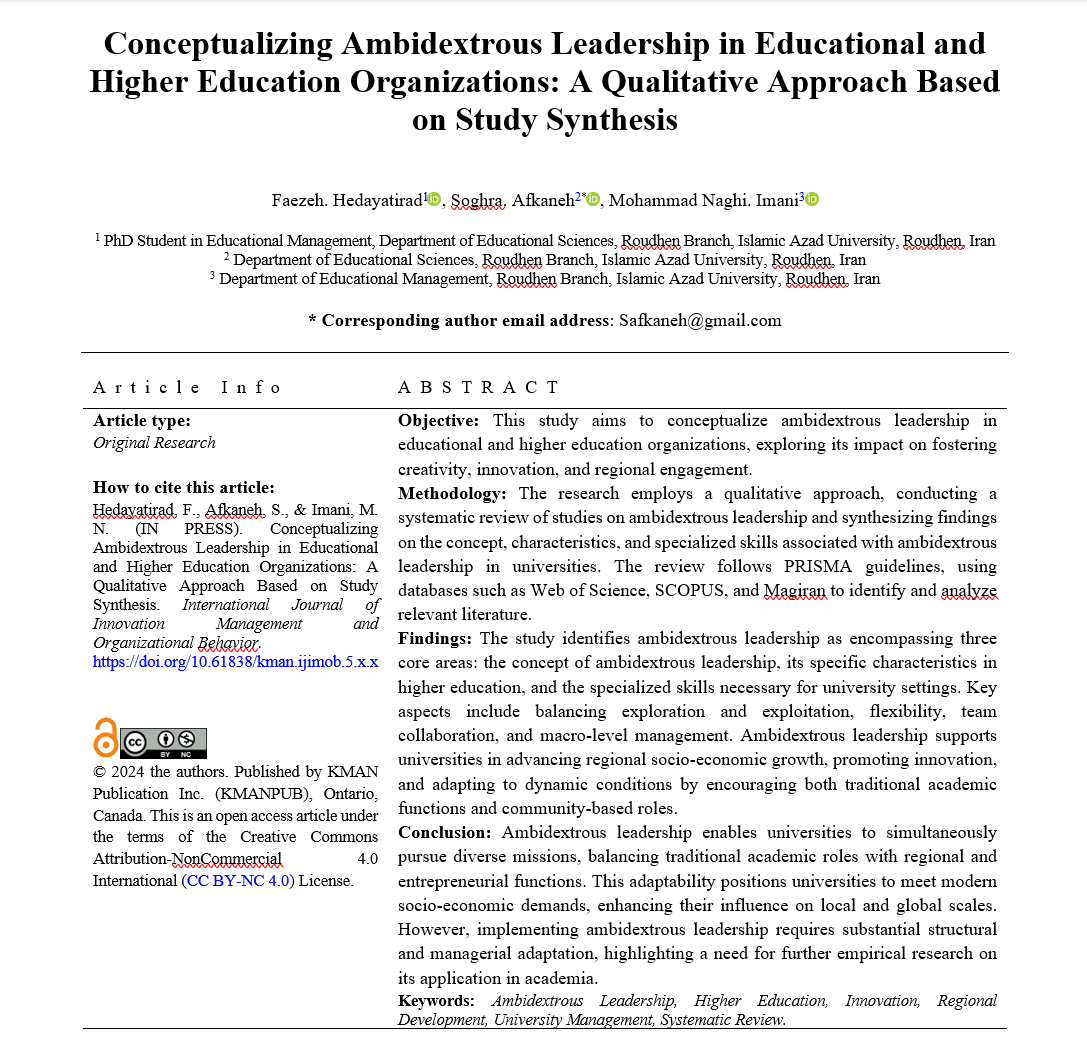
Objective: This study aims to conceptualize ambidextrous leadership in educational and higher education organizations, exploring its impact on fostering creativity, innovation, and regional engagement.
Methodology: The research employs a qualitative approach, conducting a systematic review of studies on ambidextrous leadership and synthesizing findings on the concept, characteristics, and specialized skills associated with ambidextrous leadership in universities. The review follows PRISMA guidelines, using databases such as Web of Science, SCOPUS, and Magiran to identify and analyze relevant literature.
Findings: The study identifies ambidextrous leadership as encompassing three core areas: the concept of ambidextrous leadership, its specific characteristics in higher education, and the specialized skills necessary for university settings. Key aspects include balancing exploration and exploitation, flexibility, team collaboration, and macro-level management. Ambidextrous leadership supports universities in advancing regional socio-economic growth, promoting innovation, and adapting to dynamic conditions by encouraging both traditional academic functions and community-based roles.
Conclusion: Ambidextrous leadership enables universities to simultaneously pursue diverse missions, balancing traditional academic roles with regional and entrepreneurial functions. This adaptability positions universities to meet modern socio-economic demands, enhancing their influence on local and global scales. However, implementing ambidextrous leadership requires substantial structural and managerial adaptation, highlighting a need for further empirical research on its application in academia.
Downloads
References
Akıncı, G., Alpkan, L., Yıldız, B., & Karacay, G. (2022). The link between ambidextrous leadership and innovative work behavior in a military organization: The moderating role of climate for innovation. Sustainability, 14(22), 15315. https://doi.org/10.3390/su142215315
Al-Shami, S. A., Rafeea, S. J., Kamalrudin, M., Widiastuti, T., & Al Mamun, A. (2023). The mediating role of absorptive capacity in the relationship between transformational leadership and corporate entrepreneurship. Cogent Business & Management, 10(2), 2226933. https://doi.org/10.1080/23311975.2023.2226933
Amiri, A. M., Kushwaha, B. P., & Singh, R. (2023). Visualisation of global research trends and future research directions of digital marketing in small and medium enterprises using bibliometric analysis. Journal of Small Business and Enterprise Development, 30(3), 621-641. https://doi.org/10.1108/JSBED-04-2022-0206
Aria, M., & Cuccurullo, C. (2017). bibliometrix: An R-tool for comprehensive science mapping analysis. Journal of Informetrics, 11(4), 959-975. https://doi.org/10.1016/j.joi.2017.08.007
Asif, M. (2020). Strategic leadership and ambidextrous learning: Exploring the role of dynamic capabilities and intellectual capital. International Journal of Quality and Service Sciences, 12(1), 1-14. https://doi.org/10.1108/IJQSS-03-2019-0034
Babu, D., & Kushwaha, B. P. (2024). Does Transformational Leadership Influence Employees' Innovativeness and Mediate the Role of Organisational Culture? Empirical Evidence. International Research Journal of Multidisciplinary Scope, 5(1), 428-440. https://doi.org/10.47857/irjms.2024.v05i01.0244
Babu, M. D., Prasad, K. B., & Prasad, U. T. (2024). Impact of Ambidextrous Leadership on Innovative Work Behaviour and Employee Performance in the IT Sector. Heliyon. https://www.sciencedirect.com/science/article/pii/S2405844024091552
Cabeza-Pullés, D., Fernández-Pérez, V., & Roldán-Bravo, M. I. (2020). Internal networking and innovation ambidexterity: The mediating role of knowledge management processes in university research. European Management Journal, 38(3), 450-461. https://doi.org/10.1016/j.emj.2019.12.008
Duwe, J. (2021). Ambidextrous leadership: How leaders unlock innovation through ambidexterity. Springer Nature. https://doi.org/10.1007/978-3-662-64032-6
Elsamani, Y., & Kajikawa, Y. (2023). Teleworking Employees' Well-being and Innovativeness: A Bibliometric Analysis of Teleworking Literature. 2023 Portland International Conference on Management of Engineering and Technology (PICMET),
Farzana, S., & Charoensukmongkol, P. (2023). Using approach-inhibition theory of power to explain how participative decision-making enhances innovative work behavior of high power distance-oriented employees. Journal of Organizational Effectiveness: People and Performance, 10(4), 565-581. https://doi.org/10.1108/JOEPP-10-2022-0304
Gerlach, F., Hundeling, M., & Rosing, K. (2020). Ambidextrous leadership and innovation performance: a longitudinal study. Leadership & Organization Development Journal, 41(3), 383-398. https://doi.org/10.1108/LODJ-07-2019-0321
Ghore Jili, S., & Afandidah, N. (2021). Confirmatory Factor Analysis of Ambidextrous Leadership of University Managers in Higher Education. Journal of Marine Science Education, 8(4). https://www.magiran.com/paper/2393488/confirmatory-factor-analysis-of-ambidexterity-leadership-of-university-administrators-in-higher-education?lang=en
Ghore Jili, S., Rahmati, M. H., & Pourkarimi, J. (2019). Identifying and Determining the Factors Influencing Ambidextrous Leadership in Universities: A Meta-Synthesis Study. Journal of Marine Science Education, 6(1), 123-138. https://www.magiran.com/paper/1984915/dual-power-leadership-components-a-meta-synthesis-study?lang=en
Ghore Jili, S., Rahmati, M. H., & Pourkarimi, J. (2020). Providing an Ambidextrous Leadership Model for Universities Based on a Grounded Theory Approach (Case Study: Public Universities of Tehran). Public Organizations Management, 8(2 (Issue 30)), 143-168. https://ipom.journals.pnu.ac.ir/article_6792.html?lang=en
Jia, R., Hu, W., & Li, S. (2022). Ambidextrous leadership and organizational innovation: The importance of knowledge search and strategic flexibility. Journal of Knowledge Management, 26(3), 781-801. https://doi.org/10.1108/JKM-07-2020-0544
Jiang, Y., Asante, D., Zhang, J., & Ampaw, E. M. (2023). The influence of ambidextrous leadership on the employee innovative behavior: an empirical study based on Chinese manufacturing enterprises. Current Psychology, 42(11), 9452-9465. https://doi.org/10.1007/s12144-021-02233-1
Kafetzopoulos, D. (2022). Ambidextrous leadership: a narrative literature review for theory development and directions for future research. Baltic Journal of Management, 17(2), 206-232. https://doi.org/10.1108/BJM-01-2021-0001
Kafetzopoulos, D. (2023). Talent development: a driver for strategic flexibility, innovativeness and financial performance. Euromed Journal of Business, 18(2), 296-312. https://doi.org/10.1108/EMJB-02-2022-0042
Karimi, S., Ahmadi Malek, F., Yaghoubi Farani, A., & Liobikienė, G. (2023). The role of transformational leadership in developing innovative work behaviors: The mediating role of employees' psychological capital. Sustainability, 15(2), 1267. https://doi.org/10.3390/su15021267
Kasavin, I. T. (2021). The Humboldt-University and its Rivals Under the Market Science Condition. Voprosy Filosofii(3), 41-46. https://doi.org/10.21146/0042-8744-2021-3-41-46
Kebede, A. G., Terefe, S. D., & Ijigu, A. W. (2024). Ambidextrous leadership and academic staff innovative behavior at Debre Berhan University, Ethiopia: the mediating role of workplace happiness. Cogent Business & Management, 11(1), 2307564. https://doi.org/10.1080/23311975.2024.2307564
Klonek, F. E., Gerpott, F. H., & Parker, S. K. (2023). A conceptual replication of ambidextrous leadership theory: An experimental approach. The Leadership Quarterly, 34(4), 101473. https://doi.org/10.1016/j.leaqua.2020.101473
Kushwaha, B. P. (2021). Paradigm shift in traditional lifestyle to digital lifestyle in Gen Z: a conception of consumer behaviour in the virtual business world. International Journal of Web Based Communities, 17(4), 305-320. https://doi.org/10.1504/IJWBC.2021.119472
Kushwaha, B. P., Kaur, G., Singh, N., & Sharma, A. (2022). Integrating employees, customers and technology to build an effective sustainable marketing strategy. International Journal of Sustainable Society, 14(4), 310-322. https://doi.org/10.1504/IJSSOC.2022.10052817
Mohiya, M., & Sulphey, M. M. (2021). Do Saudi Arabian leaders exhibit ambidextrous leadership: A qualitative examination. Sage Open, 11(4), 21582440211054496. https://doi.org/10.1177/21582440211054496
Mohtaram, M., & Pakbaz, Z. (2023). Designing a Competency Model for Ambidextrous Leadership in Social Systems. Journal of Management and educational perspective, 5(3), 25-48. https://www.jmep.ir/article_172294.html?lang=en
Omrani, M., Karimi, A., ZandHessami, H., & Seyed Naqdi, M. (2022). Training Ambidextrous Leadership in Knowledge-Based Startups with a Meta-Combination Approach. Jundishapur Journal of Educational Development, 13(1), 220-233. https://edj.ajums.ac.ir/article_153464.html?lang=en
Sliż, P., & Dobrowolska, E. (2023). The ambidextrous university concept: balancing exploitation and exploration in higher education. Zeszyty Naukowe Politechniki Śląskiej. Organizacja i Zarządzanie(177). https://doi.org/10.29119/1641-3466.2023.177.34
Tan, D., Wu, Y., Lv, J., Li, J., Ou, X., Meng, Y., & Zhang, Z. (2023). Performance optimization of a diesel engine fueled with hydrogen/biodiesel with water addition based on the response surface methodology. Energy, 263, 125869. https://doi.org/10.1016/j.energy.2023.129168
Thomas, E., Pugh, R., Soetanto, D., & Jack, S. L. (2023). Beyond ambidexterity: Universities and their changing roles in driving regional development in challenging times. The Journal of Technology Transfer, 48(6), 2054-2073. https://doi.org/10.1007/s10961-022-09992-4
Tranfield, D., Denyer, D., & Smart, P. (2003). Towards a methodology for developing evidence‐informed management knowledge by means of systematic review. British Journal of Management, 14(3), 207-222. https://doi.org/10.1111/1467-8551.00375
Zabiegalski, E., & Marquardt, M. J. (2022). Action learning and the ambidextrous organization. Journal of Work-Applied Management, 14(2), 170-183. https://doi.org/10.1108/JWAM-11-2021-0062
Downloads
Additional Files
Publication Timeline
- Submitted
- Revised
- Accepted
Issue
Section
License
Copyright (c) 2025 Faezeh Hedayatirad (Author); Soghra Afkaneh (Corresponding Author); Mohammad Naghi Imani (Author)

This work is licensed under a Creative Commons Attribution-NonCommercial 4.0 International License.