Mediating role of intrinsic motivation in relationship between perception of organizational justice and extra-role behaviors among Wasit University faculty members
DOI:
https://doi.org/10.61838/kman.ijimob.5.5.2Keywords:
extra-role behaviors, intrinsic motivation, organizational justice, faculty members, IraqAbstract
Objective: This study aims to analyze the mediating role of intrinsic job motivation in relationship between perception of organizational justice and extra-role behaviors of faculty members of Wasit University in Iraq.
Methodology: Research method was Correlation and statistical population included all faculty members of Wasit University in the spring and summer of 1403 (summer of 2024). 250 people were selected from mentioned statistical population through convenience sampling method, and answered to three questionnaires of extra-role behaviors (Lee and Allen, 2002), perception of organizational justice (Colquitt, 2001), and internal job motivation (Gagne et al. 2015). Research data were analyzed using Pearson's correlation coefficient and Structural Equation Modeling (SEM) by using SPSS version 26 and AMOS version 25.
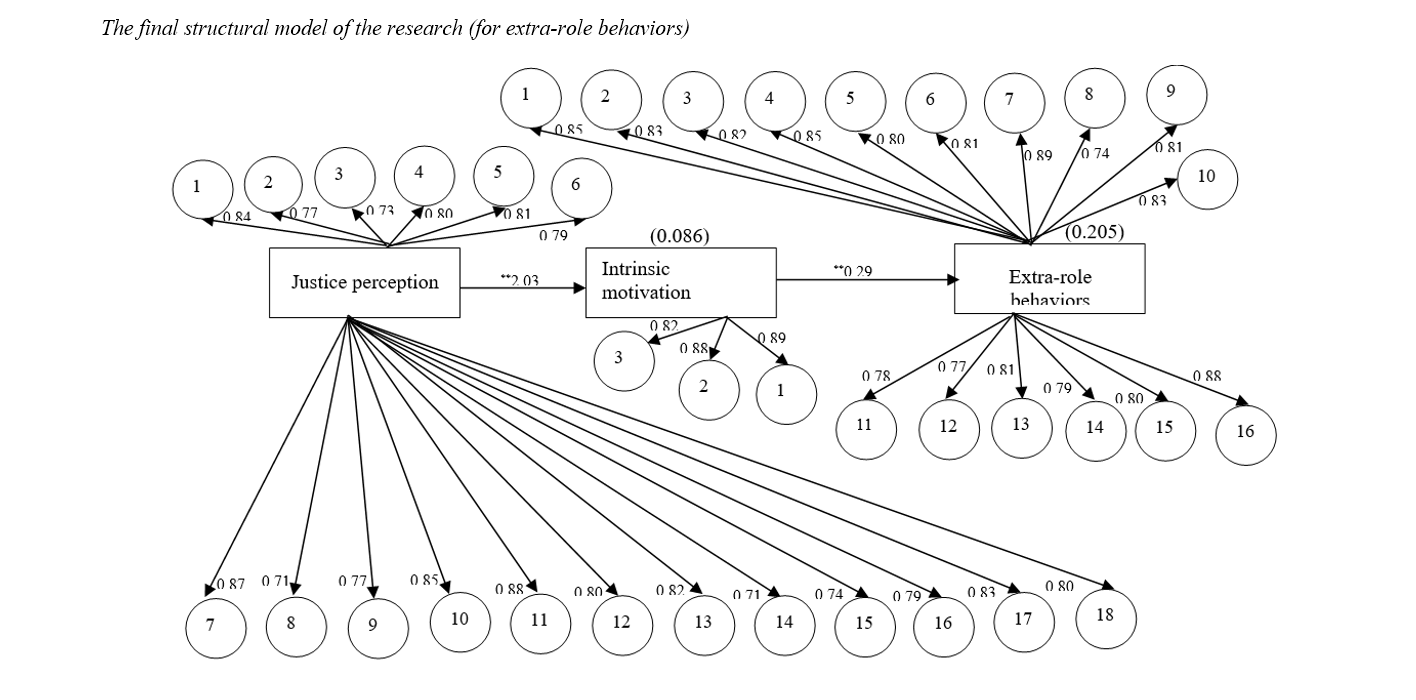
Findings: The results showed that the perception of organizational justice has a significant relationship with internal job motivation and extra-role behaviors (p<0.01). Moreover, the results of structural equation modeling showed that intrinsic job motivation is a complete mediating variable in the relationship between the perception of organizational justice and extra-role behaviors.
Conclusion: Based on the findings of the present study, it is necessary to implement and develop fair policies in distributive, procedural and interactive fields in order to develop extra-role behaviors and internal job motivation of university faculty members in academic settings. It should be considered by policymakers of higher education system in Iraq.
Downloads
References
Arab, N., Hashemi Sheikh Shabani, S. I., Qadiri, M., & Rezaei Badafshani, F. (2013). The Relationship Between the Experience of Incivility in the Workplace and Organizational Justice with Committing Incivility in the Workplace: The Mediating Role of Negative Affect and the Moderating Role of Neuroticism. Cognitive and Behavioral Science Research, 4(2), 45-58.
Artatanaya, I. G. L. S., & Widhari, C. I. S. (2023). Organizational Justice and Motivation on Organizational Citizenship Behavior (OCB). World Journal of Advanced Research and Reviews, 20(2), 1093-1097. https://doi.org/10.30574/wjarr.2023.20.2.2391
Baluarte, Z., Tocmo, C. V., Pendang, M. L., Abiol, M. J., Hamoy, G., & Lee, R. (2023). Enhancing Workplace Performance: Exploring the Influence of Intrinsic and Extrinsic Motivation on Employees’ Productivity in Iligan City’s Appliance Retail Industry. IMCC Journal of Science, 3(1), 8-14.
Darabi, M. (2022). Design and Validation of the Quality Management Model of Educational Activities of University Faculty Members. Quarterly Journal of Research and Planning in Higher Education, 28(3), 55-83.
Fan, Q., Wider, W., & Chan, C. K. (2023). The Brief Introduction to Organizational Citizenship Behaviors and Counterproductive Work Behaviors: A Literature Review. Frontiers in psychology, 14, 1181930. https://doi.org/10.3389/fpsyg.2023.1181930
Farid, H., Xiongying, N. I. U., Raza, J., Gul, H., & Hanif, N. (2023). How and When Organizational Justice Impact Extra-Role Customer Service: A Social Exchange Perspective of Thriving at Work. Current Psychology, 42(12), 9743-9758. https://doi.org/10.1007/s12144-021-02244-y
Faris, S., Siregar, C. L., Edward, Y. R., & Siregar, R. T. (2024). The Effect of Work Motivation and Work Environment on Organizational Citizenship Behavior (OCB) through Job Satisfaction as an Intervening Variable at RSU Royal Prima Medan. International Journal of Science and Research Archive, 11(1), 1069-1077. https://doi.org/10.54443/ijebas.v1i2.78
Gagne, M., Forest, J., Vansteenkiste, M., Crevier-Braud, L., Van den Broeck, A., Aspeli, A. K., Bellerose, J., Benabou, C., Chemolli, E., Gunter, T., Halvari, H., Indiyasstuti, L., Johnson, P. A., Molstand, M. H., Naudin, M., Nado, A., Olafsen, A. H., Roussell, P., Wang, Z., & Webstbyt, C. (2015). The Multidimensional Work Motivation Scale: Validation Evidence in Seven Languages and Nine Countries. European Journal of work and organizational psychology, 24(2), 178-196. https://doi.org/10.1080/1359432X.2013.877892
Hsu, J. S. C., Shih, S. P., Hung, Y. W., & Lowry, P. B. (2015). The Role of Extra-Role Behaviors and Social Controls in Information Security Policy Effectiveness. Information Systems Research, 26(2), 282-300. https://doi.org/10.1287/isre.2015.0569
Kiranmayi, G. R., Madhavi, B., Karavadi, S., Jesvina, H., & Huggahalli, M. P. (2024). Examining Organizational Justice, Psychological Well-being, and Citizenship Behaviors in the Indian Banking Sector: A Mediation Analysis. ORGANIZATION, PURPOSE, AND VALUES, 114-128.
Lee, K., & Allen, N. J. (2002). Organizational Citizenship Behavior and Workplace Deviance: The Role of Affect and Cognitions. Journal of Applied Psychology, 87(1), 131-142. https://doi.org/10.1037/0021-9010.87.1.131
Mehdad, A. (2023). Industrial and Organizational Psychology. Jangle Javdaneh Publications.
Mehdad, A., & Arifin, H. Z. (2009). Moderating effect of Nationality, Gender, position and tenure on the relationship between organizational citizenship behavior and counterproductive work behaviors among Iranian and Malaysian automotive workers. Iranian International Journal of Psychology, 3, 120-145. https://www.magiran.com/paper
Mehdad, A., & Khoshnami, A. (2016). Predicting Employees Organizational Loyalty through Perceived Organizational Justice Components. ijpb, 10(1).
Mehdad, A., Malekzadeh, M., & Amiri, V. (2018). The Effect of the Perception of Organizational Injustice, the Perception of Job Insecurity and the Perception of Organizational Stressors on the Work Failure of Retired Employees: The Mediating Role of Job Burnout. Geriatric Nursing, 5(3), 1-10.
Mehdad, A., & Minaeian, S. (2019). The Mediating Role of Achievement Motivation in the Relationship between Conscientiousness and Role Performance and Extra-Role Performance. Career and Organizational Counseling, 12(43), 73-90.
Mirzaeian, A., & Mehdad, A. (2016). Predicting Job Effort and Organizational Citizenship Behaviors through Job Motivation Dimensions. Psychological Achievements (Educational Sciences and Psychology), 24(1), 111-126.
Moqhtadari Isfahani, A., & Mehdad, A. (2023). The Role of Professional Ethics, Conscientiousness and Job Commitment in Predicting Role Performance and Extra-Role Performance. Ethics in Science and Technology, 1(18), 163-171.
Nehra, N. S. (2023). Can Employee Engagement be Attained through Psychological Detachment and Job Crafting: The Mediating Role of Spirituality and Intrinsic Motivation. Journal of Organizational Effectiveness: People and Performance, 10(3), 368-393. https://doi.org/10.1108/JOEPP-05-2022-0129
Nikolova, I., Caniëls, M. C., & Sverke, M. (2023). Qualitative Job Insecurity and Extra-Role Behaviours: The Moderating Role of Work Motivation and Perceived Investment in Employee Development. Economic and Industrial Democracy, 44(2), 547-572. https://doi.org/10.1177/0143831X221081167
Priscilla, Y. G., Maharani, D., & Muchsinati, E. S. (2024). Analysis the Influence of Motivation, Work Environment, Workplace Spirituality, and Leadership Style on Organizational Citizenship Behavior (OCB), with Job Satisfaction as a Mediating Factor, among Employees in Beauty Clinics in the City of Batam. International Journal of Business, Economics, and Social Development, 5(1), 54-63. https://doi.org/10.54443/ijebas.v1i2.78
Ryan, R. M., & Deci, E. L. (2000). Self-Determination Theory and the Facilitation of Intrinsic Motivation, Social Development, and Well-being. The American psychologist, 55(1), 68-78. https://doi.org/10.1037//0003-066X.55.1.68
Setrojoyo, S. M., Rony, Z. T., Sutrisno, N. S., Manap, A., & Sakti, B. P. (2023). The Effect of Intrinsic Motivation, Organizational Culture on Employee Performance with Organizational Commitment as an Intervening Variable. International Journal of Professional Business Review, 8(7), e02436.
Shibaoka, M., Takada, M., Watanabe, M., Kojima, R., Kakinuma, M., Tanaka, K., & Kawakami, N. (2010). Development and Validity of the Japanese Version of the Organizational Justice Scale. Industrial health, 48(1), 66-73. https://doi.org/10.2486/indhealth.48.66
Stockkamp, M., Kuonath, A., Kühnel, J., Kennecke, S., & Frey, D. (2023). Intrinsic Motivation as a Double-Edged Sword: Investigating Effects on Well-being and the Role of Flex Place Practices as Moderator to Buffer Adverse Effects. Applied Psychology. Health and Well-being, 15(2), 611-628. https://doi.org/10.1111/aphw.12399
Sujono, D., Tunas, B., & Sudiarditha, I. (2020). Vitality of Work Involvement in Mediation: The Effect of Organizational Justice on Organizational Citizenship Behavior. Management Science Letters, 10(5), 1061-1068.
Suprapto, D., & Widigdo, A. M. N. (2021). The Effect of Employee Empowerment, Organizational Justice, Conflict, and Work Motivation on Employee Performance (Case Study of Bank Mandiri Indonesia). European Journal of Business and Management Research, 6(5), 204-208.
Sutanto, E. M. (2018). Organizational Justice, Work Environment, and Motivation
Tziner, A., Fein, E. C., Kim, S. K., Vasiliu, C., & Shkoler, O. (2020). Combining Associations between Emotional Intelligence, Work Motivation, and Organizational Justice with Counterproductive Work Behavior: A Profile Analysis via Multidimensional Scaling (PAMS) Approach. Frontiers in psychology, 11, 851.
Wang, J., & Wang, X. (2012). Structural Equation Modeling: Applications Using M plus. John Wiley & Sons.
Downloads
Additional Files
Publication Timeline
- Submitted
- Revised
- Accepted
Issue
Section
License
Copyright (c) 2025 Hayder Abdulridha Hussein Shihmani (Author); Gholamreza Gholamreza Manshaee (Corresponding Author); Adnan Marid Jabur, Ali Mahdad (Author)

This work is licensed under a Creative Commons Attribution-NonCommercial 4.0 International License.