Transformational Leadership and Its Effects on Employee Creativity and Innovation: A Qualitative Analysis in Commercial Organizations
DOI:
https://doi.org/10.61838/kman.ijimob.263Keywords:
Transformational leadership, employee creativity, innovation, organizational culture, qualitative research, commercial organizationsAbstract
Objective: This study aims to investigate the effects of transformational leadership on employee creativity and innovation within commercial organizations.
Methodology: A qualitative research design was employed, utilizing semi-structured interviews to gather in-depth data from 24 employees working in commercial organizations in Tehran, Iran. The sample was selected through purposive sampling to ensure diverse perspectives on the impact of transformational leadership. Data collection ceased upon reaching theoretical saturation. Thematic analysis was conducted using NVivo software, following Braun and Clarke’s six-phase approach to identify key themes and patterns within the data.
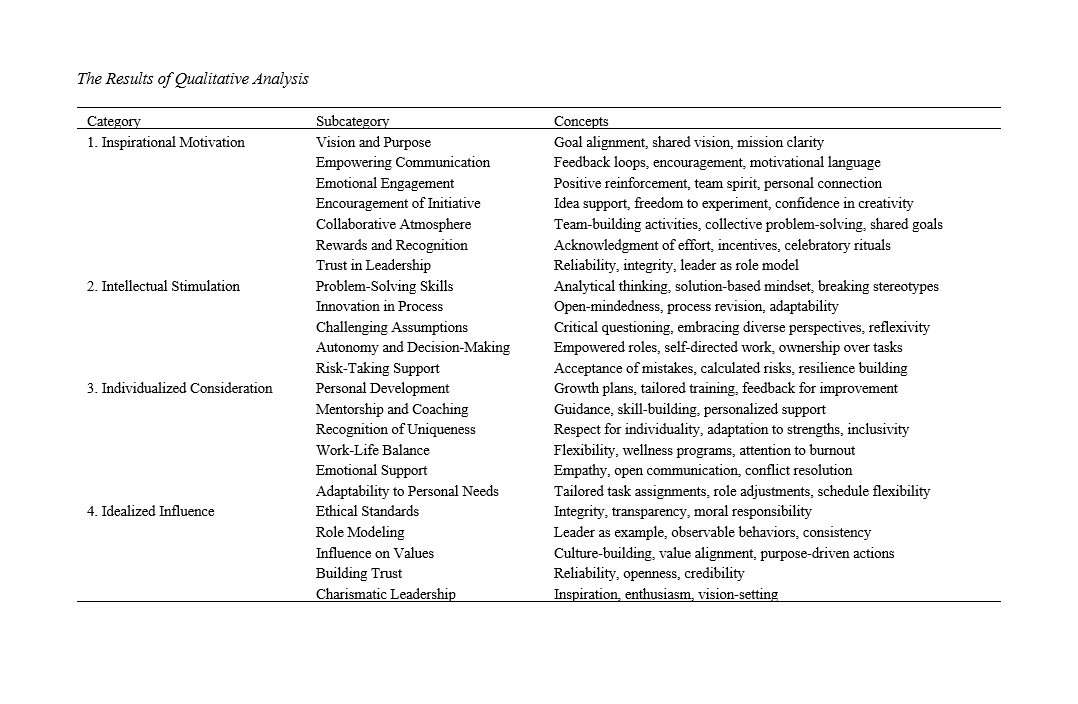
Findings: The analysis revealed four primary themes: inspirational motivation, intellectual stimulation, individualized consideration, and idealized influence. Participants highlighted that transformational leaders who communicated a clear vision, encouraged open communication, supported autonomy, and provided personalized mentorship significantly influenced their creativity and innovation. Additionally, ethical standards and trust-building by leaders reinforced a safe and collaborative environment that facilitated innovative thinking. These findings align with existing literature on transformational leadership and its impact on organizational culture, employee engagement, and performance.
Conclusion: This study demonstrates that transformational leadership plays a crucial role in fostering employee creativity and innovation by creating a supportive, inspiring, and value-driven organizational culture.
Downloads
References
Afsouran, N. R., Charkhabi, M., Mohammadkhani, F., & Seidel, L. B. (2022). The Link Between Transformational Leadership and Organizational Development: Testing the Mediating Role of Employees' Maturity. The Journal of Management Development, 41(7/8), 417-430. https://doi.org/10.1108/jmd-06-2021-0167
Aghaei Ghaleche, S. (2023). Maintenance of Employees and Its Impact on Organizational Performance with the Moderation of Sustainable Competitive Advantage. Dynamic Management and Business Analysis, 1(1), 45-58. https://doi.org/10.22034/dmbaj.2024.2022641.1012
Almashhadani, M. (2023). The Impacts of Transformational Leadership Dimensions on Employee and Firm Performance in Service Companies. International Journal of Scientific and Management Research, 06(09), 136-148. https://doi.org/10.37502/ijsmr.2023.6910
Azmy, A. (2023). The Influence of Transformational Leadership and Organizational Culture on Employee Performance at PT. Krakatau Bandar Samudera. 135-143. https://doi.org/10.2991/978-94-6463-244-6_23
Bajracharya, A. (2023). Transformational Leadership and Employees’ Job Satisfaction in the Educational Sector of Nepal. Peoples J. MGT, 26-45. https://doi.org/10.3126/pjm.v11i1.63166
Budur, T., & Demir, A. (2022). The Relationship Between Transformational Leadership and Employee Performance: Mediating Effects of Organizational Citizenship Behaviors. Iranian Journal of Management Studies, 15(4), 899-921. https://www.magiran.com/paper/2483428
Du, Y., & Yan, M. (2022). Green Transformational Leadership and Employees’ Taking Charge Behavior: The Mediating Role of Personal Initiative and the Moderating Role of Green Organizational Identity. International journal of environmental research and public health, 19(7), 4172. https://doi.org/10.3390/ijerph19074172
Gu, S. (2023). The Effect of Strategic Leadership on Retention and Creativity of Employee in Chinese Universities: Career Aspiration as a Mediator. International Journal of Education and Humanities, 9(2), 214-220. https://doi.org/10.54097/ijeh.v9i2.9936
Herawati, A. R., Lestari, L. A., & Yuniningsih, T. (2023). The Influence of Transformasional Leadership Style, Work Ethic, and Employee Competence on Employee Performance at the Population and Civil Registration Office of Rejang Lebong Regency. Kne Social Sciences. https://doi.org/10.18502/kss.v8i11.13563
Hooi, L. W., & Chan, A. J. (2023). Does Workplace Digitalization Matter in Linking Transformational Leadership and Innovative Culture to Employee Engagement? Journal of Organizational Change Management. https://doi.org/10.1108/jocm-06-2022-0184
Kwarteng, S., Frimpong, S. O., Asare, R., & Wiredu, T. J. N. (2024). Effect of employee recognition, employee engagement on their productivity: the role of transformational leadership style at Ghana Health Service. Current Psychology, 43(6), 5502-5513. https://doi.org/10.1007/s12144-023-04708-9
Moshayekh Moini, A. (2023). The Impact of Transformational Leadership on Employee Performance Through Knowledge and Innovation. Scientific Journal of New Research Approaches in Management and Accounting, 7(24), 1088-1101. https://www.majournal.ir/index.php/ma/article/view/1952
Odugbesan, J. A., Aghazadeh, S., Qaralleh, R. E. A., & Sogeke, O. S. (2022). Green Talent Management and Employees’ Innovative Work Behavior: The Roles of Artificial Intelligence and Transformational Leadership. Journal of Knowledge Management, 27(3), 696-716. https://doi.org/10.1108/jkm-08-2021-0601
Putri, N., & Meria, L. (2022). The Effect of Transformational Leadership on Employee Performance Through Job Satisfaction and Organizational Commitment. Iaic Transactions on Sustainable Digital Innovation (Itsdi), 4(1), 8-21. https://doi.org/10.34306/itsdi.v4i1.565
Rachmat, A. (2023). The Influence of Transformational Leadership and Organizational Commitment on Employee Performance Through Communication at the Directorate General of Budget, Directorate General of Budget. International Journal of Multidisciplinary Research and Growth Evaluation, 4(3), 942-952. https://doi.org/10.54660/.ijmrge.2023.4.3.942-952
Rahimi, M., Bahmaee, L., & Barekat, G. H. (2023). Designing A Paradigmatic Model of Barriers to Innovation Management in Ahvaz Primary Schools. International Journal of Innovation Management and Organizational Behavior (IJIMOB), 3(4), 19-27. https://doi.org/10.61838/kman.ijimob.3.4.3
Syukran, R., Adam, M., & Kesuma, T. M. (2023). The Influence of Self-Efficacy Creativity and Employee Engagement on Employee Performance and Its Implications on the Performance of PT Angkasa Pura II Branch Office at Sultan Iskandar Muda Airport in Aceh. International Journal of Scientific and Management Research, 06(03), 82-95. https://doi.org/10.37502/ijsmr.2023.6306
Vanesa, V. H. (2021). The Effect of Transformational and Transactional Leadership on Employee Negative Behavior Mediated by Work Stress. International Journal of Science Technology & Management, 2(1), 368-376. https://doi.org/10.46729/ijstm.v2i1.162
Wang, H., Jiao, R., & Li, F. (2022). Research on the Impact of Entrepreneurship Education on Employee Creativity From the Perspective of Career Environment Based on an Intermediary Model. Journal of Environmental and Public Health, 2022(1). https://doi.org/10.1155/2022/1677620
Xing, Y., & Li, Y. (2022). How Does Workplace Ostracism Affect Employee Innovation Behavior: An Analysis of Chain Mediating Effect. Frontiers in psychology. https://doi.org/10.3389/fpsyg.2022.920914
Xu, Y., Han, Q., Zhang, M., Tian, F., Zhou, L., & Zhao, S. (2022). Flexible Human Resource Management Systems and Employee Innovation Performance in China – Based on the Moderated Mediation Effect. Chinese Management Studies, 17(6), 1259-1275. https://doi.org/10.1108/cms-11-2021-0495
Xu, Z., Li, X., Sun, X., Cheng, M., & Xu, J. (2022). The Relationship Between Self-Sacrificial Leadership and Employee Creativity: Multilevel Mediating and Moderating Role of Shared Vision. Management Decision. https://doi.org/10.1108/md-05-2021-0640
Yang, L., & Liu, H. (2022). The Impact of Ethical Leadership on Employees’ Green Innovation Behavior: A Mediating-Moderating Model. Frontiers in psychology, 13. https://doi.org/10.3389/fpsyg.2022.951861
Zhu, J., Zhang, B., Xie, M., & Cao, Q. (2022). Digital Leadership and Employee Creativity: The Role of Employee Job Crafting and Person-Organization Fit. Frontiers in psychology. https://doi.org/10.3389/fpsyg.2022.827057
Downloads
Additional Files
Publication Timeline
- Submitted
- Revised
- Accepted
Issue
Section
License
Copyright (c) 2025 Fatemeh Rahmani (Corresponding Author); Mohtaram Jafarian, Azam Sedighi, Mehdi Hasanzadeh Hozsorkhi, Seyed Sohbat Ollah Alavi (Author)

This work is licensed under a Creative Commons Attribution-NonCommercial 4.0 International License.