Validation of an Artificial Intelligence-Based Educational Leadership Model with a Foresight Approach in Schools of Razavi Khorasan Province
Keywords:
Artificial Intelligence, Educational Leadership, Foresight Approach, Educational System, Model Validation, Razavi KhorasanAbstract
Objective: This study aimed to validate an artificial intelligence-based educational leadership model with a foresight approach in schools of Razavi Khorasan Province, Iran.
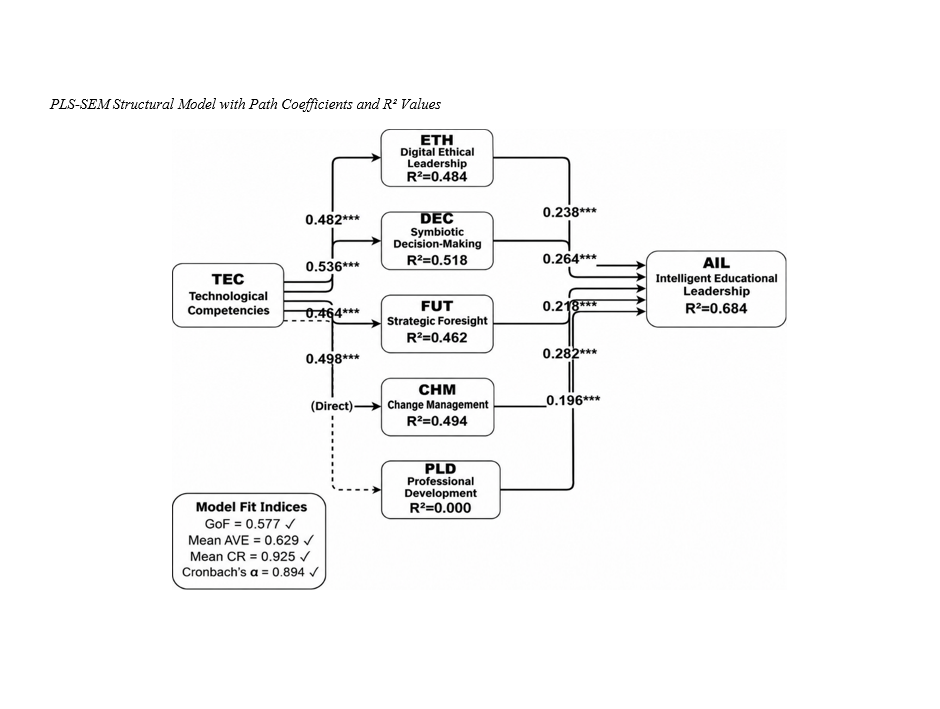
Methods and Materials: This quantitative study employed a descriptive-correlational design and structural equation modeling. The statistical population consisted of members of the educational system in Razavi Khorasan Province, from whom 461 school principals, vice-principals, and school technology experts were selected through proportionate stratified sampling. Data were collected using a researcher-developed questionnaire designed to measure the components of artificial intelligence-based educational leadership and its proposed antecedents. The hypothesized measurement and structural models were evaluated using partial least squares structural equation modeling (PLS-SEM) in SmartPLS 4. The analysis focused on testing the proposed causal relationships among technological competencies, ethical considerations, symbiotic decision-making, strategic foresight, change management, cultural resistance, and intelligent educational leadership.
Findings: Structural model analysis indicated that all ten hypothesized relationships were statistically significant at p < 0.001. Technological competencies emerged as the most influential overall driver of intelligent educational leadership, with a total effect of 0.576. Among the direct predictors, change management demonstrated the strongest direct effect on intelligent educational leadership (β = 0.282). The combined predictors explained 68.4% of the variance in intelligent educational leadership, indicating substantial explanatory power. Moreover, the overall goodness-of-fit index (GoF = 0.577) demonstrated a strong fit between the proposed theoretical framework and the empirical data, thereby supporting the adequacy of the final model for explaining AI-oriented educational leadership in the school context.
Conclusion: The validated model indicates that effective educational leadership in the era of artificial intelligence requires the integrated development of technological competencies, ethical awareness, human–AI symbiotic decision-making, strategic foresight, and effective management of organizational and cultural change.
Downloads
References
Ahmadi, S. (2023). Assessing teachers’ readiness and intention to teach artificial intelligence to secondary school students in Tehran Islamic Azad University, Science and Research Branch].
Alikarami, N., Alikarami, G., & Shohan, J. (2023). School leadership and management in the age of artificial intelligence: Recent developments and future perspectives. Seventh International Conference on Third Millennium Knowledge and Technology in Iranian Economics, Management and Accounting, Tehran.
Arasteh, H., & Khabareh, K. (2023). The role of artificial intelligence and transformation in higher education. Nasha-e Elm, 14(1), 8.
Arbabi, Z. (2023). Benefits and challenges of artificial intelligence in virtual education. Studies in Psychology and Educational Sciences, 9(4), 595-602.
Bahajab Ghodsi, S., Mazaheri, M., & Dahmardeh, M. (2023). The effect of using artificial intelligence strategies in teaching and their impact on students. Studies in Psychology and Educational Sciences, 6(60), 77-86.
Dadashpour, M., & Dehghanpour, A. (2023). Examining the effect of artificial intelligence on the education process. International Conference on Management and Humanities Research in Iran,
Dai, Y., Chai, C. S., Lin, P. Y., Jong, M. S. Y., Guo, Y., & Qin, J. (2020). Promoting students' well being by developing their readiness for the artificial intelligence age. Sustainability, 12(16), 1-15. https://doi.org/10.3390/su12166597
Darmansyah, F. B. A., Hendratmi, A., & Aziz, P. F. (2020). Factors determining behavioral intentions to use Islamic financial technology: Three competing models. Journal of Islamic Marketing, 12(4), 794-812. https://doi.org/10.1108/JIMA-12-2019-0252
Davies, H. C., Eynon, R., & Salveson, C. (2021). The mobilisation of AI in education: A Bourdieusean field analysis. Sociology, 55(3), 539-560. https://doi.org/10.1177/0038038520967888
Dennis, M. J. (2018). Artificial intelligence and recruitment, admission, progression, and retention. Enrollment Management Report, 22(9), 1-3. https://doi.org/10.1002/emt.30479
Eaton, S. E. (2025). Global trends in education: Artificial intelligence, postplagiarism, and future focused learning for 2025 and beyond-2024-2025 Werklund Distinguished Research Lecture. International Journal for Educational Integrity, 21(1), 12. https://doi.org/10.1007/s40979-025-00187-6
Fathipour Lat Mahalleh, G. (2024). Designing an artificial intelligence-based educational model. First International Conference of Outstanding Teachers, Masjed Soleyman.
García Peñalvo, F. J. (2023). The perception of artificial intelligence in educational contexts after the launch of ChatGPT: disruption or panic? Education in the Knowledge Society, 24, 1-9. https://doi.org/10.14201/eks.31279
Göçen, A., & Döğer, M. F. (2025). A global perspective on artificial intelligence in educational leadership. The Journal of Educational Research, 1-19. https://doi.org/10.1080/00220671.2025.2510397
González Calatayud, V., Prendes Espinosa, P., & Roig Vila, R. (2021). Artificial intelligence for student assessment: A systematic review. Applied Sciences, 11(12), 5467. https://doi.org/10.3390/app11125467
Gulson, K. N., Sellar, S., & Webb, P. T. (2022). Algorithms of Education: How datafcation and artifcial intelligence shape policy. University of Minnesota Press. https://doi.org/10.5749/9781452968797
Guo, Y., & Xiao, Y. (2019). Artificial Intelligence in Education. 4th International Conference on Modern Management, Education Technology and Social Science (MMETSS 2019),
Hanifehzadeh Noudehi, F. (2023). The effect of artificial intelligence and modern educational technologies on education in the modern world. International Conference on Management and Educational Research in Education,
Khabareh, K. (2025). The role of artificial intelligence in educational leadership in schools: A qualitative approach. https://civilica.com/doc/2265231
Landon, F., & Soleimani, M. (2024). Integrating artificial intelligence into educational leadership: Strategies for effective management. Management Research and Development(4), 105-121.
Majiditalab, S. S., & Reda, B. (2025). Artificial intelligence and instructional leadership in schools. First International Conference on Artificial Intelligence in Education, Psychology, Educational Sciences and Religious, Cultural, Social and Management Studies in the Third Millennium, Bushehr.
Parsarad, F., Ferdousipour, Z., Rafiei Vardanjani, Z., & Sarvestan, S. (2023). Modern approaches to education with a focus on artificial intelligence and machine learning technologies. International Conference on Management and Educational Research in Education,
Sheikh Shoaei, H. (2021). Challenges, roles and policymaking in artificial intelligence research in education. International Conference on Management, Tourism and Technology,
Downloads
Additional Files
Publication Timeline
- Submitted
- Revised
- Accepted