Modeling Strategic Agility Based on Technological Transformation Considering Mediating and Moderating Variables
Keywords:
technological transformation, strategic agility, human resource dynamism, Iran Customs AdministrationAbstract
Objective: The present study aimed to model strategic agility based on technological transformation while considering mediating and moderating variables.
Methods and Materials: This study was grounded in the positivist research philosophy, employed a descriptive-correlational design, and adopted a quantitative approach using structural equation modeling (SEM) to achieve the research objectives. The statistical population consisted of all employees of customs administrations across the provinces of Iran, from whom a sample of 360 participants was selected using proportionate stratified probability sampling. The sample size was determined based on Cohen’s (1988) statistical power analysis tables for multivariate tests. Data were collected using a researcher-developed questionnaire. Structural equation modeling was performed using SmartPLS version 3.
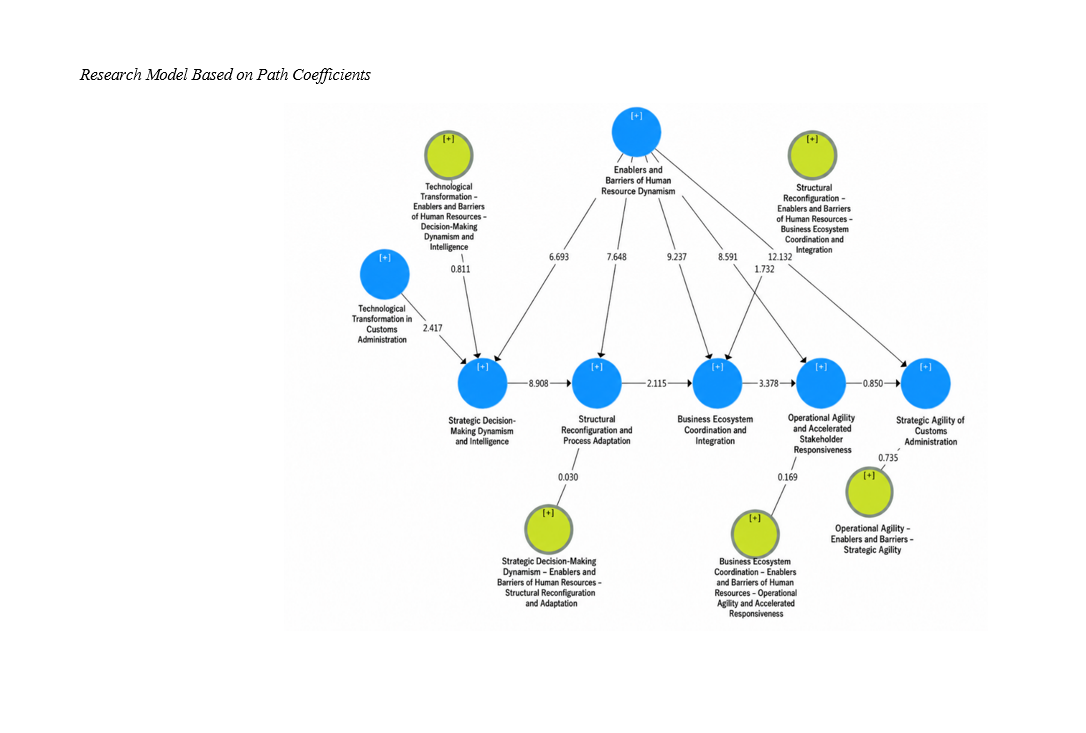
Findings: The findings indicated that technological transformation had a positive and significant effect on decision-making dynamism (β = .187), decision-making dynamism had a positive and significant effect on structural reconfiguration (β = .490), structural reconfiguration had a positive and significant effect on ecosystem coordination (β = .162), ecosystem coordination had a positive and significant effect on operational agility (β = .250), and operational agility had a positive and significant effect on strategic agility (β = .159; t > 1.96, p < .05). Furthermore, the enablers and barriers of human resource dynamism positively moderated the relationships among all the aforementioned variables (p < .01). The bootstrapping test also confirmed the validity of the serial mediation pathway from technological transformation to the realization of strategic agility (β = .101, t = 2.463, p < .01).
Conclusion: Strategic agility in customs administration is the outcome of a synergistic value chain comprising technology, intelligent decision-making, structural reform, and external coordination, the functioning of which is accelerated by human resource dynamism.
Downloads
References
Alzuod, M. A., & Alqhaiwi, L. A. (2022). The Role of Strategic Flexibility in Enhancing Crisis Management in the Commercial Banking Sector During the COVID-19 Pandemic. Corporate Governance and Organizational Behavior Review, 6(2).
Barrington, A., & Wood, P. (2021). Human Capital Dynamics and Digital Transformation: The Moderating Role of Employee Agility. Journal of Strategic Management, 45(3), 210-228. https://doi.org/10.1007/s13132-023-01377-8
Bounfour, A., Housel, T., Silkey, T., & Nonnis, A. (2023). Digital Transformation and Strategic Agility During the COVID-19 Crisis: The Role of the Intangible Capital Conversion. Digital Transformation and Society, 2(3), 257-275. https://doi.org/10.1108/DTS-09-2022-0048
Doz, Y. L., & Kosonen, M. (2010). Embedding Strategic Agility: A Leadership Agenda for Accelerating Business Model Renewal. Long Range Planning, 43(2-3), 370-382. https://doi.org/10.1016/j.lrp.2009.07.006
Gharbi J, M., Salehi, M., Amirianzadeh, M., & Allah Ahmadi, E. (2022). Modeling the Agility of Education Departments with a Digital Transformation Approach. International Journal of Digital Content Management (IJDCM), 2(4), 137-163.
Lamberg, J. A. (2023). Technological Transformation and Organizational Survival: The Path to Strategic Agility. Academy of Management Perspectives, 37(1), 45-62. https://doi.org/10.5267/j.ijdns.2024.2.009
Oh, J. (2022). Ecosystem Integration and Strategic Agility in Public Sectors. International Journal of Information Management, 62, 102-119. https://doi.org/10.1016/j.jbusres.2022.03.038
Qiao, G., Li, Y., & Hong, A. (2024). The Strategic Role of Digital Transformation: Leveraging Digital Leadership to Enhance Employee Performance and Organizational Commitment in the Digital Era. Systems, 12(11), 457. https://doi.org/10.3390/systems12110457
Rawashdeh, A., Abdallah, A. B., Alfawaeer, M., Al Dweiri, M., & Al-Jaghbeer, F. (2024). The Impact of Strategic Agility on Environmental Sustainability: The Mediating Role of Digital Transformation. Sustainability, 16, 1338. https://doi.org/10.3390/su16031338
Shao, W. (2025). The Role of Digital Transformation in Enhancing Organizational Agility and Competitive Advantages: A Strategic Perspective Proceedings of the 3rd International Conference on Financial Technology and Business Analysis, https://doi.org/10.54254/2754-1169/154/2024.19552
Teece, D. J. (2007). Explicating Dynamic Capabilities: The Nature and Microfoundations of (Sustainable) Enterprise Performance. Strategic management journal, 28(13), 1319-1350. https://doi.org/10.1002/smj.640
Vahdati, H., Bazgir, A., & Mousavinejad, S. H. (2023). Enhancing Agility in Iran's Digital Content Industry: The Role of Knowledge Strategy and Intellectual Assets in Marketing. Quarterly Journal of Technology Development Management, 11(2), 135-162.
Vishlaghi, M., Zarei, A., & Feiz, D. (2021). Designing a Strategic Agility Model in Relation to Sustainable Production Boom Based on Grounded Theory: A Study of the Automotive Industry. Management Improvement, 15(2), 127-153.
Downloads
Additional Files
Publication Timeline
- Submitted
- Revised
- Accepted