Structural Model Comparison of the Relationship Between Early Maladaptive Schemas and Self-Compassion via Affective Flexibility in Women Seeking Divorce and Non-clinical Women
DOI:
https://doi.org/10.61838/kman.pwj.4562Keywords:
affective flexibility, self-compassion, maladaptive schemas, divorceAbstract
Objective: This study aimed to compare the structural relationships between early maladaptive schemas and self-compassion, mediated by affective flexibility, in women seeking divorce and non-clinical (community) women.
Methods and Materials: The research employed a correlational design using structural equation modeling (SEM). The statistical population consisted of all women seeking divorce and non-clinical women who attended counseling and psychology centers in Tehran in 2024. A total of 400 participants (200 women seeking divorce and 200 non-clinical women) were selected using multistage cluster sampling. Participants completed the Self-Compassion Scale (Neff, 2003), Young Schema Questionnaire–Short Form (YSQ-S3; Young, 1998), and the Affective Flexibility Scale (Fu et al., 2018). Data were analyzed using SPSS-26 and AMOS-24 through confirmatory factor analysis and multigroup SEM to assess model fit, path coefficients, and mediation effects via bootstrapping.
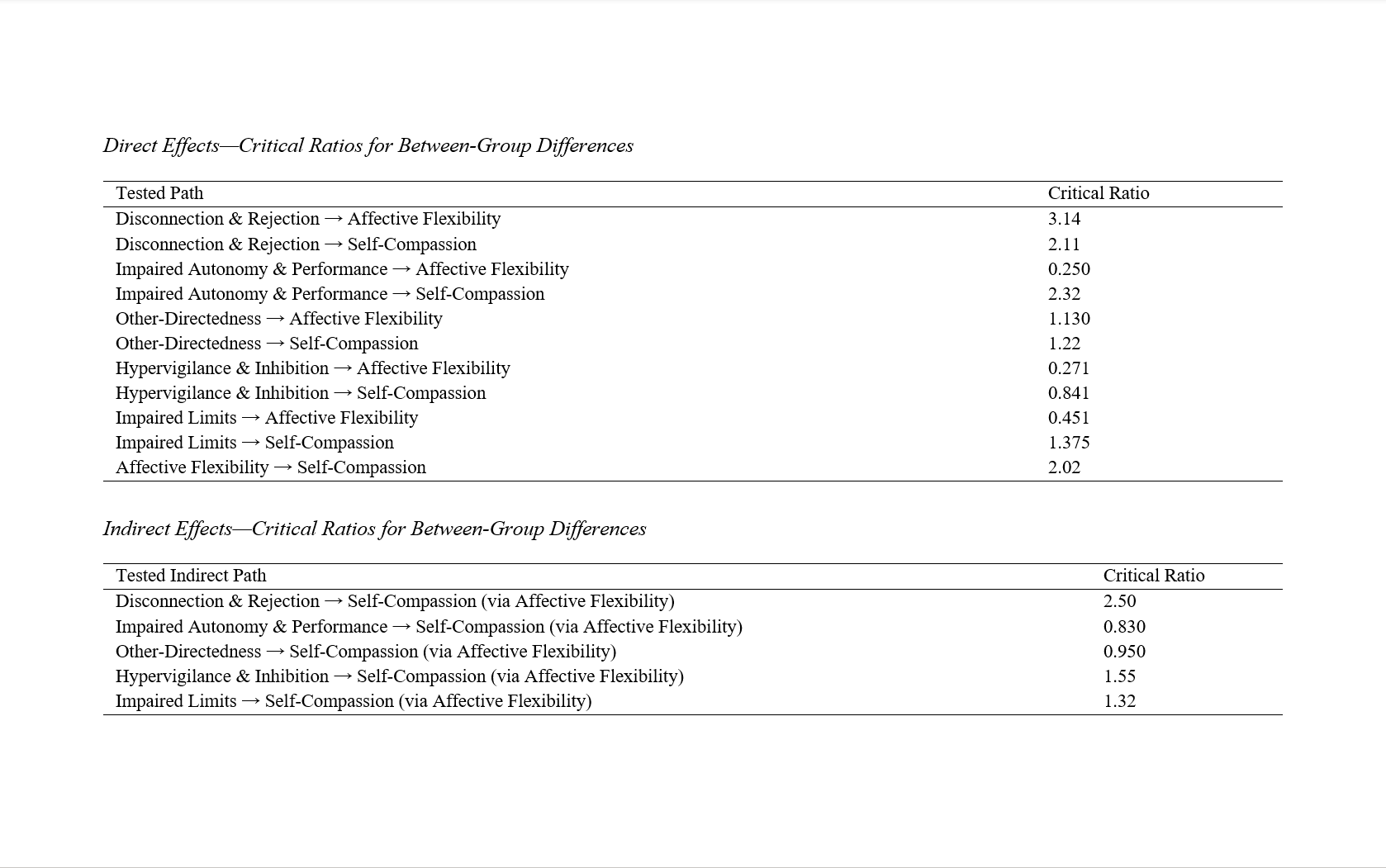
Findings: The proposed structural model showed good fit indices for both groups. Early maladaptive schemas significantly and negatively predicted affective flexibility (β = −0.211, p < .001) and self-compassion (β = −0.142, p = .048) among women seeking divorce, and also demonstrated negative effects in the community group. Affective flexibility positively predicted self-compassion in both groups (divorce-seeking: β = 0.372, p < .001; community: β = 0.501, p < .001). Bootstrapping results confirmed the mediating role of affective flexibility in the relationship between early maladaptive schemas and self-compassion, with stronger indirect effects observed in the divorce-seeking group (β = −0.0777, p = .006). Multigroup comparisons showed that path differences were significant for Disconnection & Rejection → Affective Flexibility and Impaired Autonomy & Performance → Self-Compassion.
Conclusion: Enhancing affective flexibility may therefore strengthen self-compassion and mitigate schema-driven emotional vulnerability in relational distress contexts.
Downloads
References
Afsar, M., Hassani, F., Farzad, V., & Golshani, F. (2023). Comparison of the Effectiveness of Emotionally-Focused Therapy (EFT) and Mindfulness-Based Schema Therapy (MBST) on Emotion Regulation in Women with Borderline Personality Disorder (BPD). Applied Family Therapy Journal (AFTJ), 2(1), 262-276. https://journals.kmanpub.com/index.php/aftj/article/view/433
Ahmadi, G. M., Akbarzadeh Amirdehi, N., Imani Rad, E., Kashanian, A., Mohammadi Tilehnoui, S., & Babaei, N. (2024). Comparison of the Effectiveness of Emotion-Focused Couples Therapy, Integrative Acceptance and Commitment Therapy, and Schema Therapy on Acceptance in Couples Seeking Divorce. Mental Health and Culture. https://frooyesh.ir/article-1-4499-en.html
Ameri, N. (2023). Structural Relations of Early Maladaptive Schemas to Craving in Substance-Dependent Individuals under Methadone Maintenance Treatment: The Mediating Role of Self-Compassion. etiadpajohi, 16(66), 47-70. https://doi.org/10.52547/etiadpajohi.16.66.47
Babsour, P., & Karimi, K. (2025). The effectiveness of group therapy based on self-compassion on psychological well-being and marital adjustment in women affected by domestic violence. Ravanshenasi-ye Ruyesh, 14(1), 135-144. https://frooyesh.ir/browse.php?a_id=5739&slc_lang=en&sid=1&printcase=1&hbnr=1&hmb=1
Bahrami Hidaji, M., Peyvandi, P., & Mohammadi Shirmahaleh, F. (2022). The efficacy of cognitive therapy based on acceptance and commitment with a focus on self-compassion emotional schemas and empathy in couples. Journal of Psychological Science, 21(120), 2449-2467. https://doi.org/10.52547/JPS.21.120.2449
Faustino, B., Vasco, A. B., Silva, A. N., & Marques, T. (2020). Relationships between emotional schemas, mindfulness, self-compassion and unconditional self-acceptance on the regulation of psychological needs. Research in Psychotherapy: Psychopathology, Process and Outcome, 23(2). https://pubmed.ncbi.nlm.nih.gov/33024719/
Genet, J. J., Malooly, A. M., & Siemer, M. (2013). Flexibility is not always adaptive: Affective flexibility and inflexibility predict rumination use in everyday life. Cognition & Emotion, 27(4), 685-695. https://doi.org/10.1080/02699931.2012.733351
Hassani, S. F., Tizdast, T., & Zarbakhsh, M. (2021). The Role of Self-Compassion and Hope in the Relationship Between Psychological Wellbeing, Maladaptive Schemas, Resilience, and Social Support in Women With Multiple Sclerosis. Journal of Client-Centered Nursing Care, 7(3), 195-204. https://doi.org/10.32598/jccnc.7.3.372.1
Marashian, F. S., & Shahbazi, M. (2023). Relative Effectiveness of Acceptance/Commitment and Schema Therapies on Love Trauma Syndrome and Self-Compassion in Unmarried Girls With Emotional Breakdown. Journal of Research and Health, 13(6), 437-446. https://doi.org/10.32598/jrh.13.6.1973.3
Moradi Davijani, H., Karami, J., & Yazdanbakhsh, K. (2024). The mediating role of self-compassion in the relationship between early maladaptive schemas and marital conflict. Family Research, 20(2), 23-46. https://jfr.sbu.ac.ir/article_105060.html
Nikogoftar, M., & Shourangiz, K. (2023). Developing a Post-Traumatic Growth Model Based on Emotional Schemas with the Mediating Role of Self-Compassion Among Widowed Women Who Lost Their Husbands to COVID-19. Journal of Positive Psychology Research(2), 83-102. https://ppls.ui.ac.ir/article_27834.html?lang=en
Panahi, M., & Baramash, H. (2024). The effectiveness of schema therapy on resilience levels in women at risk of divorce in Tehran.
Saadatmand, E., Mahmoudalilou, M., Esmaeilpour, K., & Hashemi, T. (2022). Investigating the Relationship Between Early Maladaptive Schemas and Symptoms of Body Dysmorphic Disorder with the Mediation of Self-Compassion. Psychiatric Nursing, 10(1), 64-75. https://ijpn.ir/article-1-1979-en.html
Salgó, E., Bajzát, B., & Unoka, Z. (2021). Schema modes and their associations with emotion regulation, mindfulness, and self-compassion among patients with personality disorders. Borderline personality disorder and emotion dysregulation, 8(1), 1-14. https://doi.org/10.1186/s40479-021-00160-y
Sanati, Y. (2024). Investigating the effectiveness of cognitive-behavioral therapy on self-compassion and experiential avoidance in women who have experienced marital infidelity. Aftj, 5(2), 112-120. https://doi.org/10.61838/kman.aftj.5.2.13
Talebi Zadeh, F., Ranjbar, M., Lotfi, P., & Barvarz Koucheh Galleh, Z. (2023). The role of early maladaptive schemas in emotional divorce among couples. Ninth Scientific Research Conference on the Development and Promotion of Educational and Psychological Sciences of Iran, Tehran.
Twivy, E., Grol, M., & Fox, E. (2021). Individual differences in affective flexibility predict future anxiety and worry. Cognition and Emotion, 35(2), 425-434. https://doi.org/10.1080/02699931.2020.1843407
Volkaert, B., Wante, L., Wiersema, J. R., & Braet, C. (2024). Depressive symptoms in early adolescence: the dynamic interplay between emotion regulation and affective flexibility. Frontiers in psychology, 15, 1165995. https://doi.org/10.3389/fpsyg.2024.1165995
Downloads
Additional Files
Publication Timeline
- Submitted
- Revised
- Accepted