Comparison of the Effectiveness of Schema Therapy-Based Couple Therapy and Emotionally Focused Couple Therapy on Attachment Behaviors in Incompatible Couples
DOI:
https://doi.org/10.61838/kman.pwj.6.2.7Keywords:
Schema Therapy-Based Couples Therapy, Emotionally Focused Couples Therapy, Attachment Behavior, Maladaptive CouplesAbstract
Objective: This study aimed to compare the effectiveness of schema therapy-based couple therapy and emotionally focused couple therapy on attachment behaviors in incompatible couples.
Methods and Materials: The research employed a quasi-experimental design with a pre-test, post-test, control group, and a two-month follow-up period. The statistical population included all couples who sought psychological and counseling services in Tehran in 2023. Using purposive sampling, 45 couples who met the inclusion criteria were selected and randomly assigned to three equal groups (15 couples per group). Data were collected using the Spanier Marital Adjustment Questionnaire (1976) and the Accessibility, Responsiveness, and Companionship Questionnaire by Sandberg et al. (2012). Participants in the experimental groups received therapeutic interventions over 10 weekly sessions, each lasting 90 minutes, while the control group did not receive any interventions. Data were analyzed using repeated-measures analysis of variance (ANOVA).
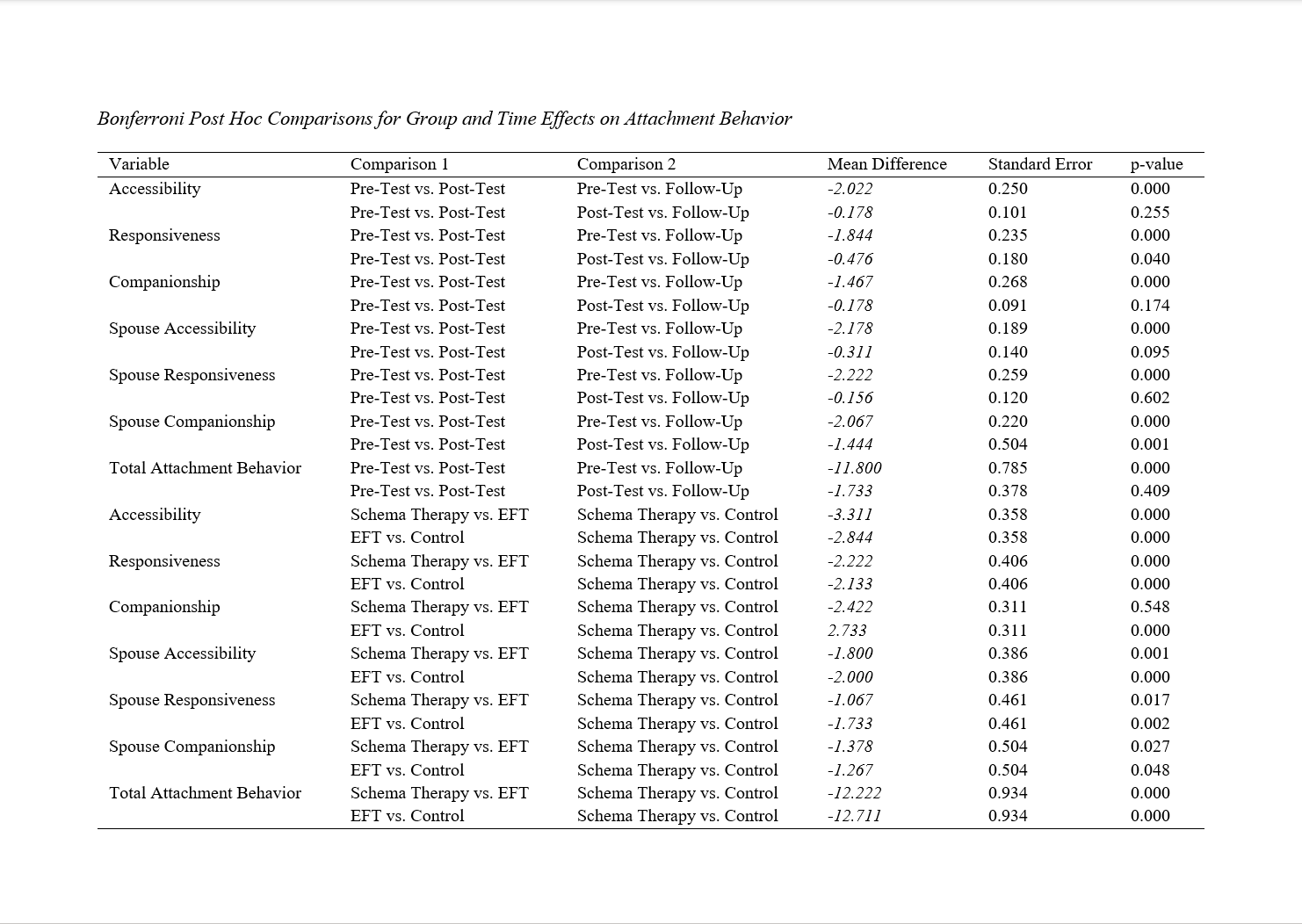
Findings: The results indicated that both schema therapy-based couple therapy and emotionally focused couple therapy significantly increased attachment behaviors in incompatible couples compared to the control group (p < 0.05).
Conclusion: Given the effectiveness of these therapeutic approaches, psychologists and counselors working in this field are recommended to utilize these intervention methods to enhance attachment behaviors in couples experiencing incompatibility.
Downloads
References
Atkinson, T., & Perris, P. (2020). Schema Therapy for Couples: Interventions to Promote Secure Connections In Creative Methods in Schema Therapy. Routledge. https://doi.org/10.4324/9781351171847-13
Chan, E. W. L., & Tan, H. J. R. (2019). Positive psychology couple schema therapy: A new model of couple therapy focusing on reigniting couple attraction via schema therapy and positive psychology. ReAttach Therapy and Developmental Diversities, 2(2), 61-69. https://doi.org/10.26407/2019jrtdd.1.24
Ganz, M. B., Rasmussen, H. F., McDougall, T. V., Corner, G. W., Black, T. T., & De Los Santos, H. F. (2022). Emotionally focused couple therapy within VA healthcare: Reductions in relationship distress, PTSD, and depressive symptoms as a function of attachment-based couple treatment. Couple and family psychology: Research and practice, 11(1), 15. https://doi.org/10.1037/cfp0000210
Goyal, S., & Nagendran, S. (2023). Association of Mental Incompatibility in Marital Life of Patients with Depressive Disorders. Hindu, 27, 26-27. https://www.ijlbpr.com/uploadfiles/143vol12issue2pp820-823.20230424045306.pdf
Grecucci, A., Messina, I., & Dadomo, H. (2018). Decoupling internalized dysfunctional attachments: a combined ACT and schema therapy approach. Frontiers in psychology, 9, 2332. https://doi.org/10.3389/fpsyg.2018.02332
Henderson, A. K., Wong, J. S., Dues, A., & Walsemann, K. M. (2023). Interpersonal Discrimination and Relationship Quality among Married Mid-Life and Older Black Adults. Journal of Family Issues, 45(1), 185-205. https://doi.org/10.1177/0192513X221150988
Huerta, P., Edwards, C., Asiimwe, R., PettyJohn, M., VanBoxel, J., Morgan, P., & Wittenborn, A. K. (2023). Exploratory analysis of pursue-withdraw patterns, attachment, and gender among couples in emotionally focused therapy. The American Journal of Family Therapy, 51(1), 57-75. https://doi.org/10.1080/01926187.2022.2129521
Johnson, S. M., Simakhodskaya, Z., & Moran, M. (2018). Addressing issues of sexuality in couples therapy: Emotionally focused therapy meets sex therapy. Current Sexual Health Reports, 10, 65-71. https://doi.org/10.1007/s11930-018-0146-5
Khatibi, J., Haji Arbabi, F., & Fariborzi, E. (2024). Comparison of the Effectiveness of the Integrated Gottman and Emotion-Focused Therapy Model with the Imago Therapy Approach on Marital Adjustment and Love Styles in Married Students with Early Marriages. International Journal of Education and Cognitive Sciences, 5(5), 18-29.
Koçyiğit, M., & Uzun, M. (2024). Couple Burnout and Marital Satisfaction: Serial Mediation by Mindfulness and Emotion Regulation. American Journal of Family Therapy, 1-19. https://doi.org/10.1080/01926187.2024.2322461
Koppers, D., Van, H. L., Peen, J., & Dekker, J. J. (2023). Exploring the effect of group schema therapy and comorbidity on the treatment course of personality disorders. Current Opinion in Psychiatry, 36(1), 80-85. https://doi.org/10.1097/YCO.0000000000000828
Körük, S., & Özabacı, N. (2023). How do early maladaptive schemas and family functions predict dyadic marital adjustment? A test on Turkish married individuals. Journal of sex & marital therapy, 49(7), 772-782. https://doi.org/10.1080/0092623X.2023.2195857
Nunes, C., Martins, C., Leal, A., Pechorro, P., Ferreira, L. I., & Ayala-Nunes, L. (2022). The ENRICH Marital Satisfaction (EMS) Scale: A Psychometric Study in a Sample of Portuguese Parents. Social Sciences, 11(3), 107. https://doi.org/10.3390/socsci11030107
Rahim, M. A., & Magner, N. R. (1995). Confirmatory factor analysis of the styles of handling interpersonal conflict: first-order factor model and its invariance across groups. Journal of Applied Psychology, 80(1), 122-132. https://doi.org/10.1037/0021-9010.80.1.122
Sadeghi, M., Ghaderijavid, S., & Shalani, B. (2019). Prediction of Marital Commitment based on Personality Traits, Attachment Styles, and Religious Orientation in Married Students. Journal of Pizhūhish dar dīn va Salāmat (i.e., Research on Religion & Health), 5(3), 18-31. https://doi.org/10.22037/jrrh.v5i3.20209
Scarlat, E. M. (2021). The role of cognitive schemas in the relationship between attachment style and emotional intelligence. Studia Doctoralia, 12(1), 54-69. https://doi.org/10.47040/sd/sdpsych.v12i1.123
Shaver, P. R., & Mikulincer, M. (2009). An overview of adult attachment theory Attachment theory and research in clinical work with adults. https://psycnet.apa.org/record/2009-02347-002
Shrout, M. R., Renna, M. E., Madison, A. A., Malarkey, W. B., & Kiecolt-Glaser, J. K. (2023). Marital negativity's festering wounds: The emotional, immunological, and relational toll of couples' negative communication patterns. Psychoneuroendocrinology, 149, 105989. https://doi.org/10.1016/j.psyneuen.2022.105989
Spengler, P. M., Lee, N. A., Wiebe, S. A., & Wittenborn, A. K. (2022). A comprehensive meta-analysis on the efficacy of emotionally focused couple therapy. Couple and family psychology: Research and practice. https://psycnet.apa.org/record/2023-02978-001
Sumbaga, M., & Lapian, M. E. (2023). Attachment insecurity and marital satisfaction as a mediator to see the tendency of partner's infidelity.
Uluyol, F. M., & Özen-Çıplak, A. (2024). Dyadic relationship of adult attachment patterns and interpersonal schemas in marital adjustment: Actor-partner effect model. Family Relations. https://doi.org/10.1111/fare.13002
Van Diest, S. L., den Oudsten, B. L., Aaronson, N. K., Beaulen, A., Verboon, P., Aarnoudse, B., & van Lankveld, J. J. (2023). Emotionally focused couple therapy in cancer survivor couples with marital and sexual problems: a replicated single-case experimental design. Frontiers in psychology, 14, 1123821. https://doi.org/10.3389/fpsyg.2023.1123821
Wiebe, S. A., Johnson, S. M., Lafontaine, M. F., Burgess Moser, M., Dalgleish, T. L., & Tasca, G. A. (2017). Two-year follow-up outcomes in emotionally focused couple therapy: An investigation of relationship satisfaction and attachment trajectories. Journal of marital and family therapy, 43(2), 227-244. https://doi.org/10.1111/jmft.12206
Wilde, J. L., Gillies, J. C., & Dozois, D. J. (2021). Cognitive and interpersonal contributors to relationship distress and depression: A review of the dyadic partner-schema model. The Neuroscience of Depression, 373-380. https://doi.org/10.1016/B978-0-12-817935-2.00013-1
Young, J. E., Klosko, J. S., & Weishaar, M. E. (2005). Schema therapy: A practitioner's guide (Vol. 33). https://books.google.com/books/about/Schema_Therapy.html?id=vScjGGgJEZgC
Downloads
Additional Files
Publication Timeline
- Submitted
- Revised
- Accepted
Issue
Section
License
Copyright (c) 2025 Neda Besharatmehr (Author); Mohammad Mehdi Jahangiri (Corresponding Author); Davood Taghvaei (Author)

This work is licensed under a Creative Commons Attribution-NonCommercial 4.0 International License.