Rejection Sensitivity and Attachment Avoidance as Predictors of Intimacy Struggles in Romantic Relationships
DOI:
https://doi.org/10.61838/kman.pwj.6.2.17Keywords:
Rejection sensitivity, attachment avoidance, intimacy strugglesAbstract
Objective: This study aimed to investigate whether rejection sensitivity and attachment avoidance significantly predict intimacy struggles in romantic relationships.
Methods and Materials: A correlational descriptive research design was employed using a sample of 433 adults from Mexico, selected based on the Morgan and Krejcie sample size table. Participants completed standardized self-report measures assessing rejection sensitivity, attachment avoidance, and intimacy struggles. Data were analyzed using SPSS-27, including Pearson correlation to examine the relationships between the dependent variable and each independent variable, and multiple linear regression to assess the predictive power of the independent variables on intimacy struggles. All statistical assumptions were checked and met before performing the analyses.
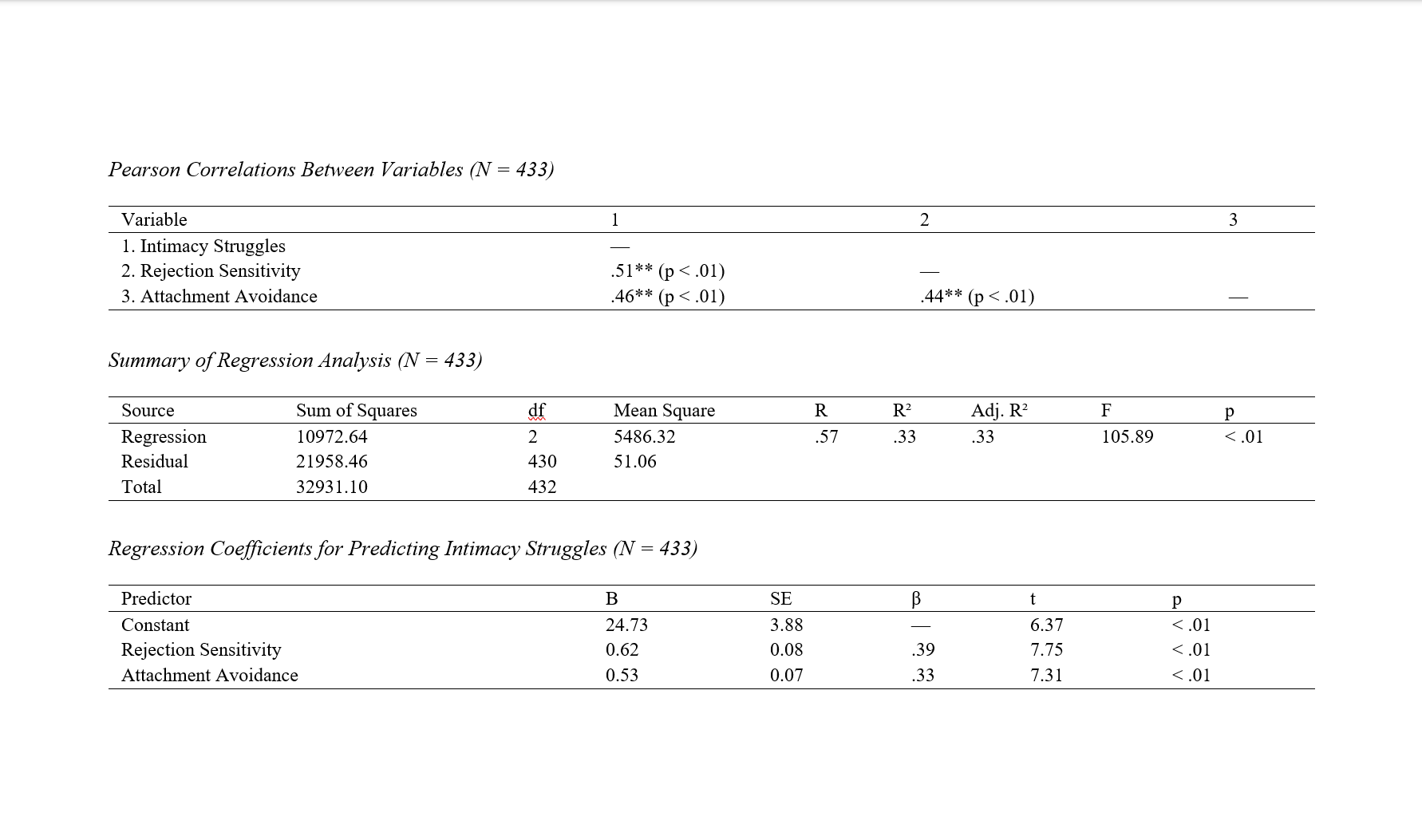
Findings: Results indicated significant positive correlations between intimacy struggles and both rejection sensitivity (r = .51, p < .01) and attachment avoidance (r = .46, p < .01). Multiple regression analysis revealed that rejection sensitivity (β = .39, t = 7.75, p < .01) and attachment avoidance (β = .33, t = 7.31, p < .01) were both significant predictors of intimacy struggles. The overall model was statistically significant, F(2, 430) = 105.89, p < .01, with an R² of .33, indicating that 33% of the variance in intimacy struggles was explained by the predictor variables.
Conclusion: The findings highlight that both rejection sensitivity and attachment avoidance are key psychological factors contributing to intimacy struggles in romantic relationships. These results underscore the importance of addressing underlying emotional vulnerabilities in relationship counseling and psychological interventions, particularly in culturally diverse populations such as adults in Mexico.
Downloads
References
Akhavan-Abiri, F., Shairi, M. R., & Gholami Fesharaki, M. (2019). The relationship between attachment and psychological distress with regard to the mediating role of mindfulness [Research]. Feyz Medical Sciences Journal, 23(1), 89-101. http://feyz.kaums.ac.ir/article-1-3691-en.html
Amichai‐Hamburger, Y., & Etgar, S. (2016). Intimacy and Smartphone Multitasking—A New Oxymoron? Psychological Reports, 119(3), 826-838. https://doi.org/10.1177/0033294116662658
Asad, V. (2025). Rejection Sensitivity, Urgency, and Interpersonal Difficulties in Young Adults. Pakistan Journal of Humanities and Social Sciences, 13(1), 46-55. https://doi.org/10.52131/pjhss.2025.v13i1.2590
Choi, J., & Lim, J. (2023). Does Your Childhood Attachment Make You Bully Your Lover? The Role of Rejection Sensitivity and Romantic Relationship Satisfaction. Emerging Adulthood, 11(6), 1423-1432. https://doi.org/10.1177/21676968231193185
Davis, T. J., Morris, M., & Drake, M. M. (2016). The moderation effect of mindfulness on the relationship between adult attachment and wellbeing. Personality and individual differences, 96, 115-121. https://www.sciencedirect.com/science/article/pii/S0191886916301350
Ercan, H. (2025). The Relationships Between Love Styles and Satisfaction in Romantic Relationships: the Mediating Role of Intimacy. Journal of Education and Future(28), 15-30. https://doi.org/10.30786/jef.1480912
Farajİ, H. (2024). Investigation of the Relationship Between Borderline Personality Organization and Perceived Abuse Experiences in Romantic Relationships: Moderating Role of Rejection Sensitivity. Journal of Health Sciences and Medicine, 7(3), 259-263. https://doi.org/10.32322/jhsm.1452696
Farajİ, H., BİLĞİŞ, C., & DarÇIn, Z. (2024). The Mediator Role of Rejection Sensitivity Between Perceived Maternal Narcissism and Self-Disclosure in Romantic Relationship. Türk Psikolojik Danışma Ve Rehberlik Dergisi, 14(72), 37-47. https://doi.org/10.17066/tpdrd.1237523_3
Finzi‐Dottan, R., & Abadi, H. Z. M. (2024). From Emotional Abuse to a Fear of Intimacy: A Preliminary Study of the Mediating Role of Attachment Styles and Rejection Sensitivity. International journal of environmental research and public health, 21(12), 1679. https://doi.org/10.3390/ijerph21121679
Geçer, E., Tongar, H. K., Söğütlü, L., Körez, M. K., Yıldırım, M., Akgül, Ö., Akgül, E., & Baysal, K. (2022). Examining the Impact of Turkish Couples’ Intimacy Levels in Romantic Relationship on Children’s Anxiety During the COVID-19 Pandemic. Electronic Journal of General Medicine, 19(3), em370. https://doi.org/10.29333/ejgm/11875
Ghasemi, Y. (2023). The Relationship Between Attachment Symbols, Attachment Styles and Self-Differentiation With Marital Intimacy. Obstetrics Gynecology and Reproductive Sciences, 7(4), 01-08. https://doi.org/10.31579/2578-8965/168
Giovazolias, T., & Paschalidi, E. (2022). The Effect of Rejection Sensitivity on Fear of Intimacy in Emerging Adulthood. European Journal of Psychology Open, 81(1), 1-12. https://doi.org/10.1024/2673-8627/a000019
Graziano, F., Mastrokoukou, S., Cattelino, E., Rollè, L., & Calandri, E. (2024). Conflict and Intimacy in Emerging Adults’ Romantic Relationships and Depressive Symptoms: The Mediating Role of Identity and Couple Satisfaction. Behavioral Sciences, 14(11), 977. https://doi.org/10.3390/bs14110977
İyiaydın, A. A., Toplu‐Demirtaş, E., Kayabol, N. B. A., & Rohner, R. P. (2023). All You Fear Is Love: The Roles of Rejection by Intimate Others. Personal Relationships, 30(2), 451-470. https://doi.org/10.1111/pere.12473
Latack, J. A., & Davila, J. (2016). Predicting Relational Security Among Early Adolescent Girls. Journal of Social and Personal Relationships, 33(6), 792-813. https://doi.org/10.1177/0265407515597563
Leite, Â. (2025). Cultural Validation of the Fear-of-Intimacy Scale for the Portuguese Population: Exploring Its Relationship With Sociosexual Orientation. International journal of environmental research and public health, 22(2), 274. https://doi.org/10.3390/ijerph22020274
Li, J., & Zhou, L. (2024). Efficacy of Mindfulness-Based Stress Reduction on Reducing Somatization and Attachment Anxiety: A Randomized Controlled Trial. Journal of Personality and Psychosomatic Research (JPPR), 1(4), 14-22. https://journals.kmanpub.com/index.php/jppr/article/view/2571
Mishra, M., & Allen, M. S. (2025). Face, Construct and Criterion Validity, and Test-Retest Reliability, of the Adult Rejection Sensitivity Questionnaire. European Journal of Psychological Assessment, 41(2), 144-153. https://doi.org/10.1027/1015-5759/a000782
Navabinejad, S., Rostami, M., & Parsakia, K. (2024). Influences of Family Structure and Intimacy on Emotional Divorce: A Cross-Sectional Analysis. Journal of Psychosociological Research in Family and Culture, 2(1), 23-30. https://doi.org/10.61838/kman.jprfc.2.1.5
Nezamalmolki, M. (2024). Effectiveness of integrative couple therapy on sexual function, marital intimacy, and impulsivity in women affected by marital infidelity. Jarac, 6(2), 19-26. https://doi.org/10.61838/kman.jarac.6.2.3
Norona, J. C., Tregubenko, V., Boiangiu, S. B., Levy, G., Scharf, M., Welsh, D. P., & Shulman, S. (2017). Changes in Rejection Sensitivity Across Adolescence and Emerging Adulthood: Associations With Relationship Involvement, Quality, and Coping. Journal of adolescence, 63(1), 96-106. https://doi.org/10.1016/j.adolescence.2017.12.006
Opekina, T. P., & Saporovskaya, M. V. (2022). Peculiarities of Emotional States of Adults in a Situation of Long-Term Absence of Romantic Relationships. Herald of Omsk University Series Psychology(4), 55-61. https://doi.org/10.24147/2410-6364.2022.4.55-61
Özabacı, N., & Eryılmaz, A. (2015). The Sources of Self-Esteem: Initating and Maintaining Romantic Intimacy at Emerging Adulthood in Turkey. Journal of Human Sciences, 12(1), 179. https://doi.org/10.14687/ijhs.v12i1.3014
Richter, M., & Schoebi, D. (2021). Rejection Sensitivity in Intimate Relationships. Zeitschrift Für Psychologie, 229(3), 165-170. https://doi.org/10.1027/2151-2604/a000448
Richter, M., & Schoebi, D. (2023). Rejection Sensitivity in Intimate Relationships: Implications for Perceived Partner Responsiveness. https://doi.org/10.31234/osf.io/bfjv9
Schacter, H. L., Lessard, L. M., & Juvonen, J. (2019). Peer Rejection as a Precursor of Romantic Dysfunction in Adolescence: Can Friendships Protect? Journal of adolescence, 77(1), 70-80. https://doi.org/10.1016/j.adolescence.2019.10.004
Settegast, S. (2024). What Is Sexual Intimacy? Think, 23(67), 53-58. https://doi.org/10.1017/s1477175623000489
Uçar, S., & Demır, İ. (2022). Exploring Romantic Relationship Patterns Among Turkish Emerging Adults: A Grounded Theory Study. Emerging Adulthood, 11(1), 88-102. https://doi.org/10.1177/21676968221094751
Vakilian, K., Ebrahimi, S., Fouladvand, M., Moslemi, A., & Najdi, N. (2024). Predicting Commitment of Married Women Based on Emotional Intimacy, Cognitive Flexibility, and Irrational Beliefs of Infertile Couples in Arak City in the 2021:A Cross-Sectional Study. The Open Public Health Journal, 17(1). https://doi.org/10.2174/0118749445267020240209073345
Yahiiaiev, I., Savych, M., & Keller, V. (2020). The Connection Between Social Media Use and Relationship Satisfaction. Bulletin of Taras Shevchenko National University of Kyiv Series “Psychology”(2 (12)), 109-114. https://doi.org/10.17721/bsp.2020.2(12).20
Downloads
Additional Files
Publication Timeline
- Submitted
- Revised
- Accepted
Issue
Section
License

This work is licensed under a Creative Commons Attribution-NonCommercial 4.0 International License.