Cognitive Representations of Future Self as Predictors of Motivational Impairment in Women with PTSD
DOI:
https://doi.org/10.61838/kman.pwj.4333Keywords:
Post-traumatic stress disorder, future self, motivation, time perspective, women, traumaAbstract
Objective: This study aimed to explore how cognitive representations of the future self predict motivational impairment in women diagnosed with post-traumatic stress disorder (PTSD).
Methods and Materials: Using a qualitative research design, the study employed a phenomenological approach to investigate the lived experiences of 25 women with clinically diagnosed PTSD residing in urban areas of Mexico. Participants were selected through purposive sampling from trauma recovery centers and interviewed using semi-structured formats. Interviews focused on perceptions of the future self, goal orientation, and motivational capacity. Thematic analysis was conducted following Braun and Clarke’s six-phase method, with data coding and organization supported by NVivo 14. Data collection continued until theoretical saturation was achieved.
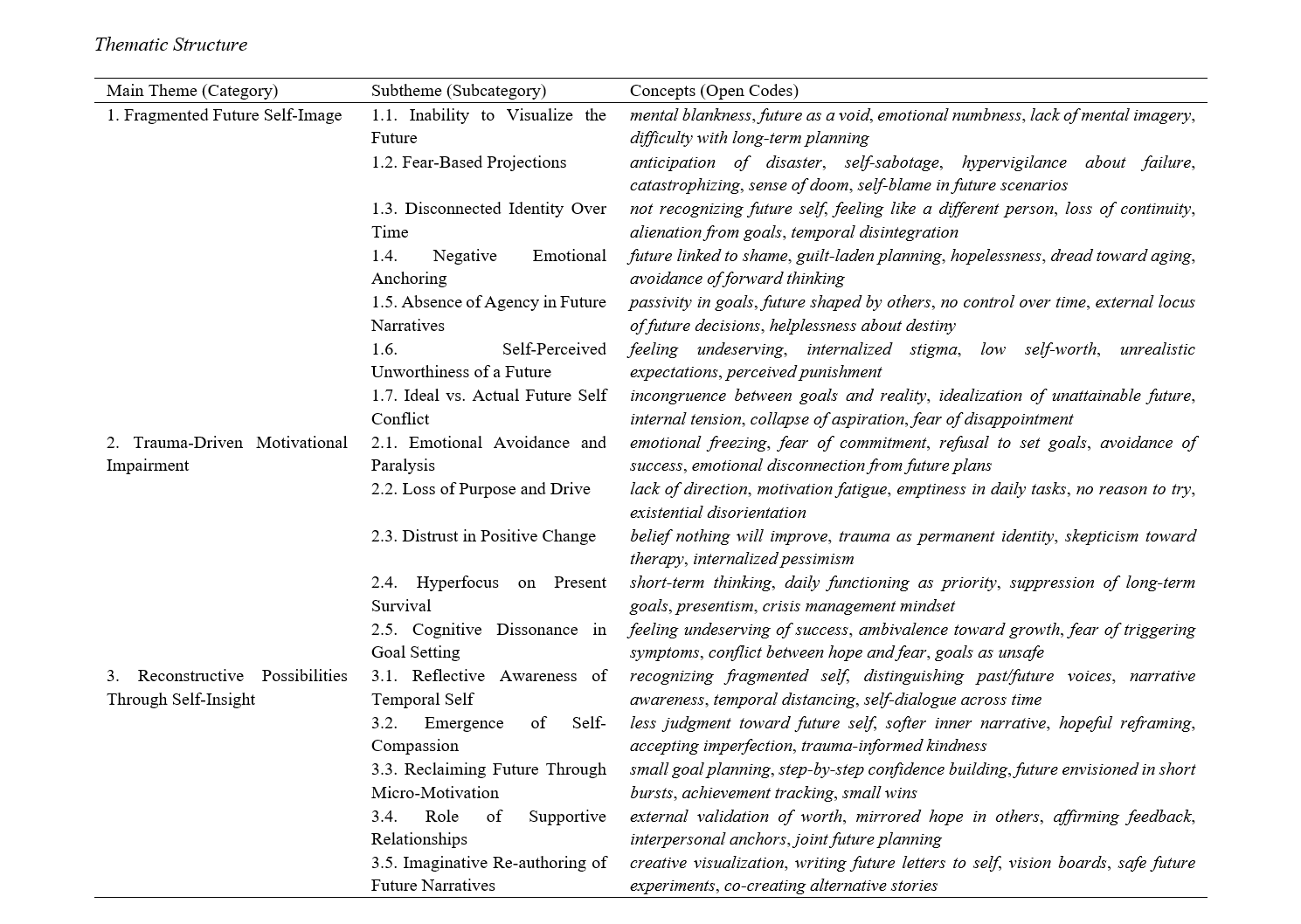
Findings: Three overarching themes emerged from the data: (1) Fragmented Future Self-Image, including subthemes such as fear-based future projections and absence of agency; (2) Trauma-Driven Motivational Impairment, characterized by emotional avoidance, loss of drive, and cognitive dissonance in goal setting; and (3) Reconstructive Possibilities Through Self-Insight, including the emergence of self-compassion, micro-motivation strategies, and support from interpersonal relationships. Participants reported a high degree of temporal disintegration, with future self-images often perceived as emotionally negative, unrealistic, or inaccessible. However, small-scale future planning and narrative reframing were identified as pathways for motivational recovery.
Conclusion: The findings highlight that PTSD significantly alters cognitive representations of the future self, leading to motivational deficits rooted in fear, avoidance, and identity fragmentation. Nevertheless, therapeutic interventions that foster time perspective balance, future self-continuity, and compassionate self-narratives may restore agency and motivational engagement in trauma-affected women.
Downloads
References
Contractor, A. A., Jin, L., Sameen, D.-e., & Weiss, N. H. (2025). Posttraumatic Stress Disorder Symptom Profiles and Positive Memory Characteristics Among South Asians in the United States. Traumatology an International Journal. https://doi.org/10.1037/trm0000534
Farrelly, K., Romero‐Sanchiz, P., Mahu, I. T., Barrett, S. P., Collins, P., Rasic, D., & Stewart, S. H. (2021). Do Cannabis Use Motives Mediate the Relationship Between PTSD Symptoms and Cannabis Craving to Trauma Cues? https://doi.org/10.26828/cannabis.2021.01.000.27
Farrelly, K. N., Romero‐Sanchiz, P., Mahu, T., Barrett, S. P., Collins, P., Rasic, D., & Stewart, S. H. (2021). Posttraumatic Stress Disorder Symptoms and Coping Motives Are Independently Associated With Cannabis Craving Elicited by Trauma Cues. Journal of Traumatic Stress, 35(1), 178-185. https://doi.org/10.1002/jts.22715
Malekiha, M., & Moradi, B. (2019). Effectiveness of Time Perspective Therapy on Increasing Psychological Well-Being and Happiness in Veterans With PTSD. Iranian Journal of War and Public Health, 11(3), 153-159. https://doi.org/10.29252/ijwph.11.3.153
Mastroleo, N. R., Possemato, K., King, P. R., Balderrama‐Durbin, C., Crinnin, C., Cigrang, J., Read, J. P., Borsari, B., Maisto, S. A., & Rauch, S. A. M. (2023). Development and Initial Testing of a Brief, Integrated Intervention Aimed at Reducing Heavy Alcohol Use and PTSD Among Military Veterans in Primary Care. Professional Psychology Research and Practice, 54(1), 70-82. https://doi.org/10.1037/pro0000489
Mengxin, Z., & Zilan, Y. (2022). The Relationship Between Intrusive Rumination and Post-Traumatic Stress Disorder: The Mediating Role of Balanced Time Perspective. Advances in Educational Technology and Psychology, 6(11). https://doi.org/10.23977/aetp.2022.061107
Nikishina, V. B., Petrash, E. A., & Unina-Pakulova, N. Y. (2025). Motivational Structure of the Time Perspective of Combatants. National Psychological Journal, 20(2), 67-79. https://doi.org/10.11621/npj.2025.0205
Pan, Y. (2024). Admiration and Motivation: Key Factors in Managing PTSD Among Firefighters. BMC public health, 24(1). https://doi.org/10.1186/s12889-024-19420-x
Rezaie, F., Arefi, M., & Golparvar, M. (2024a). Comparison of the Effectiveness of Time Perspective Therapy and Cognitive-Behavioral Therapy on Academic Motivation, Academic Engagement, Academic Procrastination, and Academic Persistence in Flood-Affected Secondary School Students With Post-Traumatic Stress Disorder Symptoms. Jsied, 4(1), 131-149. https://doi.org/10.61838/jsied.4.1.7
Rezaie, F., Arefi, M., & Golparvar, M. (2024b). Comparison of the Effectiveness of Time Perspective Therapy With Mindfulness on Academic Motivation, Academic Fascination, Academic Procrastination and Academic Sustainability of Flood-Affected Secondary Students With Symptoms of Post-Traumatic Stress Disorder. KMAN Counsel and Psych Nexus, 2(1), 162-172. https://doi.org/10.61838/kman.psychnexus.2.1.23
Saltzman, L. Y., & Terzis, L. (2024). Psychological Predictors of the Time Perspective: The Role of Posttraumatic Stress Disorder, Posttraumatic Growth, and Temporal Triggers in a Sample of Bereaved Adults. PLoS One, 19(3), e0298445. https://doi.org/10.1371/journal.pone.0298445
Shen, Q. F., Mu, Y., & Shin, P.-Y. (2024). Health Behavior Change in Post-Traumatic Stress Disorder: Patient Perspectives. JPPR, 2(3), 35-42. https://doi.org/10.61838/kman.jppr.2.3.6
Shepherd‐Banigan, M., Shapiro, A., Stechuchak, K. M., Sheahan, K. L., Ackland, P. E., Smith, V. A., Bokhour, B. G., Glynn, S. M., Calhoun, P. S., Edelman, D., Weidenbacher, H. J., Eldridge, M. R., & Houtven, C. H. V. (2023). Exploring the Importance of Predisposing, Enabling, and Need Factors for Promoting Veteran Engagement in Mental Health Therapy for Post-Traumatic Stress: A Multiple Methods Study. BMC psychiatry, 23(1). https://doi.org/10.1186/s12888-023-04840-7
Tufan, İ., Bayraktar, F., Perspektifleri, Z., Semptom Ölçüm Araçları Olarak, K., Envanteri, O., Etkisi, Ö., Zimbardo'nun, Z. V., & Perspektifleri, E. (2020). The Predictors of Time Perspectives: A Comparative Study From Cyprus. Nesne Psikoloji Dergisi, 8(18). https://doi.org/10.7816/nesne-08-18-02
Walg, M., Eder, L. L., Martin, A., & Hapfelmeier, G. (2020). Distorted Time Perspective in Adolescent Afghan and Syrian Refugees Is Associated With Psychological Distress. The Journal of Nervous and Mental Disease, 208(9), 729-735. https://doi.org/10.1097/nmd.0000000000001194
Zaso, M. J., Colder, C. R., Fetkenhour, L. M., & Read, J. P. (2024). Role of Momentary Alcohol Cognitions in Event-Level Relations Between PTSD Symptoms and Alcohol Outcomes: Le Rôle Des Cognitions Momentanées Liées À L’alcool Au Niveau De L’événement Entre Les Symptômes Du TSPT Et La Consommation D’alcool. The Canadian Journal of Psychiatry, 70(1), 32-40. https://doi.org/10.1177/07067437241300082
Zelenska, K. (2020). Phenomenological Structure of Post-Stress Disorders in Volunteers Whose Activities Are Related to Military Servicemen Support in the ATO Zone. Експериментальна І Клінічна Медицина, 88(3), 62-66. https://doi.org/10.35339/ekm.2020.88.03.08
Downloads
Additional Files
Publication Timeline
- Submitted
- Revised
- Accepted
Issue
Section
License
Copyright (c) 2025 Juan Camilo Ríos (Author); Carlos Hernández; Bridget Abalorio (Author)

This work is licensed under a Creative Commons Attribution-NonCommercial 4.0 International License.