


















The Relationship Between Sense of Coherence and Post-Traumatic Growth in Breast Cancer Survivors: The Mediating Roles of Stress-Related Benefit Finding and Positive Changes in Attitudes Toward Life
Objective: This study aimed to investigate the relationship between sense of coherence and post-traumatic growth in breast cancer survivors, with stress-related benefit finding and positive changes in attitudes toward life as mediating variables.
Methods and Materials: This descriptive-correlational study employed structural equation modeling. The statistical population consisted of breast cancer survivors in Mashhad, Iran, from whom 400 participants were selected using convenience sampling. Data were collected using Antonovsky’s 29-item Sense of Coherence Questionnaire (1987), Tedeschi and Calhoun’s 21-item Post-Traumatic Growth Inventory (1996), Park’s 17-item Stress-Related Benefit-Finding Questionnaire (1998), and Wallace and Wright’s 24-item Attitude Toward Life Questionnaire (2005). Data were analyzed using SPSS for preliminary statistical analyses and AMOS version 24 for testing the measurement and structural models. Direct and indirect relationships among the study variables were examined, and bootstrap analysis was used to assess the significance of the mediating effects.
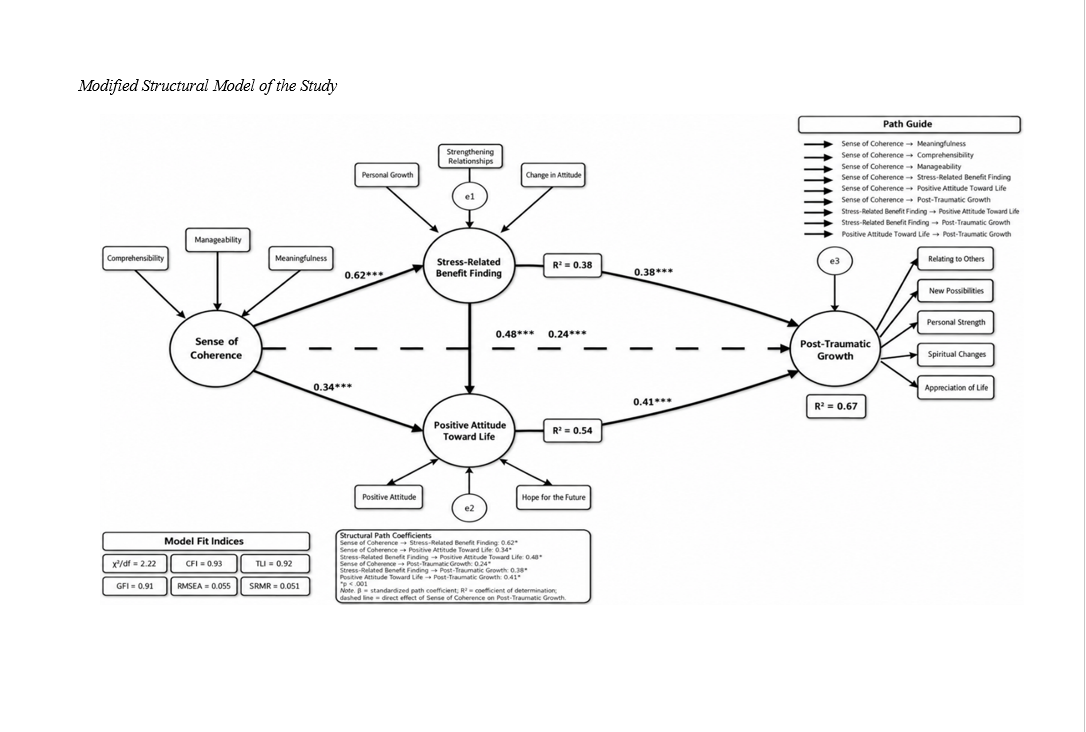
Findings: Structural equation modeling indicated that sense of coherence had a positive and statistically significant direct relationship with post-traumatic growth. Stress-related benefit finding significantly mediated the relationship between sense of coherence and post-traumatic growth. Positive changes in attitudes toward life also demonstrated a statistically significant independent mediating effect in this relationship. Furthermore, bootstrap analysis confirmed that the simultaneous indirect effect of stress-related benefit finding and positive changes in attitudes toward life on the association between sense of coherence and post-traumatic growth was statistically significant. The final structural model also demonstrated an acceptable overall fit, supporting the hypothesized relationships among the study variables.
Conclusion: Sense of coherence appears to facilitate post-traumatic growth among breast cancer survivors both directly and through adaptive psychological processes involving benefit finding and positive reconstruction of attitudes toward life.