Comparing the Effectiveness of Mindfulness-Based Cognitive Therapy and Positive Psychology Interventions on Self-Acceptance in Women with Chronic Tension-Type Headache
Keywords:
Chronic Tension-Type Headache, Mindfulness-Based Cognitive Therapy, Positive Psychology Interventions, Self-Acceptance, WomenAbstract
Objective: This study aimed to compare the effectiveness of mindfulness-based cognitive therapy (MBCT) and positive psychology interventions (PPI) in improving self-acceptance among women with chronic tension-type headache.
Methods and Materials: This quasi-experimental study employed a pretest–posttest design with a two-month follow-up and a control group. The study population comprised women diagnosed with chronic tension-type headache in Tehran, Iran, in 2025. Sixty participants were recruited through convenience sampling and assigned to three groups: MBCT (n = 20), PPI (n = 20), and control (n = 20). Both interventions were administered in eight 120-minute sessions, conducted twice weekly, while the control group received no intervention. Self-acceptance was measured using the Beck Self-Concept Test at pretest, posttest, and follow-up. Data were analyzed using mixed repeated-measures analysis of variance and Bonferroni-adjusted pairwise comparisons in SPSS version 23.
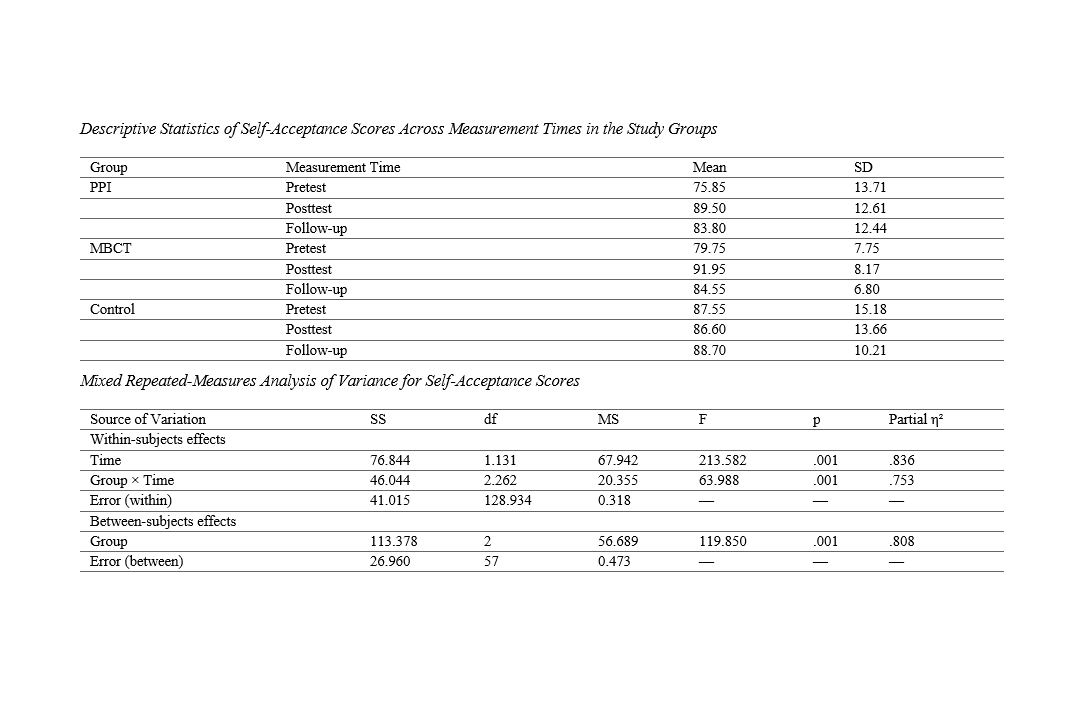
Findings: Mixed repeated-measures analysis of variance revealed statistically significant main effects of time and group and a significant time-by-group interaction on self-acceptance. Bonferroni-adjusted comparisons demonstrated significant improvements from pretest to posttest and from pretest to follow-up in both intervention groups, whereas changes in the control group were nonsignificant. Both MBCT and PPI produced significantly higher self-acceptance scores than the control condition at posttest and follow-up (p < .001). Furthermore, PPI demonstrated significantly greater effectiveness than MBCT at both posttest and follow-up assessments (p < .001), indicating a comparative advantage maintained over the two-month follow-up period.
Conclusion: Both MBCT and PPI were effective in improving self-acceptance among women with chronic tension-type headache, with PPI demonstrating superior and sustained outcomes. These findings suggest that positive psychology interventions may represent a promising psychological approach for enhancing self-acceptance in this population. Further randomized studies with longer follow-up periods are recommended to establish the durability and clinical significance of these improvements.
Downloads
References
Blasco-Belled, A., Tejada-Gallardo, C., & Alsinet, C. (2025). Positive psychology interventions can improve mental health for chronic pain patients: A systematic review and meta-analysis. Psychology & Health, 40(4), 635-651. https://doi.org/10.1080/08870446.2023.2250382
Braunwalder, C., Müller, R., Glisic, M., & Fekete, C. (2022). Are positive psychology interventions efficacious in chronic pain treatment? A systematic review and meta-analysis of randomized controlled trials. Pain Medicine, 23(1), 122-136. https://doi.org/10.1093/pm/pnab247
Flink, I. K., Smeets, E., Bergbom, S., & Peters, M. L. (2015). Happy despite pain: Pilot study of a positive psychology intervention for patients with chronic pain. Scandinavian journal of pain, 7(1), 71-79. https://doi.org/10.1016/j.sjpain.2015.01.005
Grazzi, L., D'Amico, D., & Guastafierro, E. (2023). Efficacy of mindfulness added to treatment as usual in patients with chronic migraine and medication overuse headache: A phase-III single-blind randomized-controlled trial (the MIND-CM study). The Journal of Headache and Pain, 24, 86. https://doi.org/10.1186/s10194-023-01630-0
Martinez-Calderon, J., García-Muñoz, C., Rufo-Barbero, C., Matias-Soto, J., & Cano-García, F. J. (2024). Acceptance and commitment therapy for chronic pain: An overview of systematic reviews with meta-analysis of randomized clinical trials. The Journal of Pain, 25(3), 595-617. https://doi.org/10.1016/j.jpain.2023.09.013
McCracken, L. M., & Zhao-O'Brien, J. (2010). General psychological acceptance and chronic pain: There is more to accept than the pain itself. European Journal of Pain, 14(2), 170-175. https://doi.org/10.1016/j.ejpain.2009.03.004
Mistretta, E. G., Davis, M. C., Bartsch, E. M., & Olah, M. S. (2023). Self-compassion and pain disability in adults with chronic pain: The mediating role of future self-identification and self-efficacy. Journal of Health Psychology, 28(11), 1044-1056. https://doi.org/10.1177/13591053231167275
Müller, R., Gertz, K. J., Molton, I. R., Terrill, A. L., Bombardier, C. H., Ehde, D. M., & Jensen, M. P. (2016). Effects of a tailored positive psychology intervention on well-being and pain in individuals with chronic pain and a physical disability: A feasibility trial. The Clinical Journal of Pain, 32(1), 32-44. https://doi.org/10.1097/AJP.0000000000000225
Müller, R., Segerer, W., Ronca, E., Gemperli, A., Stirnimann, D., Scheel-Sailer, A., & Jensen, M. P. (2022). Inducing positive emotions to reduce chronic pain: A randomized controlled trial of positive psychology exercises. Disability and Rehabilitation, 44(12), 2691-2704. https://doi.org/10.1080/09638288.2020.1850888
Pei, J. H., Ma, T., Nan, R. L., Chen, H. X., Zhang, Y. B., Gou, L., & Dou, X. M. (2021). Mindfulness-based cognitive therapy for treating chronic pain: A systematic review and meta-analysis. Psychology, Health & Medicine, 26(3), 333-346. https://doi.org/10.1080/13548506.2020.1849746
Peters, M. L., Smeets, E., Feijge, M., van Breukelen, G., Andersson, G., Buhrman, M., & Linton, S. J. (2017). Happy despite pain: A randomized controlled trial of an 8-week internet-delivered positive psychology intervention for enhancing well-being in patients with chronic pain. The Clinical Journal of Pain, 33(11), 962-975. https://doi.org/10.1097/AJP.0000000000000494
Ploesser, M., & Martin, D. (2024). Mechanism of action of mindfulness-based interventions for pain relief: A systematic review. Journal of Integrative and Complementary Medicine, 30(12), 1162-1178. https://doi.org/10.1089/jicm.2023.0328
Rashid, T., & Seligman, M. E. P. (2013). Positive psychotherapy. In D. Wedding & R. J. Corsini (Eds.), Current psychotherapies (pp. 461-498). Cengage Learning.
Reed, D. E., Cobos, B., Nagpal, A. S., Eckmann, M., & McGeary, D. D. (2022). The role of identity in chronic pain cognitions and pain-related disability within a clinical chronic pain population. The International Journal of Psychiatry in Medicine, 57(1), 35-52. https://doi.org/10.1177/0091217421989141
Rehman, M. A. U., Waseem, R., Habiba, U., Wasim, M. F., Rehmani, S. A., Rehmani, M. A., Abdullah, M., Khabir, Y., Hashmi, M. R., Almas, T., Ali, S. S., Shah, S. M. H., & Fatima, K. (2022). Efficacy of mindfulness-based intervention for the treatment of chronic headaches: A systematic review and meta-analysis. Annals of medicine and surgery, 78, 103862. https://doi.org/10.1016/j.amsu.2022.103862
Segal, Z. V., Williams, J. M. G., & Teasdale, J. D. (2013). Mindfulness-based cognitive therapy for depression (2 ed.). Guilford Press.
Sharpe, L., Richmond, B., Menzies, R. E., Forrest, D., Crombez, G., & Colagiuri, B. (2024). A synthesis of meta-analyses of mindfulness-based interventions in pain. Pain, 165(1), 18-28. https://doi.org/10.1097/j.pain.0000000000002997
Voorhees, H. L. (2023). "I was literally just not myself": How chronic pain changes multiple frames of identity. Health Communication, 38(8), 1641-1653. https://doi.org/10.1080/10410236.2022.2025702
Yu, L., & McCracken, L. M. (2025). The self in pain. Current opinion in psychology, 62, 101972. https://doi.org/10.1016/j.copsyc.2024.101972
Downloads
Additional Files
Publication Timeline
- Submitted
- Revised
- Accepted