Comparison of The Effectiveness of Training in Effective Teaching Strategies and A Behavior Management Program on The Self-Concept of Students with Attention-Deficit/Hyperactivity Disorder
DOI:
https://doi.org/10.61838/kman.isn.psynexus.4800Keywords:
teaching strategies, behavior management program, self-concept, attention-deficit/hyperactivity disorder (ADHD)Abstract
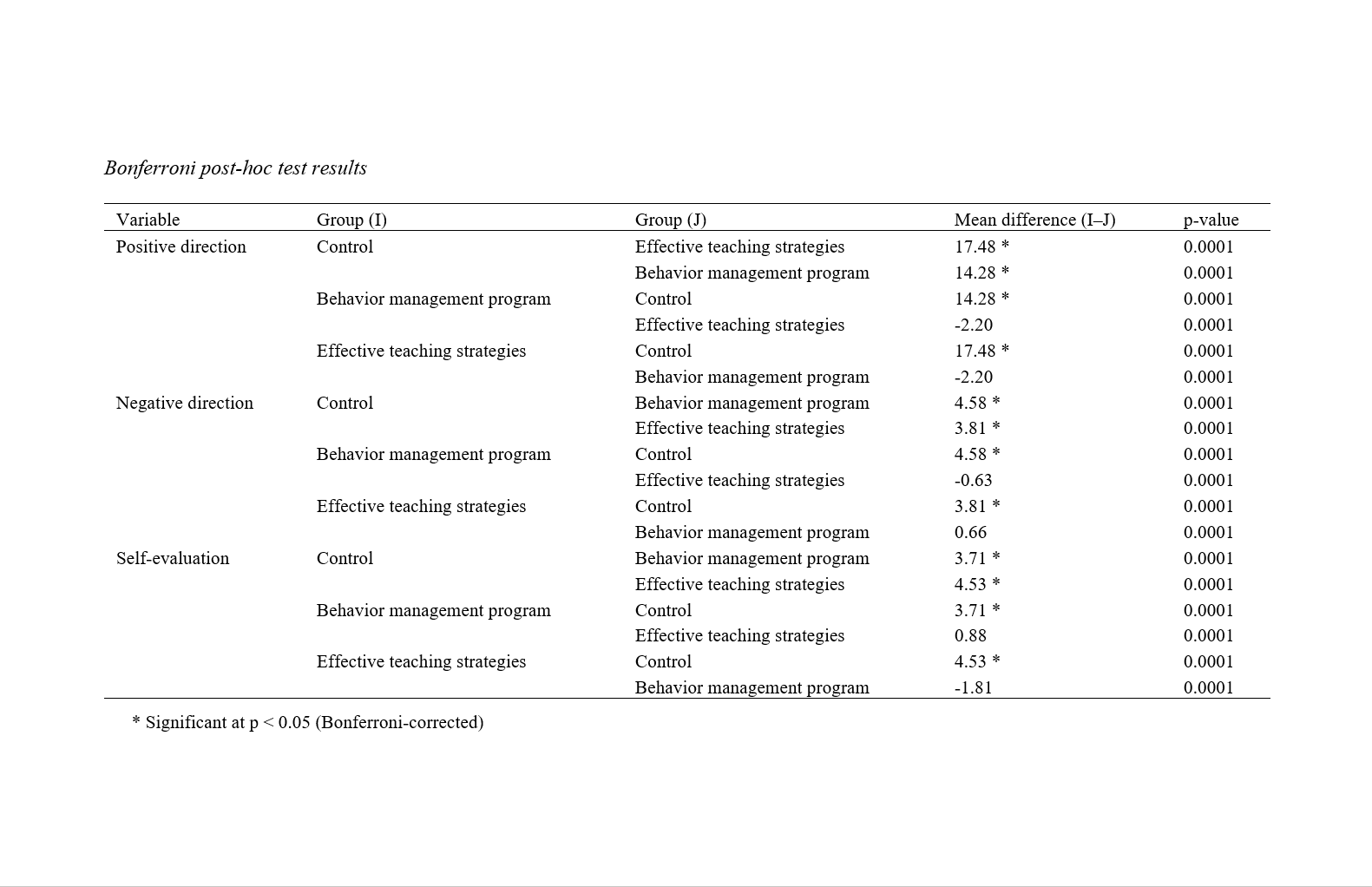
Children with attention-deficit/hyperactivity disorder (ADHD) experience difficulties with their families and teachers, and these weaknesses expose them to many academic problems. Therefore, the present study was conducted with the aim of comparatively examining the effectiveness of educational strategies and behavior management programs on the self-concept of students with ADHD in Miandoroud County. The present study was a semi-experimental research with a pretest–posttest design. The statistical population consisted of all primary school students with ADHD. The Piers–Harris Children’s Self-Concept Scale (1963) was used. A sample of 45 students was selected through multi-stage cluster random sampling and assigned to three groups of 15. The first experimental group received an educational intervention on effective teaching strategies, the second group received training in behavior management, and finally all three groups completed the posttest. The group training sessions on effective teaching methods and behavior management were held over 6 weeks, 60 minutes per day. Descriptive statistics (indices of central tendency and dispersion) and mixed-design repeated-measures analysis of variance, while observing statistical assumptions, were used to test the hypotheses. The data were analyzed using SPSS-26 software. The results of this study showed that both approaches—effective teaching strategies and the behavior management program—had a significant effect on the students’ self-concept, with an eta coefficient of 0.56 (P<0.001). After follow-up, a significant difference remained between the intervention and control groups (P<0.001). The findings indicate that effective teaching strategies and behavior management programs have a significant impact on academic achievement, self-management, self-regulation, and self-concept among students with ADHD.
Downloads
References
Amiri, M. (2020). The effectiveness of parents behavior training on hyperactivity/impulsiveness and rule breaking of their children with ADHD. Research in Cognitive Health, 9(4), 90-101. https://rph.khu.ac.ir/article-1-2604-en.html
Baquiran, S., Ignacio, I. Y., Cua, J., Hernandez, M. S., & Uy, R. (2024). Interpersonal Communication Competence: The Role of Sex, Parenting Styles, and Attachment Styles. Journal of Humanities and Social Sciences Studies, 6(6), 43-62. https://doi.org/10.32996/jhsss.2024.6.6.6
Barkley, R. A., Fischer, M., Edelbrock, C., & Smallish, L. (2020). The adolescent outcome of hyperactive children diagnosed by research criteria: III. Mother-child interactions, family conflicts and maternal psychopathology. Journal of Child Psychology and Psychiatry, 32(2), 233-255. https://doi.org/10.1111/j.1469-7610.1991.tb00304.x
Biederman, J., Monuteaux, M. C., Doyle, A. E., Seidman, L. J., Wilens, T. E., Ferrero, F., Morgan, C. L., & Faraone, S. V. (2020). Impact of executive function deficits and ADHD on academic outcomes in children. Journal of consulting and clinical psychology, 72(5), 757-766. https://doi.org/10.1037/0022-006X.72.5.757
Bröning, S., & Wartberg, L. (2024). Attachment Orientations: Associations with Romantic Partners' Self-Regulation and Dyadic Coping. Journal of sex & marital therapy, 50(4), 512-526. https://doi.org/10.1080/0092623X.2024.2322566
Cantwell, D. P., & Satterfield, J. H. (2021). Prevalence of Academic Underachievement in Hyperactive Children. Journal of Pediatric Psychology, 3(4), 168-171. https://doi.org/10.1093/jpepsy/3.4.168
Elliott, T. R., Perrin, P. B., Powers, M. B., Duffeck, D., & Warren, A. M. (2023). Resilience and Distress among Individuals with Chronic Health Conditions During the Initial Wave of the COVID-19 Pandemic. Journal of Affective Disorders Reports, 100710. https://doi.org/10.1016/j.jadr.2023.100710
Floricica, C. M., Luminita, S. M., & Ioana, P. I. (2022). The relation between attachment styles and self-esteem in adolescents. Technium Social Sciences Journal, 33, 430.
García-Martínez, I., Augusto-Landa, J. M., Quijano-López, R., & León, S. P. (2022). Self-concept as a mediator of the relation between university students' resilience and academic achievement. Frontiers in psychology, 12, 747168. https://doi.org/10.3389/fpsyg.2021.747168
Henry, L. A., Christopher, E., Chiat, S., & Messer, D. J. (2022). A Short and Engaging Adaptive Working-Memory Intervention for Children with Developmental Language Disorder: Effects on Language and Working Memory. Brain Sciences, 12(5), 642. https://doi.org/10.3390/brainsci12050642
Kahveci, H. (2023). The Positive and Negative Effects of Teacher Attitudes and Behaviors on Student Progress. Journal of Pedagogical Research, 7(1), 290-306. https://doi.org/10.33902/JPR.202319128
Kent, K. M., Pelham, W. E., Molina, B. S. G., Sibley, M. H., Waschbusch, D. A., Yu, J., Gnagy, E. M., Biswas, A., Babinski, D. E., & Karch, K. M. (2021). The academic experience of male high school students with ADHD. Journal of abnormal child psychology, 39(3), 451-462. https://doi.org/10.1007/s10802-010-9472-4
Kuriyan, A. B., Pelham, W. E., Molina, B. S., Waschbusch, D. A., Gnagy, E. M., Sibley, M. H., Babinski, D. E., Walther, C., Cheong, J. W., Yu, J., & Kent, K. M. (2021). Young adult educational and vocational outcomes of children diagnosed with ADHD. Journal of abnormal child psychology, 41(1), 27-41. https://doi.org/10.1007/s10802-012-9658-z
Pavinato, L., Delle Vedove, A., Carli, D., Ferrero, M., Carestiato, S., Howe, J. L., Agolini, E., Coviello, D. A., van de Laar, I., Au, P. Y. B., Di Gregorio, E., Fabbiani, A., Croci, S., Mencarelli, M. A., Bruno, L. P., Renieri, A., Veltra, D., Sofocleous, C., Faivre, L., . . . Brusco, A. (2023). CAPRIN1 haploinsufficiency causes a neurodevelopmental disorder with language impairment, ADHD and ASD. Brain, 146(2), 534-548. https://doi.org/10.1093/brain/awac278
Rambod, M., Hamidizadeh, S., Bazrafshan, M. R., & Parviniannasab, A. M. (2023). Risk and protective factors for resilience among adolescents and young adults with beta-thalassemia major. BMC psychology, 11(1), 231. https://doi.org/10.1186/s40359-023-01268-2
Rapp, L., Mai-Lippold, S. A., Georgiou, E., & Pollatos, O. (2023). Elevated EEG heartbeat-evoked potentials in adolescents with more ADHD symptoms. Biological Psychology, 184, 108698. https://doi.org/10.1016/j.biopsycho.2023.108698
Riehm, K. E., Brenneke, S. G., Adams, L. B., Gilan, D., Lieb, K., Kunzler, A. M., Smail, E. J., Holingue, C., Stuart, E. A., Kalb, L. G., & Thrul, J. (2021). Association between psychological resilience and changes in mental distress during the COVID-19 pandemic. Journal of affective disorders, 282, 381-385. https://doi.org/10.1016/j.jad.2020.12.071
Rohde, L. A., Biederman, J., Busnello, E. A., Zimmermann, H., Schmitz, M., Martins, S., & Tramontina, S. (2020). ADHD in a School Sample of Brazilian Adolescents: A Study of Prevalence, Comorbid Conditions, and Impairments. Journal of the American Academy of Child and Adolescent Psychiatry, 38(6), 716-722. https://doi.org/10.1097/00004583-199906000-00019
Sepahvand, A. (2024). The effectiveness of cooperative teaching methods on academic self-concept and school engagement in elementary students in Khorramabad. Journal of New Advances in Behavioral Sciences, 9(57), 83-93. http://ijndibs.com/article-1-976-fa.html
Steinberg, O., Kulakow, S., & Raufelder, D. (2024). Academic self-concept, achievement, and goal orientations in different learning environments. European Journal of Psychology of Education. https://doi.org/10.1007/s10212-024-00825-6
Superbia-Guimarães, L., Bader, M., & Camos, V. (2022). Attentional Orienting in Working Memory in Children with ADHD. Developmental Neuropsychology, 47(8), 384-400. https://doi.org/10.1080/87565641.2022.2155164
Thistle, J. E., Ramos, A., Roell, K. R., Choi, G., Manley, C. K., Hall, A. M., Villanger, G. D., Cequier, E., Sakhi, A. K., Thomsen, C., Zeiner, P., Reichborn-Kjennerud, T., Øvergaard, K. R., Herring, A., Aase, H., & Engel, S. M. (2022). Prenatal organophosphorus pesticide exposure and executive function in preschool-aged children in the Norwegian Mother, Father and Child Cohort Study (MoBa). Environmental research, 212, 113555. https://doi.org/10.1016/j.envres.2022.113555
Varshney, D., & Varshney, N. K. (2023). Self-concept and job performance: the mediating role of resilience. International Journal of Productivity and Performance Management, 14-11. https://doi.org/10.1108/IJPPM-02-2023-0061
Veryanto, S., Noviyanti, A. I., & Masyitoh, D. (2025). Sociodrama-Based Education: Improving Students’ Positive Self-Concepts in Indonesian Secondary Schools. Edu, 342-350. https://doi.org/10.59397/edu.v3i2.108
Zatz, S., & Chassin, L. (2021). Cognitions of test-anxious children. Journal of consulting and clinical psychology, 51(4), 526-534. https://doi.org/10.1037//0022-006X.51.4.526
Zhang, H. (2024). Psychological Wellbeing in Chinese University Students: Insights Into the Influences of Academic Self-Concept, Teacher Support, and Student Engagement. Frontiers in psychology, 14. https://doi.org/10.3389/fpsyg.2023.1336682
Downloads
Additional Files
Publication Timeline
- Submitted
- Revised
- Accepted