Comparison of the Effectiveness of Acceptance and Commitment Therapy and Logotherapy on Guilt, Parenting Stress, and Psychological Burnout in Mothers of Children with High-Functioning Autism Spectrum Disorder
Keywords:
Acceptance and Commitment Therapy, Logotherapy, Parental Guilt, Parenting Stress, Parental Burnout, Autism Spectrum DisorderAbstract
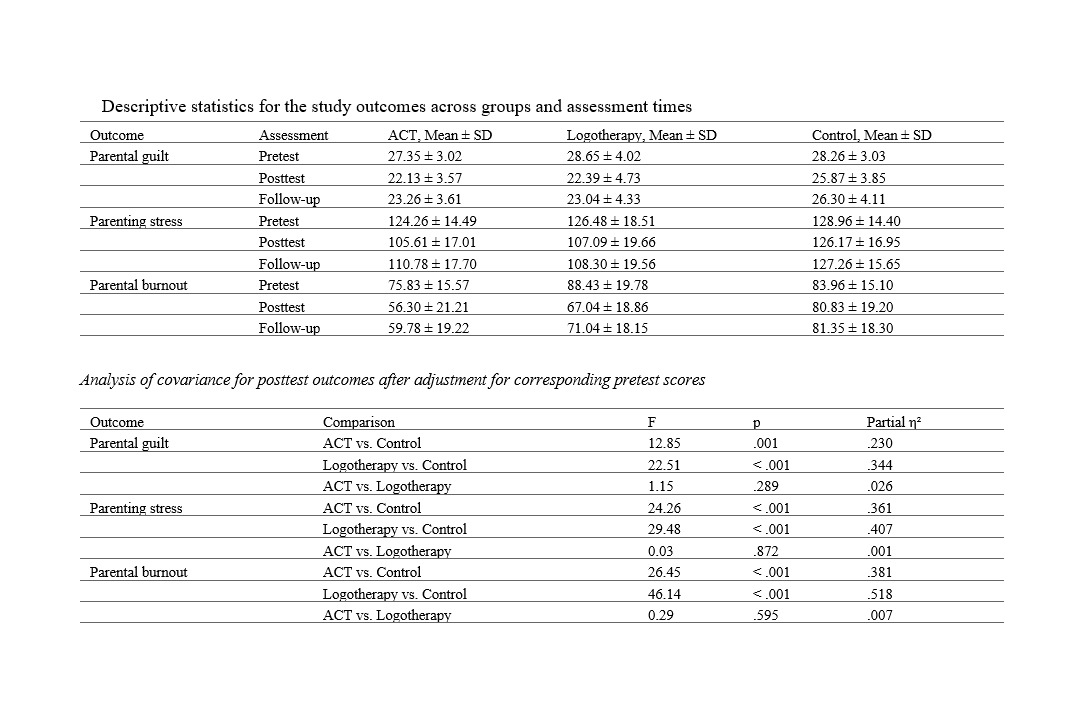
This study aimed to compare the effectiveness of Acceptance and Commitment Therapy (ACT) and logotherapy on parental guilt, parenting stress, and psychological burnout among mothers of children with high-functioning autism spectrum disorder. This quantitative quasi-experimental study used a pretest-posttest control-group design with a three-month follow-up. The statistical population consisted of mothers of children with high-functioning autism spectrum disorder in Bandar Abbas, Iran. Sixty-nine eligible mothers were recruited and assigned through block randomization to ACT, logotherapy, and control groups, with 23 participants in each group. The ACT group received eight structured sessions, the logotherapy group received ten structured sessions, and the control group received no study-specific psychological intervention during the study period. Data were collected using the Parental Guilt Scale, Parenting Stress Index-Short Form, and Parental Burnout Assessment at pretest, posttest, and follow-up. Data were analyzed using repeated-measures mixed analysis of variance, analysis of covariance, and Bonferroni-adjusted pairwise comparisons. Significant group-by-time interaction effects were found for parental guilt, F = 9.75, p < .001, partial η² = .228; parenting stress, F = 15.30, p < .001, partial η² = .370; and parental burnout, F = 21.59, p < .001, partial η² = .396. ANCOVA showed that ACT significantly reduced parental guilt, F(1,43) = 12.85, p = .001, parenting stress, F(1,43) = 24.26, p < .001, and parental burnout, F(1,43) = 26.45, p < .001, compared with the control group. Logotherapy also significantly reduced parental guilt, F(1,43) = 22.51, p < .001, parenting stress, F(1,43) = 29.48, p < .001, and parental burnout, F(1,43) = 46.14, p < .001. No significant differences were observed between ACT and logotherapy for parental guilt, parenting stress, or parental burnout. Both ACT and logotherapy were effective in improving maternal psychological outcomes, particularly parental guilt and parenting stress, while neither intervention demonstrated clear superiority over the other.
Downloads
References
Akram, M., Naqvi, S. M. Z. H., & Jameel, N. (2025). Relationship between children's autism spectrum disorder and parental anxiety and burnout. Pakistan Journal of Medical Sciences, 41(2), 366-371. https://doi.org/10.12669/pjms.41.2.9979
Al-Salihy, A. A. R. S. (2025). Female reproductive health trends and autism spectrum disorder prevalence between 2000 and 2024. Scientific reports, 15, 8507. https://doi.org/10.1038/s41598-025-89979-x
Alabdulaziz, H., Alghamdi, S., Alharbi, K. S., Alrashdi, H. R. M., Al-mutairi, J. S., & Aljuhani, F. H. (2026). Maternal emotional distress, caregiving burden, and service access among mothers of children with autism spectrum disorder: A qualitative study. Frontiers in Psychiatry, 17, 1971477. https://doi.org/10.3389/fpsyt.2026.1971477
Ali, M. M. A., Emaraa, N. S., & Elgendy, R. S. (2025). The effectiveness of logotherapy-based intervention on meaning of life and resilience among mothers of children with autistic spectrum disorder. Menoufia Nursing Journal, 10(2), 109-132. https://doi.org/10.21608/menj.2025.441598
Asadi, H., & Mohammadi, M. (2025). Challenges and models of integrative psychotherapy focused on acceptance and commitment therapy. Fourth National and Second International Conference on Research and Innovation in Psychology, with Special Emphasis on Cognitive Behavioral Therapy, Babolsar.
Babapour Kheiraldin, J., Shokouhi Rad, M., Zarean, M., & Alilou, M. M. (2025). The effectiveness of an integrative treatment program based on parent-child interaction, parent training, and family resilience on theory of mind and executive functions in children with high-functioning autism spectrum disorder.
Boni, A. C. M., Dias, I. A., Perez, S. M., & de Oliveira Bagnoli, Y. (2025). The psychological suffering in the motherhood of children with autism spectrum disorder (ASD). European Journal of Special Education Research, 11(4). https://doi.org/10.46827/ejse.v11i4.6109
Dargahi, A., Lotfi, S., Fardhasani, A., & Heydarian, H. (2025). A communication bridge: Ways to communicate effectively with students with autism.
Elhami, K., & Aran, A. (2025). Video-based intervention in mathematics education for elementary students with autism spectrum disorder. Ninth International Conference on Psychology, Educational Sciences, Social and Cultural Studies, Hamedan.
Eskandari, A. (2025). The effect of parental burnout on the mental health of family members. National Conference on Management, Psychology and Behavioral Sciences,
Goudarzi, M., & Safari, F. (2025). Examining the moderating role of parenting stress in romantic attachment styles and family functioning.
Guo, Y., He, H., & Lan, J. (2025). The effectiveness of Acceptance and Commitment Therapy on parental stress in parents of special children: A meta-analysis. Child and adolescent psychiatry and mental health, 19, 80. https://doi.org/10.1186/s13034-025-00944-y
Hosseini Kamalabadi, S. S. (2025). Investigating strategic components of adolescent policy based on logotherapy approaches. First International Conference on New Scientific Research Achievements in Education and Humanities with an Educational, Religious and Cultural Pathology Approach in Iran and the Islamic World, Bushehr.
Jamali Nazari, N., Salimi, S., Gholamali Lavasani, M., & Javaheri, A. (2025). Working mothers’ guilt and children’s behavioral problems: The moderating role of parental reflective functioning.
Kalantar Ghorayshi, M., Ebrahimi Jozani, S., Haji Sanei, M., Taghan Jouybari, F., & Ebrahimzadeh Natanzi, Z. (2025). Predicting parenting stress patterns based on self-conscious emotions of shame and guilt with the mediating role of functioning. Second International Conference on Educational Sciences, Psychology, Sport Sciences and Physical Education, Sari.
Karimian, F. (2025). Parenting stress and its effect on children’s academic performance. First International Conference on New Scientific Research Achievements in Education and Humanities with an Educational, Religious and Cultural Pathology Approach in Iran and the Islamic World, Bushehr.
Mahdi Asiabari, M. (2025). Examining acceptance and commitment therapy in young adults. Eighteenth National Conference on New Research in Education, Psychology, Jurisprudence, Law and Social Sciences, Shirvan.
Mohammadi Tabas, F., & Mohammadi Tabas, Z. (2025). Effectiveness of family resilience training on quality of life and mental health of mothers of children with autism. Ninth International Conference on Religious Studies and Humanities in the Islamic World, Tehran.
Mohammadzadeh Ghorban Gholi, Z., Mikaeili, N., & Atadokht, A. (2025). Effectiveness of cognitive-behavioral hypnotherapy on dysfunctional thoughts, fear of contamination, and guilt in individuals with obsessive-compulsive disorder symptoms.
Nik Khou, G. H., & Azizi, H. (2025). The relationship of feelings of inferiority and guilt with dependency in adolescents. Fourth International Conference on Interdisciplinary Research in Education and Research, Tehran.
Ostfeld-Etzion, S., & Ben-Artzi, E. (2025). Guilt and maternal depression among married and single mothers of children with autism spectrum disorder: Moderation analysis. International Journal of Developmental Disabilities, 1-10. https://doi.org/10.1080/20473869.2025.2504437
Pajouhesh, A., Najafzadeh Morid, S., Pajouhesh, A., Babaeian, D., Behvandi, H., & Manouchehri, F. (2025). Acceptance and commitment therapy. Twenty-first National Conference on Management and Humanities Research in Iran, Tehran.
Rezq, K. A., Albalawi, H. M. H., & Alharbi, H. F. (2026). Maternal psychological distress and parent-reported child behavioural and emotional outcomes among mothers of children with autism spectrum disorder: A cross-sectional study. Healthcare, 14(17), 2816. https://doi.org/10.3390/healthcare14172816
Salah, V. (2025). Developing an optimal parenting training program based on mindful compassion and its effectiveness on quality of life, psychological flexibility, and mental fatigue among mothers of children with attention-deficit/hyperactivity disorder.
Selvakumar, R. (2025). Insights on parental experiences with autism spectrum disorder for global audiences. Journal of Psychosocial Nursing and Mental Health Services, 63(8), 6. https://doi.org/10.3928/02793695-20250612-02
Shabanzadeh, K., Alaeinasab, S., & Shabanian Moghari, F. (2025). Development and assessment of the factor structure and reliability of a trauma-related guilt questionnaire. Fourth National and Second International Conference on Research and Innovation in Psychology, Babolsar.
Shafiei, M. (2025). The effect of standardized assessment pressure on teachers’ mental health. First International Conference on Technological Innovations in Education, Ramshir.
Sharifi, M., & Mahni, H. (2025). Analyzing the behavior of Prophet Yunus from a psychological perspective based on the verses of Surah Yunus. Second International Conference on Educational Sciences, Psychology, Sport Sciences and Physical Education, Sari.
Sotoudeh Navroudi, S. O., Esmailnejad, R., & Farrokhi, N. (2025). Predicting marital satisfaction among parents of children under three based on cohesion, adaptability, and parenting stress. Sixteenth International Conference on Psychology, Educational Sciences and Lifestyle,
Tabatabaei, F. S. (2025). Predicting shame and guilt based on attachment style and parenting practices among female upper secondary students in Sepidan County.
Downloads
Additional Files
Publication Timeline
- Submitted
- Revised
- Accepted