Teacher–Student Interaction Quality and Academic Motivation in Neurodivergent Learners: The Mediating Role of Social Relatedness
DOI:
https://doi.org/10.61838/kman.prien.3.3.4Keywords:
Teacher–student interaction, social relatedness, academic motivation, neurodivergent learnersAbstract
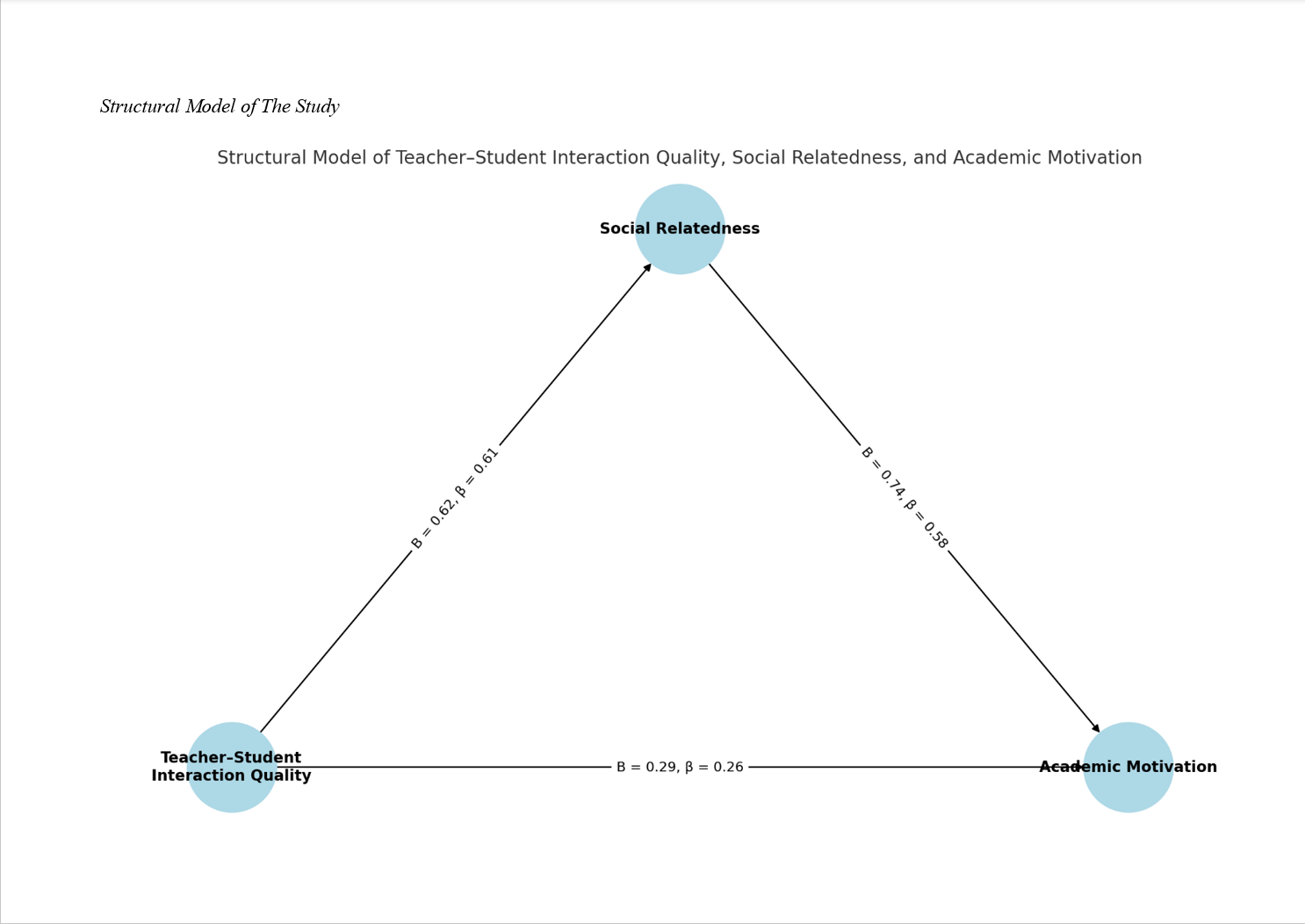
This study aimed to investigate the effect of teacher–student interaction quality on academic motivation in neurodivergent learners, with social relatedness examined as a mediating variable. A descriptive correlational design was employed using a sample of 403 neurodivergent secondary school students in Slovenia, selected based on Krejcie and Morgan’s sampling table. Standardized instruments were used to assess teacher–student interaction quality, social relatedness, and academic motivation, all measured on 7-point Likert scales. Data were analyzed using Pearson correlation in SPSS-27 to explore bivariate associations and Structural Equation Modeling (SEM) in AMOS-21 to test the hypothesized mediating model. Model fit was evaluated using multiple indices, including χ²/df, GFI, AGFI, CFI, TLI, and RMSEA. The results indicated significant positive correlations among all variables: teacher–student interaction quality was positively correlated with social relatedness (r = .61, p < .001) and academic motivation (r = .55, p < .001), while social relatedness was strongly correlated with academic motivation (r = .67, p < .001). The SEM analysis showed an acceptable model fit (χ²/df = 2.35, CFI = 0.97, RMSEA = 0.057). Teacher–student interaction quality had significant direct effects on both social relatedness (β = .61, p < .001) and academic motivation (β = .26, p < .001). Social relatedness significantly predicted academic motivation (β = .58, p < .001), and also mediated the relationship between teacher–student interaction and academic motivation (indirect β = .35, p < .001), confirming a partial mediation model. The findings underscore the critical role of social relatedness in explaining how supportive teacher–student interactions enhance academic motivation among neurodivergent learners. Educational interventions that strengthen relational dynamics in inclusive classrooms may foster higher motivation and academic engagement in this population.
Downloads
References
Anne, G. M. d. B., & Grimminger, E. (2025). Received and Perceived Peer Acceptance in Relation to Enjoyment, Social Competence, and Physical Activity in Primary School Physical Education and the Role of Peer-Relatedness Need Satisfaction. Journal of Teaching in Physical Education, 1-11. https://doi.org/10.1123/jtpe.2024-0230
Cheng, C., & Lau, Y.-C. (2022). Social Media Addiction During COVID-19-Mandated Physical Distancing: Relatedness Needs as Motives. International journal of environmental research and public health, 19(8), 4621. https://doi.org/10.3390/ijerph19084621
Datu, J. A. D., & Noltemeyer, A. (2024). Sense of Relatedness and Science Engagement Among Filipino High School Students. Psychology in the Schools, 61(8), 3410-3420. https://doi.org/10.1002/pits.23224
Escandell, S., & Chu, T. L. (2021). Implementing Relatedness-Supportive Teaching Strategies to Promote Learning in the College Classroom. Teaching of Psychology, 50(4), 441-447. https://doi.org/10.1177/00986283211046873
Ganotice, F. A., Mendoza, N. B., John Ian Wilzon, T. D., Shen, X., Lee, J. C., Chan, E., Luk, P., Manio, M. M., He, Q., Khoo, U. S., Lam, M. P. S., Chan, S. C. S., Chow, A. Y. M., Wang, N., & Tipoe, G. L. (2024). Students’ Motivation and Engagement in Interprofessional Education: The Mediating Role of Peer Relatedness. Medical Education Online, 29(1). https://doi.org/10.1080/10872981.2024.2430593
Garwood, J. D. (2022). Character Education to Improve Students’ Sense of Relatedness: Preliminary Findings From the Positivity Project. International Journal of Education, 14(2), 36. https://doi.org/10.5296/ije.v14i2.19981
Gråstén, A., Yli‐Piipari, S., Huhtiniemi, M., Salin, K., Seppälä, S., Lahti, J., Hakonen, H., & Jaakkola, T. (2019). Predicting Accelerometer-Based Physical Activity in Physical Education and Total Physical Activity: The Self-Determination Theory Approach. Journal of Human Sport and Exercise, 14(4). https://doi.org/10.14198/jhse.2019.144.05
Gucciardi, D. F., Weixian, J. C., Gibson, W., Ntoumanis, N., & Ng, L. (2020). Motivational Climate in the Classroom. European Journal of Psychological Assessment, 36(2), 324-335. https://doi.org/10.1027/1015-5759/a000524
Kaplan, H., Najjar, Z., Kalnisky, E., & Keinan, A. (2022). The Challenge of Diversity in Teacher Education Institutions in Israel: Students’ Sense of Relatedness and Perceptions Regarding Being a Minority or Majority. Journal of Diversity in Higher Education, 15(4), 493-504. https://doi.org/10.1037/dhe0000288
Keller, H. (2020). Culture and Social Development. https://doi.org/10.1093/acrefore/9780190236557.013.592
Min, X., & Shapii, A. (2025). Exploring the Cross-Cultural Communication Challenges of Foreign Students in China: The Mediating Effects of Social Media Interaction and Psychological Resilience. Frontiers in psychology, 16. https://doi.org/10.3389/fpsyg.2025.1560298
Murray, C., Heinz, M., Munday, I., Keane, E., Flynn, N., Connolly, C., Hall, T., & MacRuairc, G. (2020). Reconceptualising Relatedness in Education in ‘Distanced’ Times. European Journal of Teacher Education, 43(4), 488-502. https://doi.org/10.1080/02619768.2020.1806820
Norder, W., Boer, A. d., & Minnaert, A. (2025). Peer Relations and Motivation in Special Secondary Education: Experiences of Adolescents With Social, Emotional and Behavioural Difficulties. British Journal of Educational Psychology. https://doi.org/10.1111/bjep.12773
Núñez‐Regueiro, F., & Wang, M. T. (2025). Adolescent Well-Being and School Engagement as a Function of Teacher and Peer Relatedness: The More (Relatedness) Is Not Always the Merrier. Journal of Educational Psychology, 117(3), 466-484. https://doi.org/10.1037/edu0000910
Pentecost, M., Gerber, B., Wainwright, M., & Cousins, T. (2018). Critical Orientations for Humanising Health Sciences Education in South Africa. Medical Humanities, 44(4), 221-229. https://doi.org/10.1136/medhum-2018-011472
Raižienė, S., Gabrialavičiūtė, I., Garckija, R., & Kalesinskas, L. (2017). Teacher’s Provided Feedback and Students’ Dropout Intentions: The Role of Basic Psychological Needs. Pedagogika, 128(4), 97-113. https://doi.org/10.15823/p.2017.57
Ratelle, C. F., Duchesne, S., Litalien, D., & Plamondon, A. (2021). The Role of Mothers in Supporting Adaptation in School: A Psychological Needs Perspective. Journal of Educational Psychology, 113(1), 197-212. https://doi.org/10.1037/edu0000455
Selimi, R., Llullaku, N., Helm, P. v. d., Geert Jan, J. M. S., & Roest, J. (2023). Academic Motivation of Incarcerated Juveniles From the Perspective of Self-Determination Theory: A Multiple Case Study in Kosovo Context. International journal of offender therapy and comparative criminology, 69(8), 1101-1116. https://doi.org/10.1177/0306624x231198805
Sieber, V., Köhler, C., Christ, A. A., Helbling, J., & Praetorius, A. K. (2022). The Role of Relatedness in the Motivation and Vitality of University Students in Online Classes During Social Distancing. Frontiers in psychology, 12. https://doi.org/10.3389/fpsyg.2021.702323
Silva, S. K. D. U. D. (2021). Motives of Social Media Usage on Building Consumer Behavioural Engagement. Proceedings of International Conference on Business Management, 17. https://doi.org/10.31357/icbm.v17.5160
Xiang, P., Ağbuğa, B., Liu, J., & McBride, R. E. (2017). Relatedness Need Satisfaction, Intrinsic Motivation, and Engagement in Secondary School Physical Education. Journal of Teaching in Physical Education, 36(3), 340-352. https://doi.org/10.1123/jtpe.2017-0034
Zeng, J., & Xia, L. (2024). Modeling the Continuous Intention to Use Generative AI as an Educational Tool for EFL Learners Among Vocational College Students in Guangzhou, China. Journal of Innovation and Development, 8(2), 18-27. https://doi.org/10.54097/d1c3my56
Zhou, X., Chai, C. S., Jong, M. S., & Xiong, X. B. (2021). Does Relatedness Matter for Online Self-Regulated Learning to Promote Perceived Learning Gains and Satisfaction? The Asia-Pacific Education Researcher, 30(3), 205-215. https://doi.org/10.1007/s40299-021-00579-5
Downloads
Additional Files
Publication Timeline
- Submitted
- Revised
- Accepted
Issue
Section
License
Copyright (c) 2025 Vladimir Pelc, Marit Erves (Author); Aleksander Ternar (Corresponding Author)

This work is licensed under a Creative Commons Attribution-NonCommercial 4.0 International License.