ADHD Symptoms and Academic Performance Among Adolescents: The Roles of Executive Dysfunction, Smartphone Distraction, and Academic Procrastination
DOI:
https://doi.org/10.61838/Keywords:
ADHD symptoms, academic performance, executive dysfunction, smartphone distraction, academic procrastination, adolescents, ColombiaAbstract
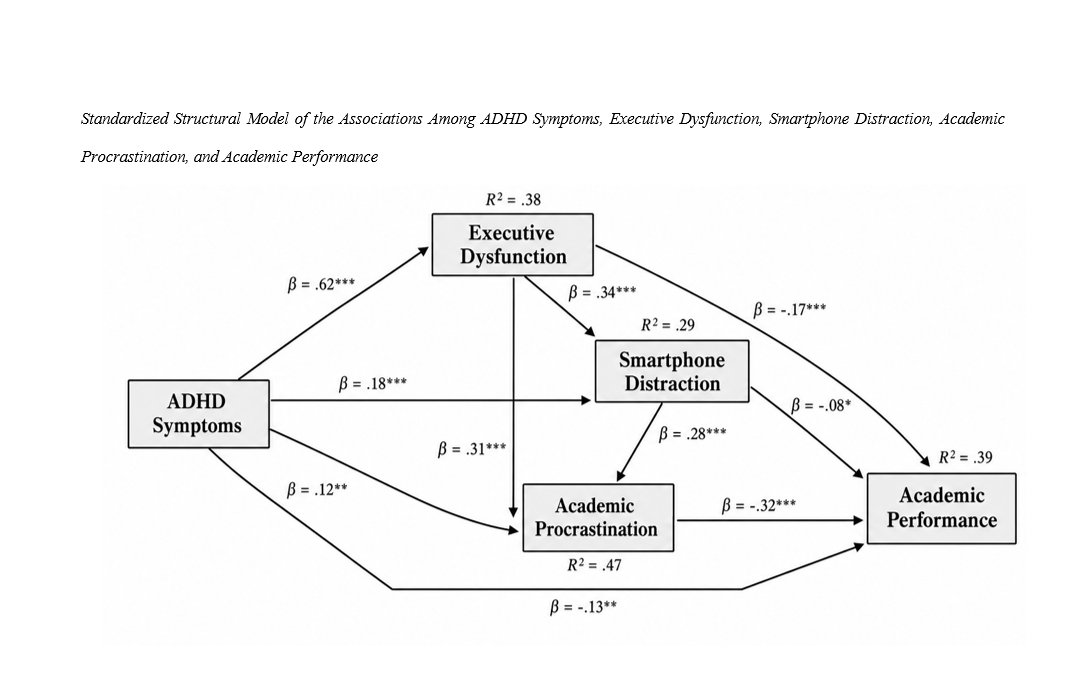
Objective: This study aimed to examine the direct and indirect relationships between ADHD symptoms and academic performance among Colombian adolescents by testing the roles of executive dysfunction, smartphone distraction, and academic procrastination within an integrated structural model.
Methods and Materials: A cross-sectional correlational study was conducted with 612 adolescents aged 12–18 years who were recruited from public and private secondary schools in Bogotá, Medellín, and Cali, Colombia, through multistage stratified cluster sampling. ADHD symptoms were assessed using the School Version of the ADHD Rating Scale–5, executive dysfunction using the Behavior Rating Inventory of Executive Function–Second Edition Self-Report Form, smartphone distraction using the Smartphone Distraction Scale, and academic procrastination using the Multidimensional Academic Procrastination Scale–15. Academic performance was obtained from official school records and standardized within school and grade level. Data were analyzed using confirmatory factor analysis, Pearson correlations, and structural equation modeling with cluster-robust standard errors. Indirect effects were examined using 5,000 bias-corrected bootstrap samples.
Findings: ADHD symptoms significantly predicted executive dysfunction, smartphone distraction, academic procrastination, and lower academic performance. Executive dysfunction significantly predicted greater smartphone distraction, greater academic procrastination, and poorer academic performance. Smartphone distraction significantly predicted procrastination and lower academic performance, while academic procrastination was the strongest immediate negative predictor of performance. The total indirect effect of ADHD symptoms on academic performance was significant, β = -.272, p < .001, and the total effect was β = -.402, p < .001. The model explained 39% of the variance in academic performance.
Conclusion: ADHD symptoms were associated with poorer academic performance primarily through executive dysfunction, smartphone distraction, and academic procrastination, indicating that cognitive self-regulation, digital-attention management, and timely task initiation are important targets for school-based and clinical interventions.
Downloads
References
Asheri, M., Ghodsi, P., & Ghasemi, M. (2024). Examining the Effects of Impulsivity, Intolerance of Uncertainty, and Smartphone Management Styles on Smartphone Addiction With the Mediating Role of Warm Executive Functions. Jayps, 5(4), 147-157. https://doi.org/10.61838/kman.jayps.5.4.16
Blasco-Fontecilla, H., Menéndez-García, Á., Sánchez‐Sánchez, F., & Bella-Fernández, M. (2023). Lack of Educational Impact of Video Game Addiction in Children and Adolescents Diagnosed With ADHD: A Cross-Sectional Study. Frontiers in Psychiatry, 14. https://doi.org/10.3389/fpsyt.2023.1136671
Chachar, A. S., & Shaikh, M. Y. (2024). Decision-Making and Attention Deficit Hyperactivity Disorder: Neuroeconomic Perspective. Frontiers in Neuroscience, 18. https://doi.org/10.3389/fnins.2024.1339825
Chauhan, N., Vardhan, C., Koner, S., Sharma, S., & Sharma, A. (2025). From Childhood Impairments to Delayed Diagnosis: A Series of Adult ADHD Cases. Journal of Indian Association for Child and Adolescent Mental Health, 21(4), 349-354. https://doi.org/10.1177/09731342251393005
Chien, Y. L., Tai, Y. M., Chiu, Y. N., Tsai, W. C., & Gau, S. S. (2023). The Mediators for the Link Between Autism and Real-World Executive Functions in Adolescence and Young Adulthood. Autism, 28(4), 881-895. https://doi.org/10.1177/13623613231184733
Dergaa, I., Dhahbi, W., Dergaa, M. A., Razzak, M., Ceylan, H. İ., Ștefănică, V., Muntean, R. I., & Guelmami, N. (2026). Physical Activity, Sedentary Behavior, and Cognitive Function in Children and Adolescents: A Scoping Review of Dose-Response Relationships, Screen Time Interactions, and Public Health Implications. Frontiers in Behavioral Neuroscience, 20. https://doi.org/10.3389/fnbeh.2026.1848119
Doulou, A., Drigas, A., & Skianis, C. (2023). Predictors in the Treatment of ADHD in Racial and Ethnic Minorities and the Significance of Physical Activity Through Apps. Research Society and Development, 12(4), e23312441093. https://doi.org/10.33448/rsd-v12i4.41093
Fabio, R. A., & Suriano, R. (2024). The Role of Smartphone Use in Sensory Processing: Differences Between Adolescents With ADHD and Typical Development. International journal of environmental research and public health, 21(12), 1705. https://doi.org/10.3390/ijerph21121705
Gálvez‐Contreras, A. Y., Cruz, I., Beltrán-Navarro, B., González-Castañeda, R. E., & González-Pérez, Ó. (2022). Therapeutic Approaches for ADHD by Developmental Stage and Clinical Presentation. International journal of environmental research and public health, 19(19), 12880. https://doi.org/10.3390/ijerph191912880
Gkintoni, E., Papachatzi, E., Efthymiadou, E., Magriplis, E., & Vantarakis, A. (2025). Neurodevelopmental Pathways From Maternal Obesity to Offspring Outcomes: An Umbrella Review of Cognitive and Behavioral Consequences Across Development. Healthcare, 13(20), 2653. https://doi.org/10.3390/healthcare13202653
Gül, H., Lelonek-Kuleta, B., & Männikkö, N. (2022). A Brief Overview of the Relationship Between Academic Achievement and Problematic Internet Use of Adolescents and Young Adults: What Are the Main Mediators? Frontiers in Education, 7. https://doi.org/10.3389/feduc.2022.978589
Haugan, A.-L. J., Sund, A. M., Thomsen, P. H., Lydersen, S., & Nøvik, T. S. (2022). Executive Functions Mediate the Association Between ADHD Symptoms and Anxiety in a Clinical Adolescent Population. Frontiers in Psychiatry, 13. https://doi.org/10.3389/fpsyt.2022.834356
Kakoura, E., Loukas, P., & Sideraki, A. (2024). A Mobile App as a Gamified Early Intervention for ADHD Students. World Journal of Biology Pharmacy and Health Sciences, 18(1), 048-053. https://doi.org/10.30574/wjbphs.2024.18.1.0146
Kocabaş, Ş., Adak, İ., Karakuş, O. B., & Toksoy, Z. E. (2025). Learning Disability as a Determinant of Digital Behavior in Adolescents With ADHD: A Cross-Sectional Study. European Child & Adolescent Psychiatry, 34(12), 3999-4007. https://doi.org/10.1007/s00787-025-02802-w
Košíková, E., Bakoš, V., Turoňová, D., Rašková, B., Mesárošová, B., Ostatníková, D., & Babinská, K. n. (2024). Hot and Cool Executive Functions in Children and Adolescents With Further Exploration in Adhd Context. Ansr, 66(2), 50-68. https://doi.org/10.31577/ansr.2024.66.2.2
Luo, X., Duan, R., & Yi-jin, W. (2021). The Role of Attention Control Deficit in ADHD and Relevant Interventions. https://doi.org/10.2991/assehr.k.210617.043
Malik, S., & Namgyal, K. (2024). Perspective Chapter: Emotion Regulation in Attention Deficit/Hyperactivity Disorder (ADHD) – A Lifespan Perspective. https://doi.org/10.5772/intechopen.1006539
Mayer, J. S., Bernhard, A., Fann, N., Boxhoorn, S., Hartman, C. A., Reif, A., & Freitag, C. M. (2021). Cognitive Mechanisms Underlying Depressive Disorders in ADHD: A Systematic Review. Neuroscience & Biobehavioral Reviews, 121, 307-345. https://doi.org/10.1016/j.neubiorev.2020.12.018
McGrath, M. A., Fletcher, K. L., & Bielski, L. M. (2023). Executive Functioning Skills of Children With Listening Difficulties. Psychology in the Schools, 60(9), 3520-3541. https://doi.org/10.1002/pits.22940
Morsink, S., Oord, S. V. d., Antrop, I., Danckaerts, M., & Scheres, A. (2021). Studying Motivation in ADHD: The Role of Internal Motives and the Relevance of Self Determination Theory. Journal of Attention Disorders, 26(8), 1139-1158. https://doi.org/10.1177/10870547211050948
Pergantis, P. (2024). Facilitators and Barriers to the Development of Giftedness in Children. GSC Advanced Research and Reviews, 18(3), 112-123. https://doi.org/10.30574/gscarr.2024.18.3.0085
Ramos-Galarza, C., Brito, D., Rodríguez, B., Guerrero-Tates, B., Cruz‐Cárdenas, J., & Bolaños-Pasquel, M. (2024). Systematic Review of Executive Function Stimulation Methods in the ADHD Population. Journal of clinical medicine, 13(14), 4208. https://doi.org/10.3390/jcm13144208
Robledo-Castro, C., Castillo, L., & Corchado, J. M. (2022). Artificial Cognitive Systems Applied in Executive Function Stimulation and Rehabilitation Programs: A Systematic Review. Arabian Journal for Science and Engineering, 48(2), 2399-2427. https://doi.org/10.1007/s13369-022-07292-5
Shuai, L., He, S., Zheng, H., Wang, Z., Qiu, M., Xia, W., Cao, X., Lu, L., & Zhang, J. (2021). Influences of Digital Media Use on Children and Adolescents With ADHD During COVID-19 Pandemic. Globalization and Health, 17(1). https://doi.org/10.1186/s12992-021-00699-z
Smets, L., Marten, F., Keuppens, L., Baeyens, D., Boyer, B., & Oord, S. V. d. (2025). Exploring the Association Between ADHD, Sleep, and Homework Problems: The Role of Behavioral Indicators of Neuropsychological Functioning. Journal of Attention Disorders, 29(10), 787-802. https://doi.org/10.1177/10870547251329772
Song, Y., Fan, B., Wang, C., & Yu, H. (2023). Meta-Analysis of the Effects of Physical Activity on Executive Function in Children and Adolescents With Attention Deficit Hyperactivity Disorder. PLoS One, 18(8), e0289732. https://doi.org/10.1371/journal.pone.0289732
Varrasi, S., Boccaccio, F. M., Guerrera, C. S., Platania, G. A., Pirrone, C., & Castellano, S. (2022). Schooling and Occupational Outcomes in Adults With ADHD: Predictors of Success and Support Strategies for Effective Learning. Education Sciences, 13(1), 37. https://doi.org/10.3390/educsci13010037
Wacks, Y., & Weinstein, A. (2021). Excessive Smartphone Use Is Associated With Health Problems in Adolescents and Young Adults. Frontiers in Psychiatry, 12. https://doi.org/10.3389/fpsyt.2021.669042
Wilens, T. E., Oberdhan, D., Jin, N., Skubiak, T., Childress, A., Stralen, J. v., & Ward, C. L. (2026). Efficacy of Centanafadine for Executive Functioning and Learning Problems in Children and Adolescents With Attention-Deficit/Hyperactivity Disorder. Journal of Child and Adolescent Psychopharmacology, 36(5), 266-277. https://doi.org/10.1177/10445463261441745
Yılmaz, U., Karadeniz, C., Demirkaya, B., Sparrenberg, L., Toraman, D., Yağmurlu, K., Hasoğlu, T., Yüksel, Ç., Sifa, R., & Albayram, Ö. (2025). Cognitive Fingerprinting of Attention-Deficit/Hyperactivity Disorder Subtypes via Artificial Intelligence-Driven Virtual Reality. Ai in Neuroscience, 1(4), 149-157. https://doi.org/10.1177/2997979x251401408
Zamboni, L., Fusina, F., Casari, R., Lugoboni, F., Zandonai, T., & Federico, A. (2025). Klinefelter Syndrome and ADHD: A Short Systematic Review. Frontiers in Psychiatry, 16. https://doi.org/10.3389/fpsyt.2025.1585259
Zheng, Q., Cheng, Y., Sonuga‐Barke, E., & Shum, K. K. (2022). Do Executive Dysfunction, Delay Aversion, and Time Perception Deficit Predict ADHD Symptoms and Early Academic Performance in Preschoolers. Research on Child and Adolescent Psychopathology, 50(11), 1381-1397. https://doi.org/10.1007/s10802-022-00937-x
Žnidarič, U., Štrumbelj, E., & Machidon, O. (2026). A Review of the Negative Effects of Digital Technology on Cognition. https://doi.org/10.48550/arxiv.2603.10025
Downloads
Additional Files
Publication Timeline
- Submitted
- Revised
- Accepted