Family Conflict and Adolescent Aggression: A Structural Equation Modeling Study of Parental Psychological Control, Autonomy Frustration, and Anger Dysregulation
DOI:
https://doi.org/10.61838/Keywords:
Family conflict, adolescent aggression, parental psychological control, autonomy frustration, anger dysregulation, structural equation modelingAbstract
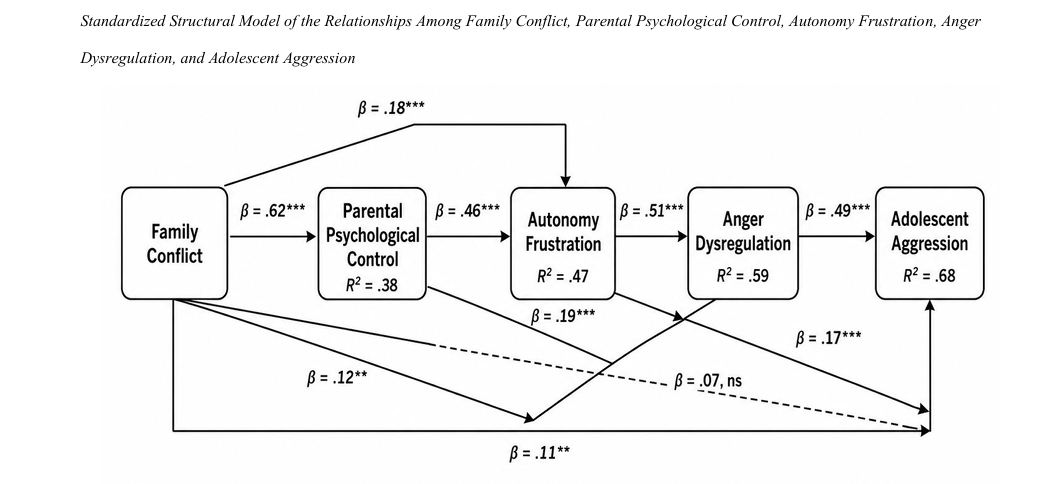
Objective: This study aimed to test a structural equation model examining the direct and sequential indirect relationships between family conflict and adolescent aggression through parental psychological control, autonomy frustration, and anger dysregulation among Canadian adolescents.
Methods and Materials: This cross-sectional correlational study included 624 adolescents aged 13 to 18 years who were recruited from public secondary schools in Ontario, Canada, through multistage cluster sampling. Participants completed measures of family conflict, parental psychological control, autonomy frustration, anger dysregulation, and reactive-proactive aggression. Data were analyzed using confirmatory factor analysis and structural equation modeling with robust maximum likelihood estimation. Model fit was evaluated using the chi-square statistic, comparative fit index, Tucker–Lewis index, root mean square error of approximation, and standardized root mean square residual. Indirect effects were tested using 5,000 bootstrap resamples and bias-corrected 95% confidence intervals. Age, gender, family structure, and perceived family economic status were included as covariates.
Findings: Family conflict significantly predicted parental psychological control, autonomy frustration, anger dysregulation, and adolescent aggression. Parental psychological control significantly predicted autonomy frustration and anger dysregulation, whereas its direct effect on aggression was nonsignificant. Autonomy frustration significantly predicted both anger dysregulation and aggression, and anger dysregulation was the strongest direct predictor of aggression. The sequential indirect effect of family conflict on aggression through parental psychological control, autonomy frustration, and anger dysregulation was significant. The total indirect effect of family conflict on aggression was also significant, and the model explained 68% of the variance in adolescent aggression.
Conclusion: Family conflict appears to contribute to adolescent aggression largely through psychologically controlling parenting, frustration of autonomy, and impaired anger regulation, highlighting the importance of family-based and emotion-regulation-focused prevention and intervention strategies.
Downloads
References
Borrell, S. R., & Albertos, A. (2023). Potential Connection Between Positive Frustration in Family Leisure Time and the Promotion of Adolescent Autonomy. Frontiers in psychology, 14. https://doi.org/10.3389/fpsyg.2023.1258748
Breaux, R., Eadeh, H. M., Swanson, C. S., & McQuade, J. D. (2021). Adolescent Emotionality and Emotion Regulation in the Context of Parent Emotion Socialization Among Adolescents With Neurodevelopmental Disorders: A Call to Action With Pilot Data. Research on Child and Adolescent Psychopathology, 50(1), 77-88. https://doi.org/10.1007/s10802-021-00833-w
Breaux, R., Majusiak, C., Cash, A. R., Pham, S. N., & Le, M. (2026). Review of Emotion Regulation Psychosocial Interventions for Children and Adolescents With ADHD. Brain Sciences, 16(6), 560. https://doi.org/10.3390/brainsci16060560
Dunbar, A. S., Ahn, L. H., Coates, E. E., & Bynum, M. S. (2022). Observed Dyadic Racial Socialization Disrupts the Association Between Frequent Discriminatory Experiences and Emotional Reactivity Among Black Adolescents. Child development, 93(1), 39-57. https://doi.org/10.1111/cdev.13680
George, C., & Aikins, J. W. (2023). Developing a Secure Base in Family Intervention: Using the Adult Attachment Projective System to Assess Attachment in Family Relationships. Frontiers in psychology, 14. https://doi.org/10.3389/fpsyg.2023.1291661
Haspolat, N. K., AĞIrkan, M., & Eşkisu, M. (2023). Psychological Symptoms Among Adolescents: Latent Class Analysis of Parental Attitudes, Psychological Needs, Self‐regulation, and Alexithymia. Psychology in the Schools, 61(3), 920-941. https://doi.org/10.1002/pits.23090
Hu, J., Zheng, Q., Zhou, T., & Huang, Z. (2024). Development and Initial Validation of the Parental Response to Adolescents' Emotions Scale: A Mixed Methods Approach. Journal of Research on Adolescence, 34(2), 599-613. https://doi.org/10.1111/jora.12945
Huffman, S., Valdivia, M. P. d., Davidson, L., Cooney, E., & Watson, J. (2024). The Invisible Connection: A Qualitative Analysis of the Experience of Support-Seeking Siblings of Individuals With Emotion Dysregulation. https://doi.org/10.22541/au.171421190.05759094/v1
Huffman, S., Valdivia, M. P. d., Davidson, L., Cooney, E., & Watson, J. (2025). The Invisible Connection: A Qualitative Analysis of the Experience of Support‐Seeking Siblings of Individuals With Borderline Personality Disorder Traits. Journal of Clinical Psychology, 81(12), 1221-1230. https://doi.org/10.1002/jclp.70030
Kalvin, C., Zhong, J., Rutten, M. R., Ibrahim, K., & Sukhodolsky, D. G. (2025). Review: Evidence-Based Psychosocial Treatments for Childhood Irritability and Aggressive Behavior. Jaacap Open, 3(1), 14-28. https://doi.org/10.1016/j.jaacop.2024.01.009
Lee, D. H., & Shin, H. (2021). Parental Bonding and Adolescent Bullying Perpetration: Examining Sequential Indirect Effects of Anxiety and Anger-In. School Psychology International, 42(3), 259-284. https://doi.org/10.1177/0143034320988152
Li, Y., Wang, X., Zhang, L., & Chen, L. (2025). The Association Between Maternal Overprotection and Idol Worship Among College Students: The Chain Mediating Role of Reactive Anger and Cybervictimization. Frontiers in psychology, 16. https://doi.org/10.3389/fpsyg.2025.1525326
Lu, F., Xie, X., Tao, Z., Shuliang, X., Yang, C., Wang, Z., Bao, X., Jiang, L., & Zhang, W. (2023). The Moderating Effect of Anger Expression on the Relationship Between Parental Overprotection, Psychological Need Satisfaction, and Non-Suicidal Self-Injury Among Chinese Adolescents. https://doi.org/10.22541/au.168313503.35198245/v1
Miadich, S. A., Shrewsbury, A. M., Doane, L. D., Davis, M. C., Clifford, S., & Lemery‐Chalfant, K. (2020). Children’s Sleep, Impulsivity, and Anger: Shared Genetic Etiology and Implications for Developmental Psychopathology. Journal of Child Psychology and Psychiatry, 61(10), 1070-1079. https://doi.org/10.1111/jcpp.13328
Moise, M., Andrei, L. E., Mihăilescu, I., Buică, A., & Rad, F. (2025). Aggression and Risk Behaviors in a Group of Adolescents With High-Functioning Autism. Children, 12(7), 852. https://doi.org/10.3390/children12070852
Nassif, Y. B., Hamonnière, T., Rahioui, H., & Varescon, I. (2024). Integrative Therapy for Youth With Cannabis Use Disorder Targeting Attachment Insecurity and Emotion Dysregulation: A Process-Based Case Study. Clinical Case Studies, 24(2), 135-153. https://doi.org/10.1177/15346501241307220
Pagán, A. F. (2025). Discipline, Love, and Authenticity: A Psychologist’s Guide to Coaching Parents. Journal of Health Service Psychology. https://doi.org/10.1007/s42843-025-00133-7
Paley, B., & Hajal, N. J. (2022). Conceptualizing Emotion Regulation and Coregulation as Family-Level Phenomena. Clinical Child and Family Psychology Review, 25(1), 19-43. https://doi.org/10.1007/s10567-022-00378-4
Paulus, F. W., Ohmann, S., Möhler, E., Plener, P. L., & Popow, C. (2021). Emotional Dysregulation in Children and Adolescents With Psychiatric Disorders. A Narrative Review. Frontiers in Psychiatry, 12. https://doi.org/10.3389/fpsyt.2021.628252
Pop‐Jordanova, N. (2023). Emotional Dysregulation Is the Core Problem in Psychopathological Manifestations. Prilozi, 44(2), 7-16. https://doi.org/10.2478/prilozi-2023-0020
Revollar, C. P., Yañez, G. E., & Sarmiento, P. S. (2023). Family Social Climate and Anxiety, Depression and Stress in University Students in Times of Covid-19. Nursing & Care Open Access Journal, 9(2), 48-56. https://doi.org/10.15406/ncoaj.2023.09.00260
Rosharudin, N. A., Hoesni, S. M., Ali, M. M., & Khairuddin, K. F. (2023). Parenting Factors and Emotion Regulation Among Asian Adolescents: A Systematic Review. International Journal of Academic Research in Business and Social Sciences, 13(11). https://doi.org/10.6007/ijarbss/v13-i11/19492
Şahin, E., Manap, A., & Topkaya, N. (2026). Parental Acceptance and Control as Predictors of Different Forms of Aggression Among Turkish Emerging Adults. Behavioral Sciences, 16(6), 870. https://doi.org/10.3390/bs16060870
Saladino, V., Mosca, O., Lauriola, M., Hoelzlhammer, L., Cabras, C., & Verrastro, V. (2020). Is Family Structure Associated With Deviance Propensity During Adolescence? The Role of Family Climate and Anger Dysregulation. International journal of environmental research and public health, 17(24), 9257. https://doi.org/10.3390/ijerph17249257
Smiley, P. A., Partington, L. C., Cochran, C. R., & Borelli, J. L. (2020). Autonomy‐restrictive Socialization of Anger: Associations With School‐aged Children’s Physiology, Trait Anxiety, State Distress, and Relationship Closeness. Developmental Psychobiology, 62(8), 1134-1149. https://doi.org/10.1002/dev.21975
Vacher, C., Romo, L., Dereure, M., Soler, M., Picot, M. C., & Purper‐Ouakil, D. (2022). Efficacy of Cognitive Behavioral Therapy on Aggressive Behavior in Children With Attention Deficit Hyperactivity Disorder and Emotion Dysregulation: Study Protocol of a Randomized Controlled Trial. Trials, 23(1). https://doi.org/10.1186/s13063-022-05996-5
Vacher, C., Romo, L., & Purper‐Ouakil, D. (2021). Efficacy of Cognitive-Behavioral Therapy (CBT) on Aggressive Behavior in Children With ADHD and Emotion Dysregulation: Study Protocol of a Randomized Controlled Trial. https://doi.org/10.21203/rs.3.rs-446296/v1
Vanwoerden, S., Vine, V., Byrd, A. L., Altman, K., Jennings, J. R., & Stepp, S. D. (2026). Investigating Physiology‐Behavior Associations for Youth During Parent–Child Conflict Discussions. Developmental Psychobiology, 68(3). https://doi.org/10.1002/dev.70149
Warmansyah, J., Ismandela, A., Nabila, D. F., Wulandari, R. T., Wahyu, W. P., Khairunnisa, K., putri, A., Komalasari, E., Sari, M., & Yuningsih, R. (2023). Smartphone Addiction, Executive Function, and Mother-Child Relationships in Early Childhood Emotion Dysregulation. Jpud - Jurnal Pendidikan Usia Dini, 17(2), 241-266. https://doi.org/10.21009/jpud.172.05
Wei, Z., Huang, Y. B., Ke, H., Tan, C., & Zhang, Y. (2026). On Cybervictimization and Cyberbullying Among Chinese Adolescents: The Moderating Role of the Dark Triad Traits and Parental Psychological Control. Journal of adolescence, 98(5), 1559-1571. https://doi.org/10.1002/jad.70161
Zhao, B., Wang, X., Zhuang, R., Li, J., Ji, N. Y., & Boyanton, D. (2025). The Effect of Neuroticism on Depressive Symptoms in Chinese College Students: Maternal Parenting Practices as Moderators. Frontiers in psychology, 16. https://doi.org/10.3389/fpsyg.2025.1584212
Zhou, T., Liu, L., Chen, K., Hu, J., & Shang, Z. (2025). Parent‐adolescent Emotional Communication Patterns and Adolescent Depressive Symptoms: A Dyadic, Mixed Methods Study. Journal of Research on Adolescence, 35(1). https://doi.org/10.1111/jora.70010