Effectiveness of a Schema Therapy-Based Curriculum on Reducing Rejection Schemas and Emotional Dependency and Improving Emotional Relationships in Students with Social Anxiety
DOI:
https://doi.org/10.61838/Keywords:
Schema therapy, emotional dependency, emotional relationships, social anxiety, university studentsAbstract
Objective: The present study aimed to investigate the effectiveness of a schema therapy-based curriculum on reducing rejection schemas and emotional dependency and improving emotional relationships among university students with social anxiety symptoms.
Methods and Materials: This study employed a quasi-experimental design with pretest–posttest and two-month follow-up assessments alongside a control group. The statistical population consisted of university students with social anxiety symptoms in Tehran during the 2025–2026 academic year. Following screening and eligibility assessment, 30 students were selected through purposive sampling and randomly assigned into experimental and control groups, each containing 15 participants. Data collection instruments included the Young Schema Questionnaire–Short Form, the Relationship Assessment Scale, and the Social Phobia Inventory. The experimental group participated in a schema therapy-based curriculum delivered in 10 weekly sessions of 90 minutes, while the control group received no intervention. The educational program focused on identifying and modifying maladaptive schemas, improving emotional regulation, strengthening interpersonal skills, and reducing emotional dependency. Data were analyzed using repeated measures analysis of variance in IBM SPSS Statistics.
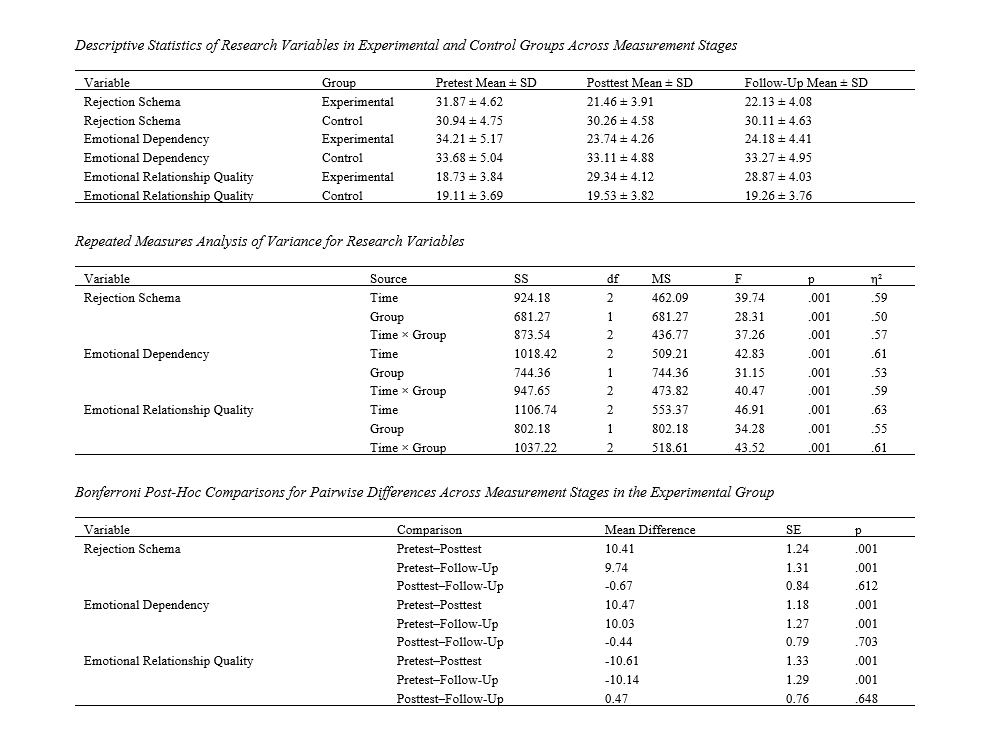
Findings: The findings demonstrated significant differences between the experimental and control groups across posttest and follow-up stages. Results of repeated measures analysis of variance indicated that the schema therapy-based curriculum significantly reduced rejection schemas and emotional dependency while significantly improving emotional relationship quality among students with social anxiety (p < .001). Significant interaction effects between time and group were observed for all dependent variables, indicating that changes in the experimental group were attributable to the intervention. Furthermore, Bonferroni post-hoc comparisons revealed that improvements achieved during the posttest stage remained stable during the two-month follow-up period, confirming the durability of treatment effects over time.
Conclusion: The findings suggest that schema therapy-based educational interventions are effective in modifying maladaptive schemas, reducing emotional dependency, and improving emotional relationships among university students with social anxiety. By targeting deep cognitive-emotional vulnerabilities and attachment-related insecurities, schema-focused curricula may contribute to greater emotional regulation, interpersonal security, and psychological adjustment in educational settings. Therefore, integrating schema therapy-based programs into university counseling and mental health services may represent an effective preventive and therapeutic approach for socially anxious students.
Downloads
References
Adubale, A. A., & Tokurah, A. E. (2024). Effectiveness of Dialectical Behaviour and Schema-Focused Therapies in the Management of Depressive Disorders Among in-School Adolescents in Edo State. Mediterranean Journal of Social Sciences, 15(6), 71. https://doi.org/10.36941/mjss-2024-0055
Aflakian, M., Atashpour, S. H., & Khayatan, F. (2023). Comparison of the Effectiveness of the Schema Therapy Package Based on Psychosocial Issues of Obsessive-Compulsive Patients With Cognitive-Behavioral Therapy on Early Maladaptive Schemas and Anxiety in Patients With Obsessive-Compulsive Disorder. Jayps, 4(5), 129-137. https://doi.org/10.61838/kman.jayps.4.5.12
Ahn, H. J., & Chang, S.-j. (2024). The Relationship Among Disconnection and Rejection Schema, Difficulties in Emotion Regulation, Mindfulness, Self-Compassion, and Undergraduate Student NSSI: A Moderated-Moderated Mediation Effect Study. https://doi.org/10.21203/rs.3.rs-4003901/v1
Alizadeh, N., Mirzaian, B., & Abbasi, G. (2021). The Effect of Schema Therapy on Psychological Capital and Vulnerable Attachmenin Women With Breast Cancer. Medical - Surgical Nursing Journal, 10(2). https://doi.org/10.5812/msnj.117043
Asmari, Y., Dolatshahi, B., Poursharifi, H., & Barahmand, U. (2022). "Early Negative Memories, Humiliation and Defectiveness/Shame Schema: An Emotion-Focused Therapeutic Approach to Social Anxiety". Journal of Evidence-Based Psychotherapies, 22(1), 117-136. https://doi.org/10.24193/jebp.2022.1.7
Bintas-Zorer, P., & Dirik, G. (2023). Social Anxiety From an Attachment Theory Perspective: The Mediating Role of Early Maladaptive Schema Domains and Rejection Sensitivity. Journal of Evidence-Based Psychotherapies, 23(2), 25-47. https://doi.org/10.24193/jebp.2023.2.9
Bruysters, N. Y. F., & Pilkington, P. D. (2022). Overprotective Parenting Experiences and Early Maladaptive Schemas in Adolescence and Adulthood: A Systematic Review and Meta‐analysis. Clinical Psychology & Psychotherapy, 30(1), 10-23. https://doi.org/10.1002/cpp.2776
Cardoso, B. L. A., Lima, A. F. A., Costa, F. R. M., Loose, C., Liu, X., & Fabris, M. A. (2024). Sociocultural Implications in the Development of Early Maladaptive Schemas in Adolescents Belonging to Sexual and Gender Minorities. International journal of environmental research and public health, 21(8), 971. https://doi.org/10.3390/ijerph21080971
Chodkiewicz, J., Wydrzyński, M., & Talarowska, M. (2022). J. Young’s Early Maladaptive Schemas and Symptoms of Male Depression. Life, 12(2), 167. https://doi.org/10.3390/life12020167
Cifuentes, C. E. G., Ruiz, F. J., & Quiceno, J. M. (2024). Psychometric Properties of the Young’s Early Maladaptive Schema Questionnaire – Short Form (YSQ-S3) in Colombia. Behavioral Psychology/Psicología Conductual, 32(1), 65-87. https://doi.org/10.51668/bp.8324103n
Diamond, G., Levy, S., & King, A. A. (2026). Attachment-Based Family Therapy for Depression: Theory, Clinical Model, Research, and Future Directions. 557-577. https://doi.org/10.1037/0000438-029
Fabris, M. A. (2026). Parental Rejection and Risk of Muscle Dysmorphia in Italian Male Adolescents: The Mediating Role of Disconnection and Rejection-Related Early Maladaptive Schemas. Psychology of Men & Masculinity, 27(1), 83-91. https://doi.org/10.1037/men0000545
Farrell, J. M., & Shaw, I. A. (2022). Schema Therapy: Conceptualization and Treatment of Personality Disorders. 281-304. https://doi.org/10.1037/0000310-013
Inchausti, F., García‐Poveda, N. V., Sheila Martínez de la Hidalga González de, B., Morrás, I. I., Popolo, R., & Dimaggio, G. (2025). Metacognitive Interpersonal Group Therapy for Adolescents With Emerging Personality Disorders: The Case of Nora. Journal of Clinical Psychology, 82(2), 207-218. https://doi.org/10.1002/jclp.70050
Inchausti, F., Velázquez‐Basterra, G., Fonseca‐Pedrero, E., MacBeth, A., Popolo, R., & Dimaggio, G. (2022). Metacognitive Interpersonal Group Therapy for Adolescents With Avoidant Personality Disorder: The Case of Sofia. Journal of Clinical Psychology, 78(8), 1579-1589. https://doi.org/10.1002/jclp.23356
Jalilian, K., Momeni, K., & Jebraeili, H. (2023a). The Mediating Role of Early Maladaptive Schemas in the Relationship Between Attachment Styles and Loneliness. BMC psychology, 11(1). https://doi.org/10.1186/s40359-023-01172-9
Jalilian, K., Momeni, K., & Jebraeili, H. (2023b). The Relationship Between Attachment Styles and Loneliness: The Mediating Role of Early Maladaptive Schemas. https://doi.org/10.21203/rs.3.rs-2391389/v1
Karabatak, O. (2023). Cognitive Behavioral Therapy (CBT) for Criminal Behaviors. https://doi.org/10.5772/intechopen.1002039
Karantzas, G. C., Younan, R., & Pilkington, P. D. (2023). The Associations Between Early Maladaptive Schemas and Adult Attachment Styles: A Meta-Analysis. Clinical Psychology Science and Practice, 30(1), 1-20. https://doi.org/10.1037/cps0000108
Kirsner, J., Wilson, S. J., & Osborne, M. S. (2023). Music Performance Anxiety: The Role of Early Parenting Experiences and Cognitive Schemas. Frontiers in psychology, 14. https://doi.org/10.3389/fpsyg.2023.1185296
Kleszczewska-Albińska, A. (2023). Potential Applications Of Schema Therapy in The treatment Of adolescents With Anorexia Nervosa: A theoretical Analysis. Postępy Psychiatrii I Neurologii, 32(4), 215-233. https://doi.org/10.5114/ppn.2023.135530
Li, E., Luyten, P., & Midgley, N. (2020). Psychological Mediators of the Association Between Childhood Emotional Abuse and Depression: A Systematic Review. Frontiers in Psychiatry, 11. https://doi.org/10.3389/fpsyt.2020.559213
Louis, J. P., Ortiz, V., Barlas, J., Lee, J. S., Lockwood, G., Chong, W. F., Louis, K. M., & Sim, P. (2021). The Good Enough Parenting Early Intervention Schema Therapy Based Program: Participant Experience. PLoS One, 16(1), e0243508. https://doi.org/10.1371/journal.pone.0243508
Lukáč, J., & Popelková, M. (2020). The Relationship Between Early Maladaptive Schemas and Attachment. Pomáhajúce Profesie, 3(1), 5-19. https://doi.org/10.17846/pp.2020.3.1.5-19
Norton, A. R., Penney, E., & Abbott, M. J. (2022). An Exploratory Investigation of Schema Modes in Social Anxiety Disorder: Empirical Findings and Case Conceptualization. Journal of Clinical Psychology, 79(4), 1021-1038. https://doi.org/10.1002/jclp.23457
Obeïd, S., Fares, K., Haddad, C., Lahoud, N., Akel, M., Zakhour, M., Kheir, N., Salameh, P., & Hallit, S. (2020). Construction and Validation of the Lebanese Fear of Relationship Commitment Scale Among a Representative Sample of the Lebanese Population. Perspectives in psychiatric care, 56(2), 280-289. https://doi.org/10.1111/ppc.12424
Pereira, T., Ferreira, B. R., & Gonçalves, M. (2024). Voices of the Past: A Case Report on the Interaction Between Childhood Trauma, Social Phobia, and Psychotic Symptoms in a Transgender Male. Cureus. https://doi.org/10.7759/cureus.76006
Rada, C., Neagu, A.-E., Marinescu, V., Rodideal, A. A., & Lunga, R.-A. (2025). The Impact of Childhood Abuse on the Development of Early Maladaptive Schemas and the Expression of Violence in Adolescents. Behavioral Sciences, 15(7), 854. https://doi.org/10.3390/bs15070854
Rodríguez, A., Ratanasiripong, P., Hardaway, K., Barron, L., & Toyama, S. (2020). Latinx College Students: How Schemas and Attachments Impact Depression and Relationship Satisfaction. Hispanic Journal of Behavioral Sciences, 42(2), 248-263. https://doi.org/10.1177/0739986320910165
Starr, L. R., Santee, A. C., & Huang, M. (2023). Dependency and Excessive Reassurance Seeking. 133-155. https://doi.org/10.1037/0000332-007
Tariq, A., Quayle, E., Lawrie, S. M., Reid, C., & Chan, S. W. Y. (2021). Relationship Between Early Maladaptive Schemas and Anxiety in Adolescence and Young Adulthood: A Systematic Review and Meta-Analysis. Journal of affective disorders, 295, 1462-1473. https://doi.org/10.1016/j.jad.2021.09.031
Tsouvelas, G., Chondrokouki, M., Antoniou, X., & Nikolaidis, G. (2023). Early Maladaptive Schemas and Symptoms of Psychopathology in Children in Residential Care. Psychiatriki. https://doi.org/10.22365/jpsych.2023.007
Wheatley, R., & Conway, C. (2023). Stalking, Narcissistic Vulnerability and the Application of Schema Therapy “I Was Punishing Her for Me Not Being Good Enough”. Journal of Criminal Psychology, 13(2), 76-90. https://doi.org/10.1108/jcp-07-2021-0025
Yu, S., Zhang, C., Wang, Y., Liu, T., Chen, X., Guo, J., Zhang, G., & Xu, W. (2022). Parental Neglect, Anxious Attachment, Perceived Social Support, and Mental Health Among Chinese College Students With Left‐behind Experience: A Longitudinal Study. PsyCh Journal, 12(1), 150-160. https://doi.org/10.1002/pchj.611
Zhang, S., Liu, Q., Jia, M., Zhang, Q., & Zhang, L. (2025). The Predictive Roles of Self-Compassion, Perceived Social Support, and Psychological Flexibility in Early Maladaptive Schemas Among College Students: An Exploration Based on Latent Profile Analysis. Frontiers in psychology, 16. https://doi.org/10.3389/fpsyg.2025.1619308
Downloads
Additional Files
Publication Timeline
- Submitted
- Revised
- Accepted