The Effectiveness of Mentalization-Based Training on Rejection Sensitivity and Difficulties in Positive Emotion Regulation in Students with Social Anxiety
DOI:
https://doi.org/10.61838/Keywords:
Mentalization-based training, rejection sensitivity, difficulties in positive emotion regulation, social anxietyAbstract
Objective: The present study aimed to determine the effectiveness of mentalization-based training on rejection sensitivity and difficulties in positive emotion regulation among students with social anxiety.
Materials and Methods: This quasi-experimental study employed a pretest–posttest design with a two-month follow-up and a control group. The statistical population consisted of students with social anxiety in Tehran in 2026. Following the initial screening, participants completed the Rejection Sensitivity Questionnaire and the Difficulties in Emotion Regulation Scale–Positive (DERS-Positive). The mean score of the initial sample was 40.82 on the Rejection Sensitivity Questionnaire and 30.76 on the Difficulties in Positive Emotion Regulation Scale. Accordingly, students who obtained scores above the mean on both instruments were considered eligible for the intervention phase. Subsequently, 30 participants were selected using purposive sampling and were randomly assigned to either the experimental or control group, with 15 participants in each group. The experimental group received mentalization-based training based on the model proposed by Anthony Bateman and Peter Fonagy (2009) across eight 60-minute sessions, while the control group received no intervention during this period. Data were analyzed using the independent samples t-test, Fisher’s exact test, and two-way repeated-measures analysis of variance in IBM SPSS Statistics.
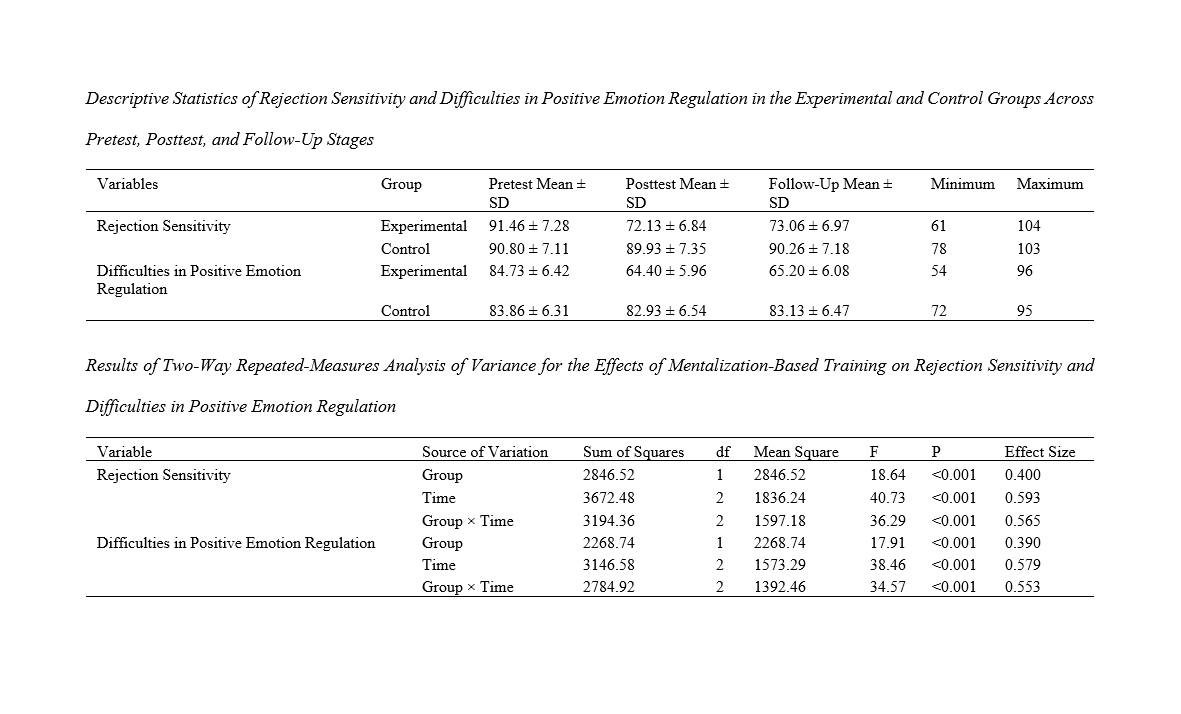
Findings: The results indicated that the experimental and control groups did not differ significantly in terms of demographic characteristics. Furthermore, the results of the two-way repeated-measures analysis of variance demonstrated that the interaction effect of group and time on rejection sensitivity and difficulties in positive emotion regulation was significant. Based on mean comparisons, the scores of rejection sensitivity and difficulties in positive emotion regulation in the experimental group decreased from the pretest to the posttest phase, and this reduction remained largely stable at the two-month follow-up stage. In contrast, no considerable changes were observed in the control group.
Conclusion: Based on the findings of the study, mentalization-based training can reduce rejection sensitivity and difficulties in positive emotion regulation among students with social anxiety.
Downloads
References
Afzali, A., Roshanai, M., Yarmohammadi Vasel, S., Ghanei, R., Khajehpour, F., Karimi Hasanabad, N., & Kazemi Amid, F. (2024). A Cross-Sectional Study of Changes in Social Skills, Academic Motivation, and Perseverance among First- to Third-Year University Students. Social Psychology Research, 14(56), 47-60.
Bateman, A., & Fonagy, P. (2009). Randomized Controlled Trial of Outpatient Mentalization-Based Treatment versus Structured Clinical Management for Borderline Personality Disorder. American Journal of Psychiatry, 166(12), 1355-1364. https://doi.org/10.1176/appi.ajp.2009.09040539
Bosk, E., Mendez, A., Hardan, T., Williams-Butler, A., Mackie, T., & MacKenzie, M. (2026). Expecting Less and Getting It: The Role of Rejection Sensitivity in Feedback-Seeking and Supervisory Relationships. Psychology International, 8(1), 5. https://doi.org/10.3390/psycholint8010005
De Neve, D., Bronstein, M. V., Leroy, A., Truyts, A., & Everaert, J. (2023). Emotion Regulation in the Classroom: A Network Approach to Model Relations among Emotion Regulation Difficulties, Engagement to Learn, and Relationships with Peers and Teachers. Journal of youth and adolescence, 52(2), 273-286. https://doi.org/10.1007/s10964-022-01678-2
Gao, S., Assink, M., Cipriani, A., & Lin, K. (2017). Associations between Rejection Sensitivity and Mental Health Outcomes: A Meta-Analytic Review. Clinical psychology review, 57, 59-74. https://doi.org/10.1016/j.cpr.2017.08.007
Gonzalez-Martin, A. M., Aibar-Almazan, A., Rivas-Campo, Y., Castellote-Caballero, Y., & Carcelen-Fraile, M. D. C. (2023). Mindfulness to Improve the Mental Health of University Students: A Systematic Review and Meta-Analysis. Frontiers in Public Health, 11, 1284632. https://doi.org/10.3389/fpubh.2023.1284632
Gruber, J., Villanueva, C., Burr, E., Purcell, J. R., & Karoly, H. (2020). Understanding and Taking Stock of Positive Emotion Disturbance. Social and Personality Psychology Compass, 14(1), e12515. https://doi.org/10.1111/spc3.12515
Lord, K. A., Suvak, M. K., & Liverant, G. I. (2022). Social Anxiety, Rejection Sensitivity, and Theory of Mind Decoding Ability. Journal of Clinical Psychology, 78(4), 656-670. https://doi.org/10.1002/jclp.23242
Munoz, N., Morales, L., & Karstensen, V. (2024). Predicting Social Anxiety through Peer Rejection and Fear of Negative Evaluation in Youth. Journal of Adolescent and Youth Psychological Studies, 5(8), 148-156. https://doi.org/10.61838/kman.jayps.5.8.18
Phan, M. L., Renshaw, T. L., Caramanico, J., Greeson, J. M., MacKenzie, E., Atkinson-Diaz, Z., Doppelt, N., Tai, H., Mandell, D. S., & Nuske, H. J. (2022). Mindfulness-Based School Interventions: A Systematic Review of Outcome Evidence Quality by Study Design. Mindfulness, 13(7), 1591-1613. https://doi.org/10.1007/s12671-022-01885-9
Spiroiu, F. I., & Maranzan, K. A. (2025). Cognitive-Emotional Impact of Negative Interpretations of Ambiguous Social Information and Fear of Negative Evaluation on the Association between Intolerance of Uncertainty and Social Anxiety Subtypes: A Cross-Sectional Mediation Analysis. Scandinavian journal of psychology, 66, 882-896. https://doi.org/10.1111/sjop.13115
Vos, L. M. W., Bronstein, M. V., Gendron, M., Joormann, J., & Everaert, J. (2025). Navigating the Social World: The Interplay between Cognitive and Socio-Affective Processes in Depression and Social Anxiety. Cognitive therapy and research, 49(3), 640-655. https://doi.org/10.1007/s10608-024-10557-y
Zimmer-Gembeck, M. J., Gardner, A. A., Hawes, T., Masters, M. R., Waters, A. M., & Farrell, L. J. (2021). Rejection Sensitivity and the Development of Social Anxiety Symptoms during Adolescence: A Five-Year Longitudinal Study. International Journal of Behavioral Development, 45(3), 204-215.
Downloads
Additional Files
Publication Timeline
- Submitted
- Revised
- Accepted