Cybervictimization and Disordered Eating Among Adolescent Girls: A Structural Equation Model of Appearance Comparison, Body Dissatisfaction, and Self-Esteem
DOI:
https://doi.org/10.61838/Keywords:
cybervictimization, disordered eating, appearance comparison, body dissatisfaction, self-esteem, adolescent girls, structural equation modelingAbstract
Objective: This study aimed to test the direct and indirect relationships between cybervictimization and disordered eating among adolescent girls, with appearance comparison, body dissatisfaction, and self-esteem examined as parallel and sequential mediators.
Methods and Materials: A cross-sectional correlational study was conducted with 648 adolescent girls aged 13–18 years who were recruited from 12 public secondary schools in Ontario, British Columbia, and Alberta, Canada. Participants completed standardized measures of cybervictimization, appearance comparison, body dissatisfaction, self-esteem, and disordered eating. Data were analyzed using descriptive statistics, Pearson correlations, confirmatory factor analysis, and structural equation modeling. Model fit was evaluated using the comparative fit index, Tucker–Lewis index, root mean square error of approximation, and standardized root mean square residual. Indirect effects were tested using 10,000 bias-corrected bootstrap samples.
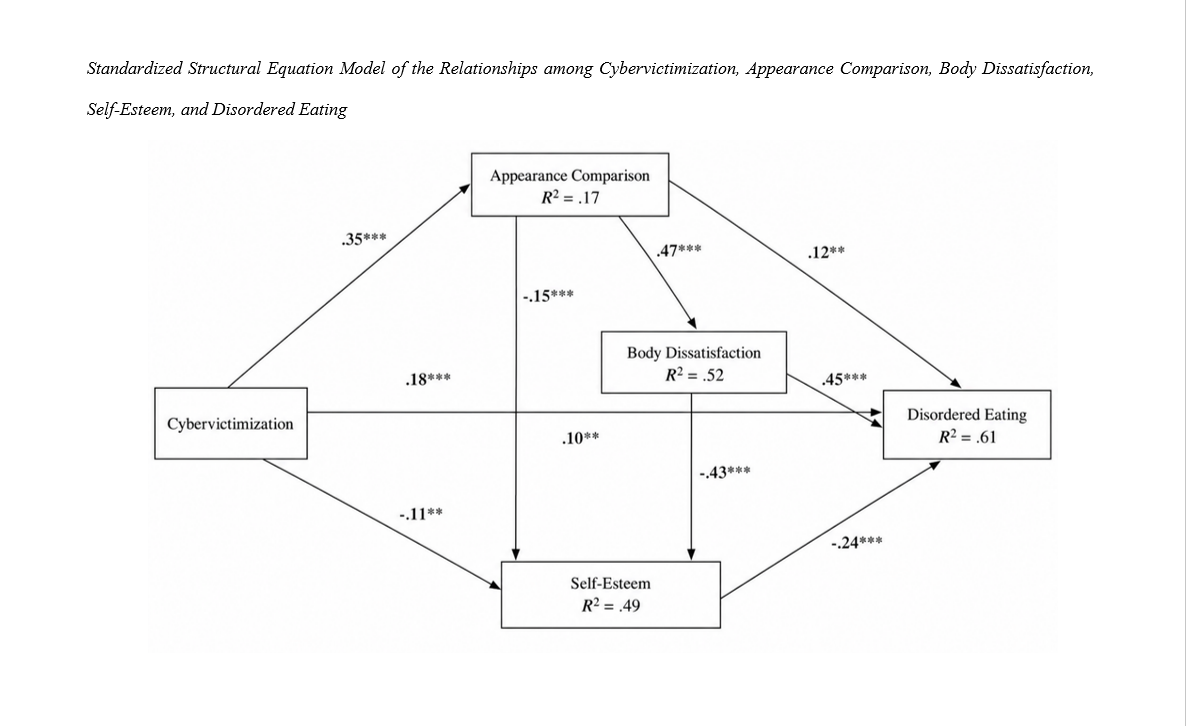
Findings: The proposed partially mediated structural model demonstrated good fit to the data, χ²(1090) = 1754.91, CFI = .950, TLI = .946, RMSEA = .031, and SRMR = .043. Cybervictimization significantly predicted appearance comparison, body dissatisfaction, lower self-esteem, and disordered eating. Appearance comparison significantly predicted body dissatisfaction, lower self-esteem, and disordered eating, while body dissatisfaction significantly predicted lower self-esteem and greater disordered eating. Self-esteem was negatively associated with disordered eating. All hypothesized specific indirect effects were significant. The total indirect effect of cybervictimization on disordered eating was .272, whereas the total effect was .372. The model explained 17% of the variance in appearance comparison, 52% in body dissatisfaction, 49% in self-esteem, and 61% in disordered eating.
Conclusion: Cybervictimization was associated with disordered eating both directly and through interconnected appearance-related and self-evaluative mechanisms, highlighting appearance comparison, body dissatisfaction, and self-esteem as important targets for prevention and intervention.
Downloads
References
Álvarez-Mon, M. Á., Sánchez‐Villegas, A., Gutiérrez-Rojas, L., & Martínez‐González, M. Á. (2024). Screen Exposure, Mental Health and Emotional Well-Being in the Adolescent Population: Is It Time for Governments to Take Action?. Journal of Epidemiology & Community Health, 78(12), 759-763. https://doi.org/10.1136/jech-2023-220577
Awopetu, R. G., Olabimitan, B. A., Kolawole, S. O., Newton, R., Odok, A. A., & Awopetu, A. (2024). The Systematic Review of Social Media Addiction and Mental Health of Nigerian University Students: The Good, the Bad and the Ugly. European Journal of Theoretical and Applied Sciences, 2(1), 767-788. https://doi.org/10.59324/ejtas.2024.2(1).69
Fatima, R. (2025). Understanding Body Image Issues Among Young Pakistani Adults in the Age of Social Media. https://doi.org/10.21203/rs.3.rs-7578713/v1
Flores-Mata, C., & Castellano‐Tejedor, C. (2024). Relationship Between Instagram, Body Satisfaction, and Self-Esteem in Early Adulthood. https://doi.org/10.20944/preprints202406.0420.v1
Gao, M. (2023). Social Media's Influence on Eating Disorders. Modern Economics & Management Forum, 4(4), 107. https://doi.org/10.32629/memf.v4i4.1489
Jakobek, V., Kranjčev, M., & Barić, R. (2024). Predictors of Body Image Dissatisfaction in Kinesiology Students. Frontiers in psychology, 14. https://doi.org/10.3389/fpsyg.2023.1322553
Kiropoulos, L., Krug, I., & Dang, P. L. (2025). Eating Disorder Symptoms in Multiple Sclerosis: Relationships Between Neuroticism, Body Dissatisfaction, and Self-Esteem. Nutrients, 17(10), 1609. https://doi.org/10.3390/nu17101609
Kudlová, K., Hollá, K., Turzík, J., & Hrkotáčová, N. (2024). Body Shaming in Online Space: Systematic Review. Journal of Ecohumanism, 3(8). https://doi.org/10.62754/joe.v3i8.4728
Lee, J., Kim, J., & Lee, J.-E. (2025). Cybervictimization and Eating Disorders in University Sample in Singapore: A Moderated Mediation Model of Deviant Peer Association and Self-Esteem. BMC public health, 25(1). https://doi.org/10.1186/s12889-025-24493-3
Liu, Y. (2023). Social Media Leads to Eating Disorders and Response Strategies. Advances in Education Humanities and Social Science Research, 5(1), 307. https://doi.org/10.56028/aehssr.5.1.307.2023
Makarova, E. A., & Makarova, E. L. (2023). Cyber-Victimization and Its Impact on Victim’s Psychosomatic Status. International Journal of Cognitive Research in Science Engineering and Education, 11(2), 231-245. https://doi.org/10.23947/2334-8496-2023-11-2-231-245
Marano, G., Lisci, F. M., Rossi, S., Marzo, E. M., Boggio, G., Brisi, C., Traversi, G., Mazza, O., Pola, R., Gaetani, E., & Mazza, M. (2025). Connected but at Risk: Social Media Exposure and Psychiatric and Psychological Outcomes in Youth. Children, 12(10), 1322. https://doi.org/10.3390/children12101322
Merino, M., Tornero-Aguilera, J. F., Rubio-Zarapuz, A., Villanueva-Tobaldo, C. V., Martín-Rodríguez, A., & Clemente‐Suárez, V. J. (2024). Body Perceptions and Psychological Well-Being: A Review of the Impact of Social Media and Physical Measurements on Self-Esteem and Mental Health With a Focus on Body Image Satisfaction and Its Relationship With Cultural and Gender Factors. Healthcare, 12(14), 1396. https://doi.org/10.3390/healthcare12141396
Nia, H. S., Froelicher, E. S., Görgülü, Ö., Osborne, J. W., Błachnio, A., Fazeli, A. R., Goudarzian, A. H., & Kaveh, O. (2024). The Relationship Among Positive Body Image, Body Esteem, and Eating Attitude in Iranian Population. Frontiers in psychology, 15. https://doi.org/10.3389/fpsyg.2024.1304555
Omari, S., Mosses, L. I., & Mwanjali, H. H. (2026). Body Shaming and Women's Mental Health: Public Health Challenge for Gender Equity—A Perspective Article. Health Science Reports, 9(7). https://doi.org/10.1002/hsr2.72604
Pérez‐Jiménez, M. Á., Uclés-Torrente, M. d. M., Ruiz-Gamarra, G. E., Vaquero, M., Blancas-Sánchez, I. M., Aparicio‐Martinez, P., & Abellán, M. V. (2025). Social Media Consumption and Risk of Addiction Associated With Adolescent Disordered Eating Behaviour: An Observational Analysis. Nutrients, 17(18), 3017. https://doi.org/10.3390/nu17183017
Prince, T., Mulgrew, K. E., Driver, C., Mills, L., Loza, J., & Hermens, D. F. (2024). The Impact of Appearance-Related Cyberbullying on the Desire to Alter Physical Appearance Among Adolescent Females. https://doi.org/10.21203/rs.3.rs-4434309/v1
Rizk-Hildbrand, M., Semple, T. J., Preisig, M., Haeberling, I., Smigielski, L., Pauli, D., Walitza, S., Kleim, B., & Berger, G. (2025). The Body as a Battleground: A Qualitative Study of the Impact of Violence, Body Shaming, and Self-Harm in Adolescents With a History of Suicide Attempts. International journal of environmental research and public health, 22(6), 859. https://doi.org/10.3390/ijerph22060859
Soh, K. L. (2025). Association Between Problematic Social Media Use and Psychological Distress Among College Students: A Cross-Sectional Study in China Exploring the Mediating Role of Eating Disorders. BMJ open, 15(5), e092863. https://doi.org/10.1136/bmjopen-2024-092863
Tan, F., Luo, H., Chen, Y., & Zhao, X. (2025). Digital Interventions for Improving Body Dissatisfaction in Children and Emerging Adults: Systematic Review and Meta-Analysis. Interactive Journal of Medical Research, 14, e72231-e72231. https://doi.org/10.2196/72231
Tsartsapakis, I., Papadopoulos, P., Stavrousis, D., Dalamitros, A. A., Chatzipanteli, A., Chalatzoglidis, G., Gerou, M., & Zafeiroudi, A. (2024). Recreational Physical Activity and the Mediterranean Diet: Their Effects on Obesity-Related Body Image Dissatisfaction and Eating Disorders. Healthcare, 12(16), 1579. https://doi.org/10.3390/healthcare12161579
Varela, C., Hoyo, Á., Tapia-Sanz, M. E., Jiménez‐González, A. I., Moral, B. J., Rodríguez-Fernández, P., Vargas-Hernández, Y., & Sánchez, L. J. R. (2023). An Update on the Underlying Risk Factors of Eating Disorders Onset During Adolescence: A Systematic Review. Frontiers in psychology, 14. https://doi.org/10.3389/fpsyg.2023.1221679
Wang, J. (2023). The Impact of Social Media on Body Image Perception and Eating Disorders. Journal of Innovations in Medical Research, 2(9), 36-40. https://doi.org/10.56397/jimr/2023.09.06
Wang, W., & Ding, X. (2023). A Pilot Randomized Trial of Self‐compassion Writing for Young Adult Women Engaged in Emotional Eating in the Context of Appearance‐related Cyberbullying. International Journal of Eating Disorders, 56(8), 1520-1533. https://doi.org/10.1002/eat.23967
Xie, L., Da, Q., Chen, Y. C., Chen, Y., Wu, F., & Li, L. (2024). Association Between School Bullying Type and the Risk of Eating Disorders Among Chinese College Students: The Mediating Role of Body Dissatisfaction. BMC psychology, 12(1). https://doi.org/10.1186/s40359-024-02207-5
Xiong, Y. (2023). The Influence of Social Media on Women’s Body Image. Communications in Humanities Research, 20(1), 244-249. https://doi.org/10.54254/2753-7064/20/20231379
Zumaglini, S., Fredrick, S. S., Thompson, J. K., & Faith, M. S. (2025). Confronting Pediatric Weight‐Based Cybervictimization: Time for Action. Obesity Science & Practice, 11(3). https://doi.org/10.1002/osp4.70073
Downloads
Additional Files
Publication Timeline
- Submitted
- Revised
- Accepted