Elastic Net Regression for Predicting Psychological Well-Being among Adolescents from Resilience, Self-Compassion, Gratitude, and Perceived Social Support
DOI:
https://doi.org/10.61838/Keywords:
Psychological well-being, Adolescents, Resilience, Self-compassion, Gratitude, Perceived social supportAbstract
Objective: This study aimed to examine the predictive roles of resilience, self-compassion, gratitude, and perceived social support in explaining psychological well-being among adolescents using Elastic Net Regression.
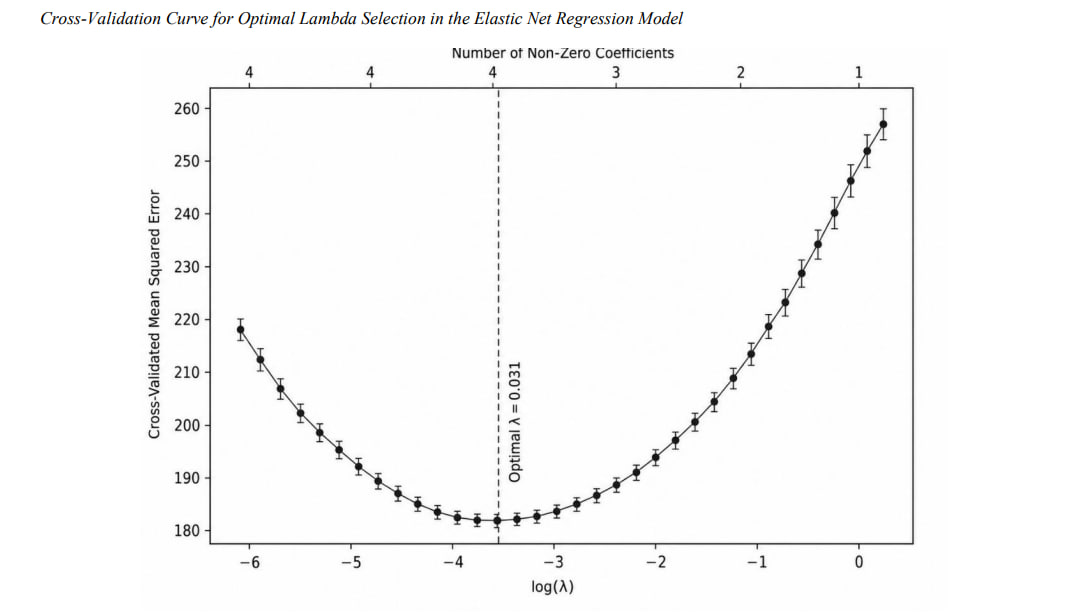
Methods and Materials: This cross-sectional predictive study was conducted among 1,284 adolescents aged 13 to 18 years from public secondary schools in Malaysia. Participants were selected through multistage cluster sampling from schools located in Selangor, Kuala Lumpur, Penang, and Johor. Data were collected using standardized self-report instruments, including the Ryff Psychological Well-Being Scale, Connor–Davidson Resilience Scale, Self-Compassion Scale–Short Form, Gratitude Questionnaire–Six Item Form, and Multidimensional Scale of Perceived Social Support. After data screening and handling of missing values through multiple imputation, descriptive statistics, correlation analysis, and Elastic Net Regression were performed. Predictor variables were standardized before modeling. The dataset was divided into training and testing subsets, and 10-fold cross-validation was applied to identify the optimal alpha and lambda values. Model performance was evaluated using R², Root Mean Square Error, and Mean Absolute Error. Bootstrap resampling with 1,000 iterations was conducted to assess coefficient stability.
Findings: Elastic Net Regression showed strong predictive accuracy, explaining 69.4% of the variance in psychological well-being in the training set and 68.1% in the testing set. The optimized model produced low prediction error indices, with RMSE values of 13.21 and 13.86 and MAE values of 10.18 and 10.73 for the training and testing datasets, respectively. Resilience emerged as the strongest predictor of psychological well-being, followed by self-compassion, perceived social support, and gratitude.
Conclusion: The findings indicate that psychological well-being among adolescents is strongly predicted by a combination of personal and relational protective factors. Resilience and self-compassion were the most influential predictors, while perceived social support and gratitude also made meaningful contributions.
Downloads
References
Aledeh, M., Sokan–Adeaga, A. A., Adam, H., Aledeh, S., & Kotera, Y. (2024). Suggesting Self-Compassion Training in Schools to Stop Cyberbullying: A Narrative Review. Discover Psychology, 4(1). https://doi.org/10.1007/s44202-023-00110-5
An, Y., Lu, A., Chen, G., Jian, Y., Chen, W., Ke, X., Zhong, Y., & Li, J. (2025). Understanding Self‐Perceived and Other‐Perceived Body Image in Adolescents: The Roles of Neuroticism, Mindfulness, and Self‐Compassion. Psychology in the Schools, 62(10), 4065-4079. https://doi.org/10.1002/pits.23597
Ashmitha, P., & Annalakshmi, N. (2022). Development of a Scale to Measure Psychosocial Risks and Protective Factors in Adolescents. Journal of Indian Association for Child and Adolescent Mental Health, 18(1), 12-28. https://doi.org/10.1177/09731342221096475
Caskey, M. M. (2022). Building Shared Knowledge: Research on the Health and Well-Being of Middle-Grades Youth. https://doi.org/10.3102/1886438
Chamizo‐Nieto, M. T., & Rey, L. (2023). Cybervictimization and Suicidal Ideation in Adolescents: A Prospective View Through Gratitude and Life Satisfaction. Journal of Health Psychology, 28(7), 620-632. https://doi.org/10.1177/13591053221140259
Chi, X., Jiang, W., Guo, T., Hall, D. L., Luberto, C. M., & Zou, L. (2022). Relationship Between Adverse Childhood Experiences and Anxiety Symptoms Among Chinese Adolescents: The Role of Self-Compassion and Social Support. Current Psychology, 42(15), 12822-12834. https://doi.org/10.1007/s12144-021-02534-5
Cousino, M. K., Dusing, C. R., Rea, K. E., Glenn, T., Armstrong, B., Les, A. S., Hansen, J. E., Pasquali, S. K., & Schumacher, K. R. (2024). Developing the WE BEAT Well-Being Education Programme to Foster Resilience and Build Connection in Paediatric Heart Disease. Cardiology in the Young, 34(8), 1701-1707. https://doi.org/10.1017/s1047951124000556
Dorjee, D. (2024). Conceptualising Child and Adolescent Mental Health and Wellbeing Neurodevelopment: an Integrative Brain Networks Framework. https://doi.org/10.31234/osf.io/7vx45
El-Bagiz, S. S., & Kinanthi, M. R. (2022). Family Fuctioning and Health-Related Quality of Life Among Adolescents of Low Socio-Economic Status. Indigenous Jurnal Ilmiah Psikologi, 7(2), 107-118. https://doi.org/10.23917/indigenous.v7i2.17507
Francisco, R., Raposo, B., Hormigo, M., Sesifredo, M., Carvalho, Á., Justo, A., & Godinho, C. (2023). #EntreViagenseAprendizagens: Study Protocol of a School-Based Intervention to Promote Well-Being and Healthy Lifestyles Among Adolescents. Frontiers in psychology, 14. https://doi.org/10.3389/fpsyg.2023.1213293
Fu, M. (2024). The Influence of Positive Psychology Interventions on Adolescent Well-Being: A Systematic Literature Review. Journal of Education Humanities and Social Sciences, 32, 111-118. https://doi.org/10.54097/3g493r69
Ginting, E. B., Lumbanbatu, J. S., & Simarmata, P. (2024). Self-Compassion as an Innovative Approach to Maintaining the Mental Well-Being of Adolescents Living in Dormitory. Bulletin of Counseling and Psychotherapy, 6(2). https://doi.org/10.51214/00202406957000
Halleyda, N., & Japar, M. (2023). The Gratitude Training to Enhance the Psychological Well-Being Among Adolescents With Single Parents. Humanitas Indonesian Psychological Journal, 174-183. https://doi.org/10.26555/humanitas.v20i2.348
Jobin, K. (2025). Development of a School-Based Mindful Yoga and Meditation Intervention Module for Enhancing Adolescents’ Emotion Regulation and Well-Being. Journal of education and health promotion, 14(1). https://doi.org/10.4103/jehp.jehp_408_25
John, E. S., Armstrong, L. L., & Watt, E. (2024). Meaning as an Early Determinant of Mental Health in Children. The Humanistic Psychologist, 52(2), 186-205. https://doi.org/10.1037/hum0000328
Khatib, N. A. M. (2023). An Examination of Adolescents Self-Compassion in Relation to Happiness. International Journal of Academic Research in Business and Social Sciences, 13(6). https://doi.org/10.6007/ijarbss/v13-i6/17559
Kim, J., Kim, S., Kim, M., Park, Y., Lee, K., Chung, D. S., Kim, Y. H., Kweon, Y. S., Moon, D.-S., Lee, H.-Y., Park, J. H., Kang, Y. H., Won, S., & Kwak, Y.-S. (2025). Effectiveness of the Mindfulness-Based Social–Emotional Growth (MSEG) Program in Enhancing Mental Health of Elementary School Students in Korea. Behavioral Sciences, 15(3), 315. https://doi.org/10.3390/bs15030315
Linford, L. B., Bekker, J., Ameen, J., & Warren, J. S. (2021). Implementation of a Positive Psychology Curriculum in a High School Setting: A Mixed Methods Pilot Study. Journal of Positive School Psychology, 6(1), 25-37. https://doi.org/10.47602/jpsp.v6i1.268
Merlo, G., Snellman, L., & Sugden, S. G. (2025). Connectedness: The Updated and Expanded Pillar of Lifestyle Psychiatry and Lifestyle Medicine. American Journal of Lifestyle Medicine, 19(8), 1104-1124. https://doi.org/10.1177/15598276251345455
Peng, Y., Xia, M., & Chi, X. (2024). Age‐varying Associations of Parent‐adolescent Relationship and School Connectedness With Adolescent Self‐compassion: Differences by Gender. Journal of adolescence, 96(8), 1767-1780. https://doi.org/10.1002/jad.12378
Preston, A. J., Rew, L., & Young, C. C. (2021). A Systematic Scoping Review of Psychological Capital Related to Mental Health in Youth. The Journal of School Nursing, 39(1), 72-86. https://doi.org/10.1177/10598405211060415
Primasari, A., & Yuniarti, K. W. (2021). Enjoying Every Moment: Improving Adolescent’s Subjective Well-Being Through Adolescent Mindfulness Program. Gadjah Mada Journal of Professional Psychology (Gamajpp), 7(2), 115. https://doi.org/10.22146/gamajpp.65594
Razza, R. A., Bergen‐Cico, D., Reid, S., & Linsner, R. K. (2021). The Benefits of Mindfulness for Promoting Resilience Among at-Risk Adolescents: Results From the Inner Strength Teen Program. ECNU Review of Education, 8(1), 272-294. https://doi.org/10.1177/2096531120982254
Razza, R. A., Zhang, Y., & Edelstein, A. (2025). Mindfulness-Based Cognitive and Emotional Wellness Supports for Adolescents: Adaptations and Lessons Learned During the COVID-19 Pandemic. School Psychology International, 46(4), 421-454. https://doi.org/10.1177/01430343251361133
Saboor, S., Medina, A., & Marciano, L. (2024). Application of Positive Psychology in Digital Interventions for Children, Adolescents, and Young Adults: Systematic Review and Meta-Analysis of Controlled Trials. Jmir Mental Health, 11, e56045. https://doi.org/10.2196/56045
Salsman, J. M., & Rosenberg, A. R. (2024). Fostering Resilience in Adolescence and Young Adulthood: Considerations for Evidence‐based, Patient‐centered Oncology Care. Cancer, 130(7), 1031-1040. https://doi.org/10.1002/cncr.35182
Shek, D. T. L. (2025). Mental Health of Young People in the Post-Pandemic Era: Perspective Based on Positive Psychology and Resilience. International journal of environmental research and public health, 22(10), 1574. https://doi.org/10.3390/ijerph22101574
Sorrenti, L., Imbesi, M., Meduri, C. F., Fumia, A., & Filippello, P. (2025). The Mediating Role of Dispositional Optimism and Perfectionism on the Relationship Between Perceived Parental Psychological Control and Support and Adolescents’ Well-Being. European Journal of Investigation in Health Psychology and Education, 15(8), 160. https://doi.org/10.3390/ejihpe15080160
Ünlü, S., Uzun, K., & Arslan, G. (2025). Mindfulness-Based Intervention in Schools: Addressing Social Media Burnout and Enhancing Well-Being in Adolescents. Children, 12(7), 826. https://doi.org/10.3390/children12070826
Vaingankar, J. A., Subramaniam, M., Seow, E., Chang, S., Sambasivam, R., Luo, N., Verma, S., Chong, S. A., & Dam, R. M. v. (2022). Youth Positive Mental Health Concepts and Definitions: A Systematic Review and Qualitative Synthesis. International journal of environmental research and public health, 19(18), 11506. https://doi.org/10.3390/ijerph191811506
Wekerle, C., Kim, K., & Wong, N. (2022). Child Sexual Abuse Victimization: Focus on Self-Compassion. Frontiers in Psychiatry, 13. https://doi.org/10.3389/fpsyt.2022.818774
White, K., Lubans, D. R., & Eather, N. (2022). Feasibility and Preliminary Efficacy of a School-Based Health and Well-Being Program for Adolescent Girls. Pilot and Feasibility Studies, 8(1). https://doi.org/10.1186/s40814-021-00964-3
Zhao, M., Miao, H., Zhu, L., Zhang, X., & Zang, L. (2025). Social Support and Adolescent Mental Health in Kenya: A Parallel Mediation Analysis of Perceived Control and Gratitude. Frontiers in Pediatrics, 13. https://doi.org/10.3389/fped.2025.1626249
Downloads
Additional Files
Publication Timeline
- Submitted
- Revised
- Accepted