Prediction of Students’ Academic Satisfaction Using Deep Learning Algorithms Based on Self-Efficacy, Professor–Student Interaction, Mental Health, and Achievement Motivation
DOI:
https://doi.org/10.61838/Keywords:
Academic satisfaction, academic self-efficacy, professor–student interaction, mental health, achievement motivation, university studentsAbstract
Objective: The present study aimed to predict students’ academic satisfaction using deep learning algorithms based on academic self-efficacy, professor–student interaction, mental health, and achievement motivation among university students in Tehran.
Methods and Materials: The present research was conducted using an applied, descriptive-correlational design with a predictive modeling approach. The statistical population consisted of university students in Tehran during the academic year, from whom 684 students were selected through multistage cluster sampling. Data were collected using the College Student Satisfaction Questionnaire, College Academic Self-Efficacy Scale, Student–Professor Interaction Scale, Depression Anxiety Stress Scales-21, and Achievement Motives Scale-Revised. Descriptive statistics and Pearson correlation analysis were performed using SPSS software, while predictive analyses were conducted using Python-based deep learning frameworks. The dataset was divided into training, validation, and testing subsets. Several deep learning models, including multilayer perceptron neural networks, deep feedforward neural networks, regularized neural networks with dropout, and autoencoder-based deep neural networks, were implemented and compared. Model performance was evaluated using coefficient of determination, mean absolute error, root mean squared error, and mean absolute percentage error.
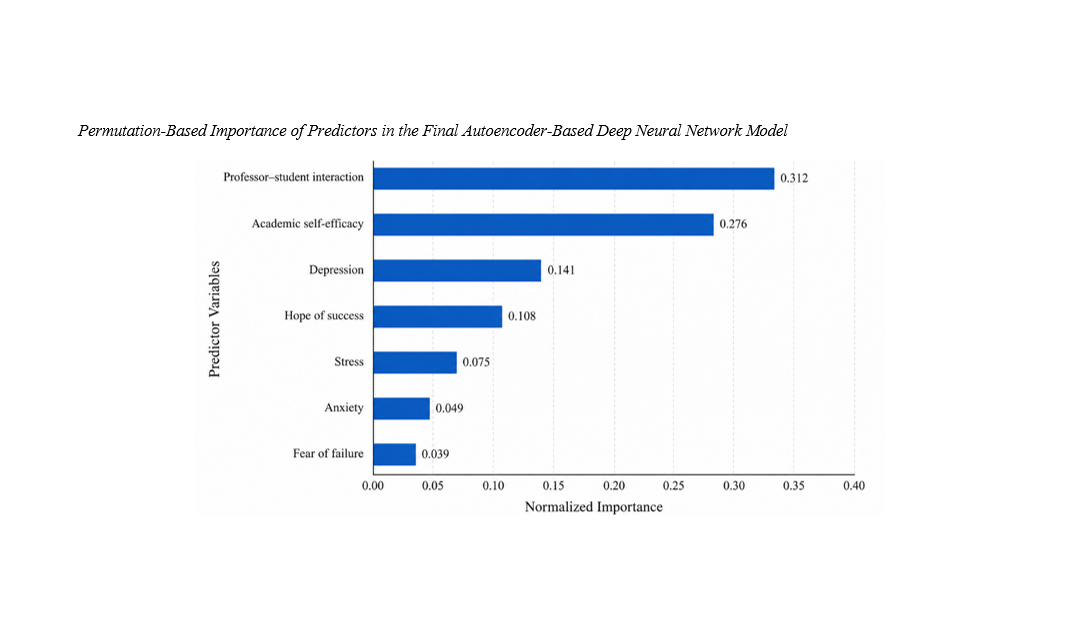
Findings: The findings showed that academic self-efficacy, professor–student interaction, and hope of success had significant positive relationships with academic satisfaction, whereas depression, anxiety, stress, and fear of failure had significant negative relationships with academic satisfaction (p < .001). Among the predictors, professor–student interaction and academic self-efficacy demonstrated the strongest predictive power. Feature-importance analysis indicated that professor–student interaction was the most influential predictor, followed by academic self-efficacy, depression, hope of success, stress, anxiety, and fear of failure. The final deep learning model explained a substantial proportion of variance in students’ academic satisfaction.
Conclusion: The findings indicate that academic satisfaction is a multidimensional construct influenced by cognitive, emotional, motivational, and interpersonal factors.
Downloads
References
Agustina, K. D., & Saragih, A. H. (2022). Learning Engagement Effect on Satisfaction, and Future Preferences of Online Tax Brevet. Dinamika Pendidikan, 17(1), 86-106. https://doi.org/10.15294/dp.v17i1.33479
Alcalde, L. M. O. (2024). Diagnosis of the Current State of University Academic Performance: Applied Educational Research in the Peruvian Context. Evolutionary Studies in Imaginative Culture, 1538-1552. https://doi.org/10.70082/esiculture.vi.1550
Bazar, J. S., Arabejo, A. J. D., Reyes, M. R., & Baluyos, G. R. (2024). Students’ Wellbeing and Level of Motivation Towards Science Learning in Relation to Their Academic Achievement. Eduline Journal of Education and Learning Innovation, 4(1), 182-195. https://doi.org/10.35877/454ri.eduline2009
Cao, L., Yu, Q., Feng, X., Wang, L., & Lang, J. (2025). The Influence of Physical Exercise on Achievement Motivation Among College Students: The Mediating Roles of Self-Efficacy and Life Satisfaction. Frontiers in psychology, 16. https://doi.org/10.3389/fpsyg.2025.1529829
Carmen Graciela Arbulú Pérez, V., Muro, J. P. M., Delgado, J. W. P., Carrasco, D. K. E., Cueva, A. F., & Enríquez, B. G. A. (2024). Mediating Role of Digital Skills and Mobile Self-Efficacy in the Stress and Academic Engagement of Peruvian University Students in Postpandemic Virtual Environments. BMC psychology, 12(1). https://doi.org/10.1186/s40359-024-01982-5
Cavioni, V., Grazzani, I., Ornaghi, V., Agliati, A., Gandellinia, S., Cefai, C., Camilleri, L., Bartolo, P. A., Vorkapić, S. T., Golob, L., Πούλου, Μ., Martinsone, B., Supe, I., Simões, C. S., Lebre, P., Colomeischi, A. A., Rusu, P. R., Acostoaie, L., Vintur, T., & Conte, E. (2023). A Multi-Component Curriculum to Promote Teachers’ Mental Health: Findings From the PROMEHS Program. International Journal of Emotional Education, 15(1), 34-52. https://doi.org/10.56300/kfnz2526
Chacón, R. G., Núñez-Sánchez, J. M., & Gálvez-Ruíz, P. (2024). Effects of Physical Activity and COVID-19 on Healthy Student Strengths in the University System: Implications for Post-Pandemic Management. European Journal of Investigation in Health Psychology and Education, 14(1), 243-255. https://doi.org/10.3390/ejihpe14010016
Corbí, R. G., Perez-Soto, N., Izquierdo, A., Costa, J. L. C., & Pozo-Rico, T. (2024). Emotional Factors and Self-Efficacy in the Psychological Well-Being of Trainee Teachers. Frontiers in psychology, 15. https://doi.org/10.3389/fpsyg.2024.1434250
E., S. A., A., M. F., M., A. C., & A., J. A. (2024). Expectancy-Value Beliefs and Task Values in Relation to the Academic Satisfaction Among Bachelor of Secondary Education Students. International Journal for Multidisciplinary Research, 6(4). https://doi.org/10.36948/ijfmr.2024.v06i04.24559
Huang, L., Al-Rashidi, A. H., & Bayat, S. (2024). Teacher Support in Language Learning: A Picture of the Effects on Language Progress, Academic Immunity, and Academic Enjoyment. BMC psychology, 12(1). https://doi.org/10.1186/s40359-024-01602-2
Jiang, J. (2024). Impact of Music Learning on Students’ Psychological Development With Mediating Role of Self-Efficacy and Self-Esteem. PLoS One, 19(9), e0309601. https://doi.org/10.1371/journal.pone.0309601
Jin, Y., & Hassan, N. C. (2022). Examining the Effects of University Teacher Self-Efficacy on Job Satisfaction Facing OMO Teaching During Post Covid-19 Pandemic. International Journal of Academic Research in Business and Social Sciences, 12(8). https://doi.org/10.6007/ijarbss/v12-i8/14508
Lin, T., & Zhu, X. (2024). Academic Self-Efficacy, Grit, and Teacher Support as Predictors of Psychological Well-Being of Chinese EFL Students. Frontiers in psychology, 14. https://doi.org/10.3389/fpsyg.2023.1332909
López-Angulo, Y., Sáez-Delgado, F., Mella-Norambuena, J., Bernardo, A., & Mújica, A. D. (2023). Predictive Model of the Dropout Intention of Chilean University Students. Frontiers in psychology, 13. https://doi.org/10.3389/fpsyg.2022.893894
Meng, Y., Sun, Y., Yang, L., & Mydin, Y. O. (2025). Mechanisms From Growth Mindset to Psychological Well-Being of Chinese Primary School Students: The Serial Mediating Role of Grit and Academic Self-Efficacy. Behavioral Sciences, 15(5), 621. https://doi.org/10.3390/bs15050621
Oyanedel, J. C., Abs, D. J. V., & Rivera-Vargas, P. (2023). Subjective Well-Being in Online and Mixed Educational Settings. https://doi.org/10.3389/978-2-83251-880-9
Perrella, L., Lodi, E., & Patrizi, P. (2024). Adaptation and Validation of the Academic Stress Scale in the Italian Context: Latent Structure, Reliability, and Concurrent Validity. European Journal of Investigation in Health Psychology and Education, 14(3), 782-807. https://doi.org/10.3390/ejihpe14030051
Qin, T. (2024). Exploring the Interplay Between Teachers' Emotions, Personal Traits, Environmental Factors and Psychological Well‐Being. European Journal of Education, 60(1). https://doi.org/10.1111/ejed.12903
Santi, E.-A., Gorghiu, G., & Pribeanu, C. (2023). Perceived Self-Efficacy and Course Satisfaction in Students Preparing for Teaching Careers. Problems of Education in the 21st Century, 81(5), 687-701. https://doi.org/10.33225/pec/23.81.687
Scheirlinckx, J., Raemdonck, L. V., Abrahams, L., Teixeira, K. C., Alves, G., Primi, R., John, O. P., & Fruyt, F. D. (2023). Social–emotional Skills of Teachers: Mapping the Content Space and Defining Taxonomy Requirements. Frontiers in Education, 8. https://doi.org/10.3389/feduc.2023.1094888
Shao, G. (2023). A Model of Teacher Enthusiasm, Teacher Self-Efficacy, Grit, and Teacher Well-Being Among English as a Foreign Language Teachers. Frontiers in psychology, 14. https://doi.org/10.3389/fpsyg.2023.1169824
Song, Y. (2024). Sustainable Growth of Learner Engagement and Well‐Being Through Social (Teacher and Peer) Support: The Mediator Role of Self‐Efficacy. European Journal of Education, 59(4). https://doi.org/10.1111/ejed.12791
Wang, Z. (2024). The Impact of Teachers' Behavior on Educational Effectiveness in Online Learning Mode. Tssehr, 5, 438-443. https://doi.org/10.62051/9t1q5v10
Yan, T., Yu, H., & Tang, J. (2024). The Influence of Multiple Factors on Musicology Doctoral Students’ Academic Performance: An Empirical Study Based in China. Behavioral Sciences, 14(11), 1073. https://doi.org/10.3390/bs14111073
Yang, J., Peng, M. Y., Wong, S.-H., & Chong, W.-L. (2021). How E-Learning Environmental Stimuli Influence Determinates of Learning Engagement in the Context of COVID-19? SOR Model Perspective. Frontiers in psychology, 12. https://doi.org/10.3389/fpsyg.2021.584976
Ying, J., & Hassan, N. B. C. (2022). Relationship Between University Organizational Management Climate, Teacher Self-Efficacy and Job Satisfaction in Chinese University. International Journal of Academic Research in Business and Social Sciences, 12(6). https://doi.org/10.6007/ijarbss/v12-i6/13940
Yu, X., & Li, Z. (2025). The Relationship Between Self-Efficacy and Job Satisfaction: A Meta-Analysis From the Perspective of Teacher Mental Health. Healthcare, 13(14), 1715. https://doi.org/10.3390/healthcare13141715
Yu, X., & Ying, T. (2024). Under the Surface of Teacher Occupational Wellness and Effectiveness in Higher Education: A Look Into the Mediator Roles of Work Passion and Emotion Regulation via SEM Analysis. BMC psychology, 12(1). https://doi.org/10.1186/s40359-024-01656-2
Zeb, I., Khan, A., & Zhang, Y. (2025). Exploring the Influence of Core Self-Evaluation on Students’ Academic Self-Efficacy: A Qualitative Study Considering Anxiety and Interpersonal Responses. Journal of Applied Research in Higher Education, 17(1), 526-541. https://doi.org/10.1108/jarhe-07-2024-0343
Zhan, W. (2025). Dose Regular Physical Activity Improve the Relationships Among Self-Efficacy, Resilience, Happiness, and Well-Being in Youth People With Hearing Disability in Guangdong—a Moderation Model. Frontiers in psychology, 16. https://doi.org/10.3389/fpsyg.2025.1611657
Zhang, G., Yue, X., Ye, Y., & Peng, M. Y. (2021). Understanding the Impact of the Psychological Cognitive Process on Student Learning Satisfaction: Combination of the Social Cognitive Career Theory and SOR Model. Frontiers in psychology, 12. https://doi.org/10.3389/fpsyg.2021.712323
Zhang, L. (2023). Reviewing the Effect of Teachers’ Resilience and Wellbeing on Their Foreign Language Teaching Enjoyment. Frontiers in psychology, 14. https://doi.org/10.3389/fpsyg.2023.1187468
Zhao, Y. (2024). The Impact of College Students’ Academic Stress on Student Satisfaction From a Typological Perspective: A Latent Profile Analysis Based on Academic Self-Efficacy and Positive Coping Strategies for Stress. Behavioral Sciences, 14(4), 311. https://doi.org/10.3390/bs14040311
Downloads
Additional Files
Publication Timeline
- Submitted
- Revised
- Accepted