The Effectiveness of Life Skills Training on Self-Handicapping among Students
DOI:
https://doi.org/10.61838/kman.jayps.4757Keywords:
Life skills training, Self-handicapping, Effort, Negative mood, Excuse-making, University studentsAbstract
Objective: This study aimed to examine the effectiveness of life skills training in reducing self-handicapping behaviors and their components among master’s students.
Methods and Materials: This applied, quantitative study used a semi-experimental pretest–posttest design with a control group and a two-month follow-up. The statistical population comprised all master’s students in Economic Management at the Islamic Azad University, Shiraz Branch, during the 2024–2025 academic year. Using convenience sampling, 78 students were selected and randomly assigned to an experimental group (n = 39) and a control group (n = 39). The experimental group participated in ten 45-minute sessions of life skills training based on Klinke’s (1994) protocol, covering self-awareness, empathy, communication, anger management, problem-solving, stress management, decision-making, creative and critical thinking, and emotional regulation. Data were collected using the Self-Handicapping Questionnaire developed by Jones and Rhodewalt (1978) and analyzed through analysis of covariance (ANCOVA) and multivariate analysis of covariance (MANCOVA) using SPSS 26.
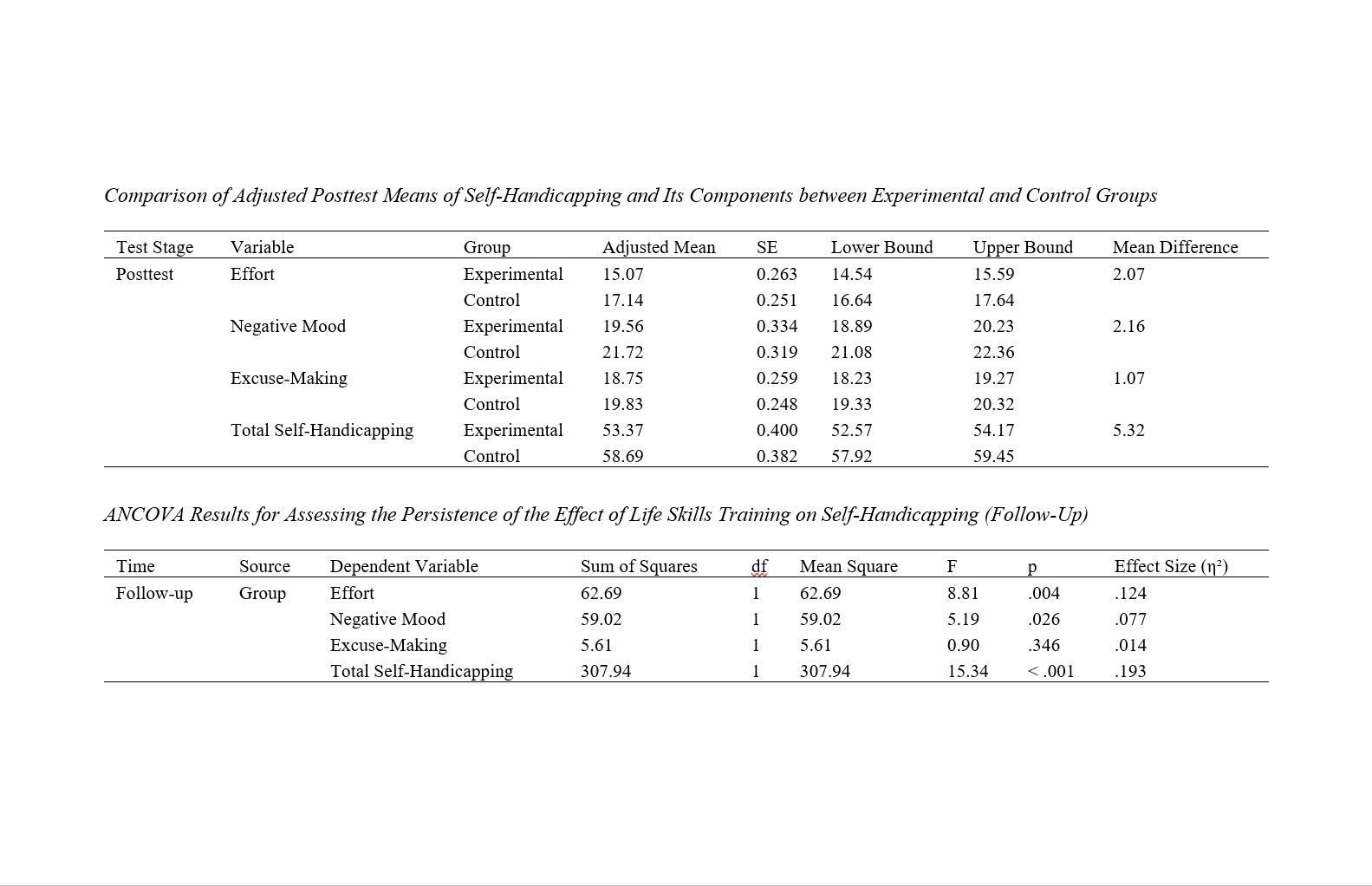
Findings: The results revealed significant reductions in total self-handicapping and its components among the experimental group compared to the control group at the posttest stage (p < .001). ANCOVA results indicated strong intervention effects on total self-handicapping (F = 92.34, η² = .591), effort (F = 32.25, η² = .342), and negative mood (F = 21.65, η² = .259), with a moderate effect on excuse-making (F = 8.90, p = .004, η² = .126). The follow-up analysis confirmed the persistence of effects after two months, except for the excuse-making component (p > .05).
Conclusion: Life skills training effectively reduces self-handicapping and its cognitive-emotional components among university students and maintains its impact over time, highlighting its importance as a preventive and developmental intervention in higher education.
Downloads
References
Afshari, A. (2023). Develop a causal model of self-handicapping syndrome based on negative self-assessment, intolerance of ambiguity, and cognitive avoidance with the mediating role of academic procrastination. Developmental Pscychology, 19(76), 409-422. https://www.magiran.com/paper/2643643
Ahmadi , F., & Amoopour , M. (2023). Predicting academic self-disability based on social support and mental health in students. Journal of Educational Psychology, 1(14), 1-9. http://sanad.iau.ir/fa/Article/953496
Alipour, F., Farid, A., & Mosleh, S. Q. (2024). The model of academic procrastination based on academic self-handicapping and perfectionism with the mediating role of students' sense of competence. Research in cognitive and behavioral sciences, 13(2), 1-20. https://cbs.ui.ac.ir/article_27778_en.html?lang=fa
Amirian Zadeh, M., & Besharati, F. (2018). The Impact of Life Skills Training on Social Skills and Academic Performance of Female High School Students. Women and Society Quarterly, 9(3), 17-43.
Amjadian, F., & Bahrami, M. (2023). The Correlation between Self-Handicapping and Students' Academic Performance: The Intermediary Role of Procrastination in High School Students in the City of Kermanshah [Research]. Quarterly Journal of Education, 38(4), 87-106. http://qjoe.ir/article-1-1857-en.html
Chang, K. J., Seo, J., Kim, M.-J., Song, H.-Y., & Kim, M. S. (2025). Psychological Mechanism Contributing to Academic Burnout and Depression in College Students: Focus on Evaluation Concern Perfectionism, Academic Procrastination, Fear of Failure, and Self-Handicapping. Korean Assoc Learner-Centered Curric Instr, 25(2), 807-824. https://doi.org/10.22251/jlcci.2025.25.2.807
Jamali Paghale, Z., Paghale Jamali, S., Feighan Jadidi, M., & Nazary, M. (2015). The Effect of Life Skills Training on Social Adjustment and Academic Performance of Adolescent Female Students. Knowledge & Research in Applied Psychology, 15(58), 121-129. https://www.magiran.com/paper/1390795
Karimi, P., Baseri, A., & Razini, H. H. (2024). The effectiveness of mindfulness-based cognitive therapy on procrastination and self-handicapping of students with academic failure. Rooyesh-e-Ravanshenasi Journal (RRJ), 13(1), 171-180. https://frooyesh.ir/browse.php?a_id=3781&sid=1&slc_lang=en&ftxt=1
Mokhtari, M., Fakhri, M. K., & Hassan Zadeh, R. (2014). The Effect of Life Skills Training on Aggression in High School Students. First Guidance Conference in Karaj City in the Academic Year 2010-2011,
Nasrabadi, M. (2012). Investigating the role of curriculum elements in fostering 21st-century life skills from the perspective of Tehran elementary school teachers in the academic year 2011-2012 Islamic Azad University, Tehran Branch].
Nouri, T. (2021). The effect of online life skills training on academic resilience of students with incarcerated parents during COVID-19. Women Police Bimonthly, 15(34), 187-206. https://elmnet.ir/doc/2417790-79188
Ortiz-Rodríguez, V., Vergara-Torres, A. P., Ramírez-Nava, R., Rodríguez, J. L. T., & Walle, J. M. L. (2024). Association Between Autonomy Support, Academic Motivation, and Life Skills in Pre-Service Physical Education Teachers and Pre-Service Sport Coaches. Frontiers in Education, 9. https://doi.org/10.3389/feduc.2024.1424359
Pakdaman-Savji, A., Ganji, K., & Ahmadzadeh, M. (2013). The Effect of Life Skills Training on Motivation and Academic Achievement of Students. Journal of Social Welfare, 12(3). https://refahj.uswr.ac.ir/browse.php?a_id=1131&sid=1&slc_lang=en
Royaee, Z., Hassanabadi, H., Kadivar, P., & keramati, h. (2023). The Game of Revolving Wheel of Academic Motivation and Engagement with the Heart of Students with Low Academic Achievement: Increasing Compatible Cognitions and Behaviors and Reducing Incompatible Ones. Biquarterly Journal of Cognitive Strategies in Learning, 11(20), 67-91. https://doi.org/10.22084/j.psychogy.2023.27265.2542
Sheikh Al-Islami, A., Jafari, I., & Abadian, A. (2016). The impact of life skills training on the self-concept of students with academic decline. Research in Educational Systems Quarterly, 32(11), 40-53.
Yazdizadeh, P., Hafezi, F., Ehteshamzadeh, P., Heidari, A., & Eftekhar Saadi, Z. (2023). Effectiveness of Reality Therapy on Emotion Regulation Difficulty and Academic Self-Handicapping of Students: A Pilot Study [Original Contributions]. Journal title, 8(3), 163-170. https://doi.org/10.32598/CJHR.8.3.446.2
Downloads
Additional Files
Publication Timeline
- Submitted
- Revised
- Accepted