Identifying the Role of Digital Self-Presentation in Adolescent Identity Formation
DOI:
https://doi.org/10.61838/kman.jayps.4746Keywords:
Adolescent identity, digital self-presentation, social media, authenticity, self-regulationAbstract
Objective: This study aimed to identify and interpret the role of digital self-presentation in shaping adolescent identity formation among Chilean youth within the broader context of social media engagement and self-concept development.
Methods and Materials: A qualitative research design was employed using semi-structured, in-depth interviews with 33 adolescents aged 14–19 years from Santiago, Valparaíso, and Concepción, Chile. Participants were selected through purposive sampling to ensure diversity in gender, socioeconomic background, and social media usage. Data collection continued until theoretical saturation was reached. All interviews were conducted in Spanish, transcribed verbatim, and analyzed using thematic analysis with NVivo 14 software. The analysis involved open, axial, and selective coding to generate core themes reflecting participants’ lived experiences and meaning-making processes in digital environments. To enhance the study’s credibility, member checking and peer debriefing were performed.
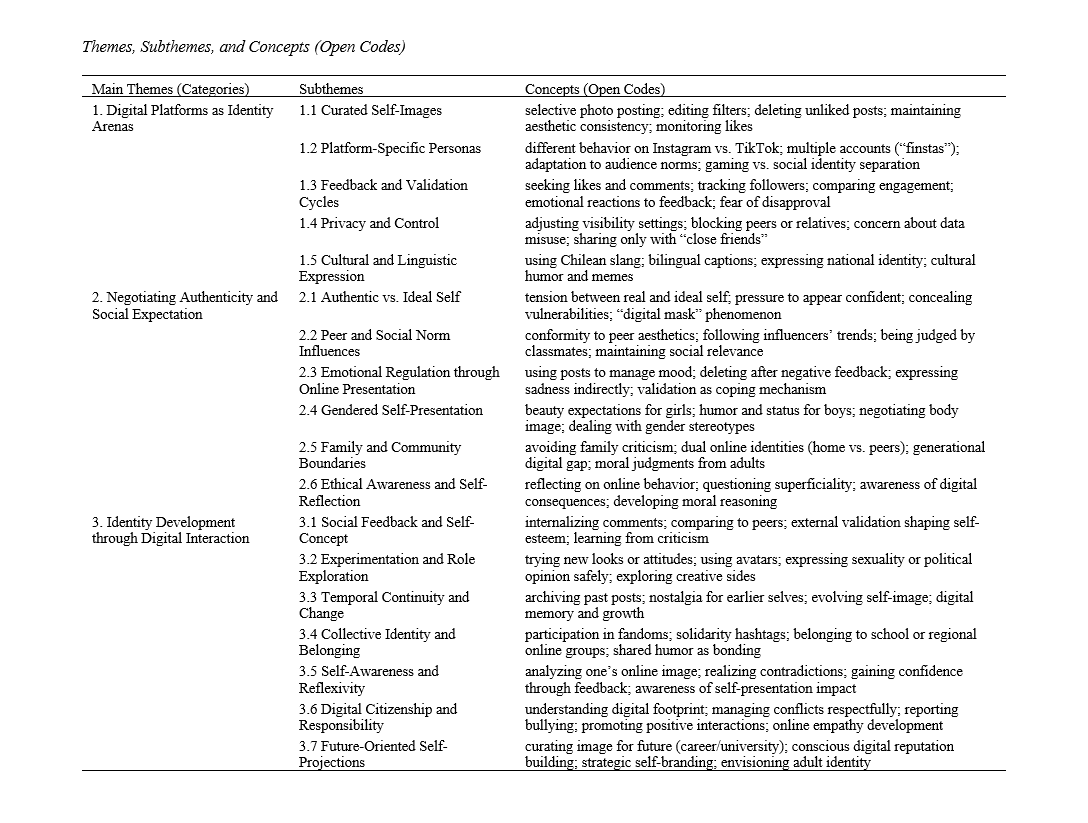
Findings: Three overarching themes emerged: (1) Digital Platforms as Identity Arenas, illustrating how adolescents strategically curate and manage their online personas; (2) Negotiating Authenticity and Social Expectation, revealing tensions between genuine self-expression and conformity to peer norms; and (3) Identity Development through Digital Interaction, emphasizing how feedback, role experimentation, and online reflection foster evolving self-awareness. The findings demonstrated that adolescents actively use social media to construct, test, and regulate their sense of self, while feedback mechanisms and social comparison dynamics significantly influence emotional well-being and self-esteem. Participants with stronger self-regulation and supportive family relationships displayed greater digital resilience and identity coherence.
Conclusion: Digital self-presentation functions as both a developmental opportunity and a psychosocial challenge. It enables adolescents to explore diverse self-aspects and foster identity growth while simultaneously exposing them to social pressures and validation dependence. Conscious and reflective engagement in digital spaces can enhance identity integration and emotional balance in adolescence.
Downloads
References
Bala, H., & Singla, P. (2025). Social Media and Risky Behavior in Adolescents: A Review of Research. International Journal of Research in Social Science and Humanities, 06(05), 96-102. https://doi.org/10.47505/ijrss.2025.5.10
Chen, Y. (2025). Analyzing the Impact of Social Media Usage on the Formation of Self-Identity Among Chinese Adolescents. Lecture Notes in Education Psychology and Public Media, 85(1), 186-192. https://doi.org/10.54254/2753-7048/2025.21366
Cho, M., Park, D., Choo, M., Han, D. H., & Kim, J. (2024). Adolescent Self-Reflection Process Through Self-Recording on Multiple Health Metrics: Qualitative Study (Preprint). https://doi.org/10.2196/preprints.62962
Cho, M., Park, D., Choo, M., Han, D. H., & Kim, J. (2025). Adolescent Self-Reflection Process Through Self-Recording on Multiple Health Metrics: Qualitative Study. Journal of medical Internet research, 27, e62962. https://doi.org/10.2196/62962
Cui, M., Frühauf, A., & Demetriou, Y. (2024). How Chinese Adolescents Present Themselves Online Regarding Physical Activity. Sn Social Sciences, 4(11). https://doi.org/10.1007/s43545-024-01007-3
Erez, S., & AĞIrkan, M. (2024). A Model for Explaining Digital Addiction in Adolescents: The Role of Self-Perception, Social-Emotional Learning, Adolescent-Parent Relationship and Peer Relationships. Bağımlılık Dergisi, 25(2), 180-190. https://doi.org/10.51982/bagimli.1362217
Harahap, H. (2025). Peran Instagram Dalam Pembentukan Identitas Remaja Di Era Digital. Jurnal Indonesia Manajemen Informatika Dan Komunikasi, 6(3), 1625-1656. https://doi.org/10.63447/jimik.v6i3.1564
Jain, P., & Saleem, T. (2025). Hooked on Hearts: The Role of Social Media Validation in Behavioral Addiction. Int. J. Environ. Sci., 1342-1348. https://doi.org/10.64252/ddnkap76
Kharlanova, E., Sivrikova, N., Roslyakova, S. V., & Chernikova, E. (2024). Educating the Digital Generation: The Role of Virtual Communities. The Education and Science Journal, 26(1), 103-132. https://doi.org/10.17853/1994-5639-2024-1-103-132
Kühn, J., & Riesmeyer, C. (2025). Adolescents’ Norms of Self-Presentation on Snapchat: Bitmojis as an Expression of Identity Development. Social Media + Society, 11(2). https://doi.org/10.1177/20563051251342793
Morales-Álvarez, A., Cuervo, Á. A. V., & Parra‐Pérez, L. G. (2025). Supportive Parenting and Adolescents Digital Citizenship Behaviors: The Mediating Role of Self-Regulation. Cyberpsychology Journal of Psychosocial Research on Cyberspace, 19(1). https://doi.org/10.5817/cp2025-1-2
Nosti, P. G. (2025). Digital Media and Adolescent Well-Being: Observational Insights and Policy Implications. https://doi.org/10.35542/osf.io/qx6gm_v1
Pérez-Torres, V. (2024). Social Media: A Digital Social Mirror for Identity Development During Adolescence. Current Psychology, 43(26), 22170-22180. https://doi.org/10.1007/s12144-024-05980-z
Qibtiya, F. N., Mubarak, N. T., & Setiyowati, N. (2025). The Fragile Self: Unraveling the Complex Web of Factors Driving Adolescent Identity Insecurity. Icossh, 2(3), 746-766. https://doi.org/10.61796/icossh.v2i3.108
Rosič, J., Schreurs, L., Janicke‐Bowles, S. H., & Vandenbosch, L. (2024). Trajectories of Digital Flourishing in Adolescence: The Predictive Roles of Developmental Changes and Digital Divide Factors. Child development, 95(5), 1586-1602. https://doi.org/10.1111/cdev.14101
Sayyed Muhammad Mehdi Raza, N., Khan, F. R., Shoaib, R., Muntaha, & Shehzad, M. (2025). The Psychology of Social Comparison on Instagram: Exploring Its Impact on Body Dissatisfaction, Self-Esteem, and Mental Health in Adolescents. RJS, 3(3), 691-709. https://doi.org/10.59075/rjs.v3i3.234
Tan, Q., Wu, W.-M., & An, S. A. (2025). A Review of Adolescents' Digital Self-Efficacy: Conceptualization, Measurement, Impacts, Influencing Factors, and Future Directions. Jcsis, 2(5), 306-315. https://doi.org/10.71113/jcsis.v2i5.291
Yadav, M., & Dube, S. (2025). Effect of Digital Devices and Parental Regulations on Adolescents’ Achievement Motivation: A Quantitative Study. Ijee, 61(2), 67-72. https://doi.org/10.48165/ijee.2025.612013
Zhang, Q. (2025). The Interplay of Technology, Family, and Identity: Chinese Adolescents’ Self-Presentation on Douyin. Frontiers in psychology, 16. https://doi.org/10.3389/fpsyg.2025.1544224
Downloads
Additional Files
Publication Timeline
- Submitted
- Revised
- Accepted