Prioritizing Psychological Consequences of Online Peer Comparison: A Mixed-Methods Analysis Among Indonesian Youth
DOI:
https://doi.org/10.61838/kman.jayps.4739Keywords:
Online peer comparison, self-esteem depletion, social media, psychological consequences, adolescentsAbstract
Objective: This study aimed to identify and prioritize the psychological consequences of online peer comparison among adolescents and young adults using a sequential mixed-methods design.
Methods and Materials: The research adopted a two-phase sequential exploratory design. The qualitative phase involved a systematic literature review of studies related to online peer comparison, social media use, and mental health outcomes. Data were analyzed using NVivo 14 through open, axial, and selective coding until theoretical saturation was achieved, resulting in nine major psychological themes. The subsequent quantitative phase utilized a cross-sectional survey of 220 Indonesian participants aged 16–30 years, all active social media users. Participants rated the severity and frequency of each identified psychological outcome using a five-point Likert scale. Data were analyzed using SPSS version 26, employing the Friedman test to establish ranking orders and post-hoc Wilcoxon tests for inferential comparisons.
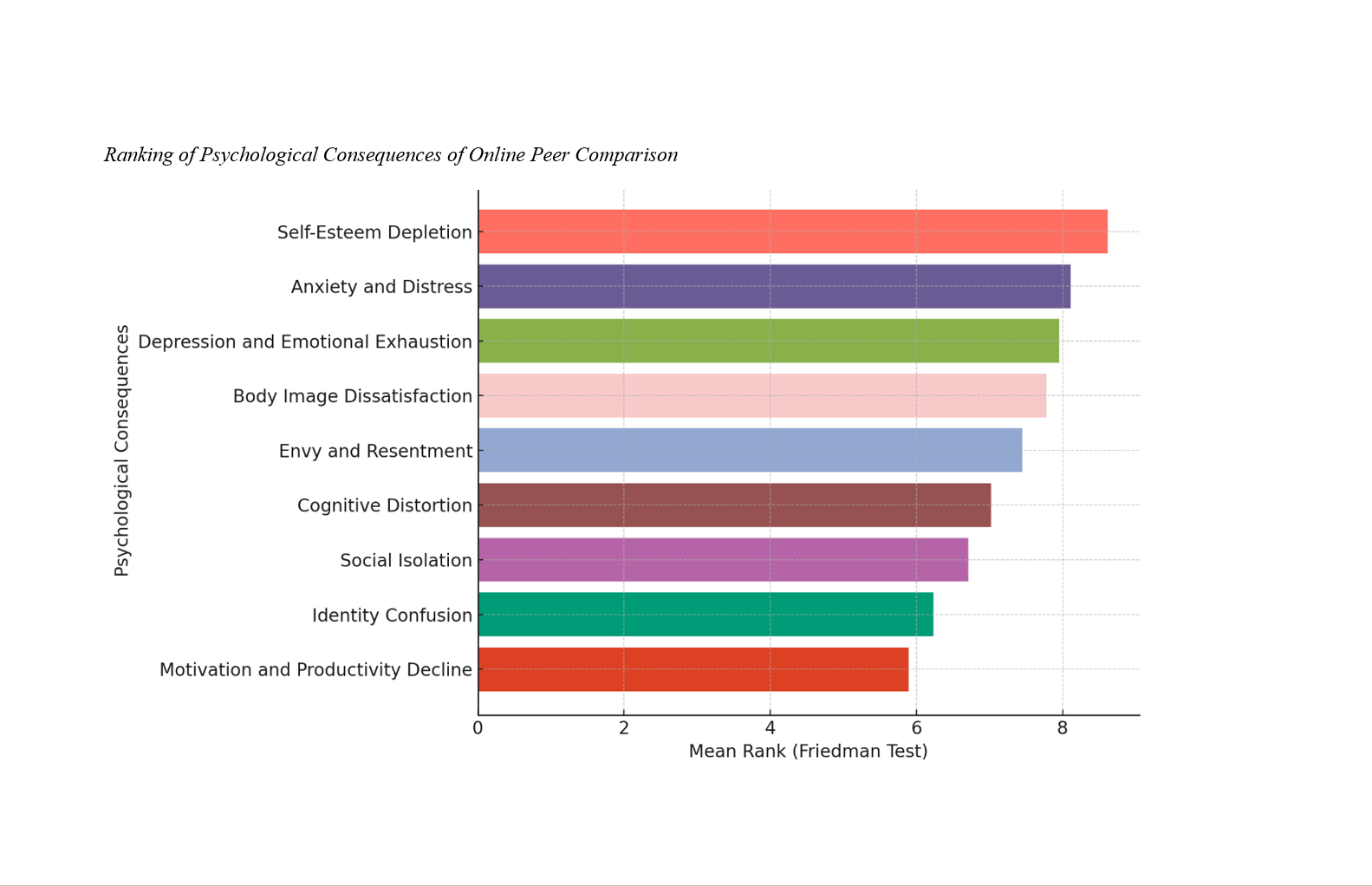
Findings: The Friedman test revealed statistically significant differences among the perceived psychological consequences (χ² = 121.37, p < .001). Self-esteem depletion ranked highest (Mean Rank = 8.62), followed by anxiety and distress (Mean Rank = 8.11) and depression and emotional exhaustion (Mean Rank = 7.95). Mid-ranked outcomes included body image dissatisfaction (Mean Rank = 7.78) and envy and resentment (Mean Rank = 7.45). Cognitive distortion, social isolation, identity confusion, and motivation and productivity decline were comparatively lower in impact. The results suggest that emotional and self-evaluative processes constitute the core mechanisms through which online peer comparison affects psychological well-being.
Conclusion: Online peer comparison primarily undermines self-esteem and emotional stability, producing multidimensional effects across emotional, cognitive, and behavioral domains. The findings emphasize the need for targeted interventions promoting self-compassion, emotional regulation, and digital literacy to mitigate comparison-induced distress in youth populations.
Downloads
References
Bai, Y., Yuan, H., Yu, Q., Liu, L., & Wang, W. (2025). Longitudinal Study of Peer Bullying Victimization and Its Psychological Effects on Adolescents. World journal of psychiatry, 15(5). https://doi.org/10.5498/wjp.v15.i5.104145
Banarjee, C., Lafontant, K., Suarez, J. R., Park, J. H., Fukuda, D. H., Stout, J. R., Lighthall, N. R., & Thiamwong, L. (2024). Peer-Led Exercise Results in Improved Sleep Efficiency Without Concurrent Changes in Mood. Innovation in Aging, 8(Supplement_1), 1040-1040. https://doi.org/10.1093/geroni/igae098.3347
Bi, X., Liu, Z., Su, W. Y., Ou, K., Cui, H., Gao, T., Feng, G., & Ma, Y. (2025). Exploring the Relationship Between Negative Life Events and Emotional Symptoms in Adolescents Using a Network Analysis. Scientific reports, 15(1). https://doi.org/10.1038/s41598-025-00044-z
Cao, Y., Wang, J., Huang, Z., Qin, Y., Gao, S., Zhang, H., Yuan, M., & Tang, X. (2025). The Relationship Between Social Anxiety and Depression Among Rural High School Adolescents: The Mediating Role of Social Comparison and Social Support. Healthcare, 13(5), 533. https://doi.org/10.3390/healthcare13050533
Dambi, J. M., Mavindidze, E., Nyamayaro, P., Beji-Chauke, R., Tunduwani, T. D., Shava, B. K., Mavhu, W., Abas, M., Chibanda, D., & Nhunzvi, C. (2024). Depressed Mood as a Transdiagnostic Target Relevant to Anxiety and/or Psychosis: A Scoping Review Protocol. BMJ open, 14(5), e077695. https://doi.org/10.1136/bmjopen-2023-077695
Galhardo, A., Gregori, P. E. M., Ferreira, C., & Cunha, M. (2024). The Relationship Between Body Image Dissatisfaction, Psychopathological Symptoms, Social Comparisons With Peers and Celebrities, and Self-Compassion in Men. Psychological Reports. https://doi.org/10.1177/00332941241270652
Gibbons, C., & Murray-Gibbons, S. (2022). Revealing the Complex Relationship Between Social Media Use, Social Comparison Orientation and Optimism on Health Outcomes. https://doi.org/10.21203/rs.3.rs-2234087/v1
Gleason, M. M., & Thompson, L. A. (2022). Depression and Anxiety Disorder in Children and Adolescents. JAMA Pediatrics, 176(5), 532. https://doi.org/10.1001/jamapediatrics.2022.0052
Goselin, G. M., & Rickert, N. P. (2022). Mental Health Symptoms Predicting American College Students’ Academic Performance: The Moderating Role of Peer Support. Psi Chi Journal of Psychological Research, 27(4), 297-305. https://doi.org/10.24839/2325-7342.jn27.4.297
Hua, Y., Zhao, Q., Shen, J., Liu, Y., Zheng, L., & Zhang, M. (2022). Program for Education and Enrichment of Relational Skills (PEERS) Training for Social Skills and Depressed Mood Intervention in Young Adult With Depression: Study Protocol for a Randomized Controlled Trial. Frontiers in Psychiatry, 13. https://doi.org/10.3389/fpsyt.2022.993124
Kataria, L., Patel, N., Savaliya, G. V., Bang, A., & Shah, D. (2025). Body Dysmorphic Symptoms and Its Clinical Correlates in Young Adults at a Medical College of Western India: A Cross-Sectional Study. Journal of Integrated Health Sciences, 13(1), 67-72. https://doi.org/10.4103/jihs.jihs_22_25
Lightbody, A. A., Bartholomay, K. L., Jordan, T. L., Lee, C. H., Miller, J. G., & Reiss, A. L. (2022). Anxiety, Depression, and Social Skills in Girls With Fragile X Syndrome: Understanding the Cycle to Improve Outcomes. Journal of Developmental & Behavioral Pediatrics, 43(9), e565-e572. https://doi.org/10.1097/dbp.0000000000001128
Liu, C., Pi, X., Liu, B., Zhang, L., Luo, M., Zhang, Y., Zhang, X., & Nie, S. (2025). Network Characteristics of Emotional Resilience, Anxiety, and Depression Among Chinese Adolescents and Their Gender Differences. Frontiers in Psychiatry, 16. https://doi.org/10.3389/fpsyt.2025.1651506
Lu, J. L., Zhu, S., Wang, R., & Liu, T. (2025). Exploring the Influencing Factors of Learning Burnout: A Network Comparison in Online and Offline Environments. Behavioral Sciences, 15(7), 903. https://doi.org/10.3390/bs15070903
Luo, S., Luo, B., Wei, Z., & Xin, L. (2025). Chain Mediation of Rumination and Anxiety State Between Mindfulness and Depressed Mood in Infertile Women. Scientific reports, 15(1). https://doi.org/10.1038/s41598-025-99147-w
Santos, J. M., & Kawabata, Y. (2023). A Path Model of Acculturation, Enculturation, Social Connectedness, and Mental Health Among Asian American/Pacific Islander Immigrants. Journal of Cross-Cultural Psychology, 54(4), 527-543. https://doi.org/10.1177/00220221231169219
Soliva, E., Kovacs, S. J., & Fritz, K. (2022). The Effects of Acute Online Yoga for Anxiety and Mood States: A Pilot Study. Commonhealth, 3(2), 65-74. https://doi.org/10.15367/ch.v3i2.558
Tagar, M., Batool, S., Kalhoro, M. A., Shoro, P., Memon, N., & Laghari, H. (2025). The Role of Cortisol, C-Reactive Protein and Brain-Derived Neurotrophic Factor in Predicting Anxiety, Depression and Mood Swings: A Cross-Sectional Study. Pakistan Journal of Pathology, 36(2), 122-128. https://doi.org/10.55629/pakjpathol.v36i2.906
Tariq, A., Yang, Y., Liu, Z., Wong, S. C., Gray, E., McLaughlin, A. L., Arthur, C. A., & Chan, S. W. Y. (2025). Effects of the Soothe Vision Well-Being Tool on University Students’ Mood: A Pilot Study. Current Psychology, 44(10), 9112-9128. https://doi.org/10.1007/s12144-025-07649-7
Thomas, G., Bradson, M. L., Riegler, K. E., & Arnett, P. A. (2023). Affective Disturbance and Neurocognitive Variability in College Athletes. Archives of Clinical Neuropsychology, 38(8), 1623-1634. https://doi.org/10.1093/arclin/acad037
Tsutsumi, S., Maeda, N., Tashiro, T., Arima, S., Mizuta, R., Fukui, K., Naito, K., Komiya, M., & Urabe, Y. (2022). Willingness to Receive the COVID-19 Vaccination and the Psychological State of Japanese University Students: A Cross-Sectional Study. International journal of environmental research and public health, 19(3), 1654. https://doi.org/10.3390/ijerph19031654
Xu, P., Wang, Z., Wang, T., Nan, T., Xu, J., Alemán, A., Luo, Y., Blain, B., & Liu, Y. (2023). Opposed Mood Dynamics of Depression and Anxiety Are Related to Reward Prediction Error. https://doi.org/10.21203/rs.3.rs-3469178/v1
Xu, S., Ju, Y., Wei, X., Ou, W., Ma, M., Lv, G., Zhao, X., Qin, Y., Li, Y., Li, L., Huang, M., Yang, S., Lu, Y., Chen, Y., Liu, J., Jin, L., Liu, B., & Zhang, Y. (2024). Network Analysis of Suicide Ideation and Depression–anxiety Symptoms Among Chinese Adolescents. General Psychiatry, 37(2), e101225. https://doi.org/10.1136/gpsych-2023-101225
Downloads
Additional Files
Publication Timeline
- Submitted
- Revised
- Accepted