Ranking the Psychological and Social Components of Life Purpose Formation in Adolescents
DOI:
https://doi.org/10.61838/kman.jayps.4639Keywords:
Adolescents, life purpose formation, psychological components, social factors, identity development, motivation, emotional regulationAbstract
Objective: This study aimed to identify and rank the key psychological and social components that contribute to the formation of life purpose among adolescents.
Methods and Materials: This research employed a mixed-method exploratory–sequential design. The first phase consisted of a qualitative literature-based analysis conducted through thematic coding using NVivo 14 to identify major psychological and social components of adolescent life purpose formation. The review continued until theoretical saturation was reached, yielding nine central themes. In the second phase, a quantitative ranking survey was carried out with 250 adolescents aged 15–18 years from various high schools in Mexico, using a structured Likert-scale questionnaire derived from the qualitative findings. The collected data were analyzed using SPSS version 26, applying Friedman’s test to determine the mean rank order of each component and Cronbach’s alpha to confirm reliability.
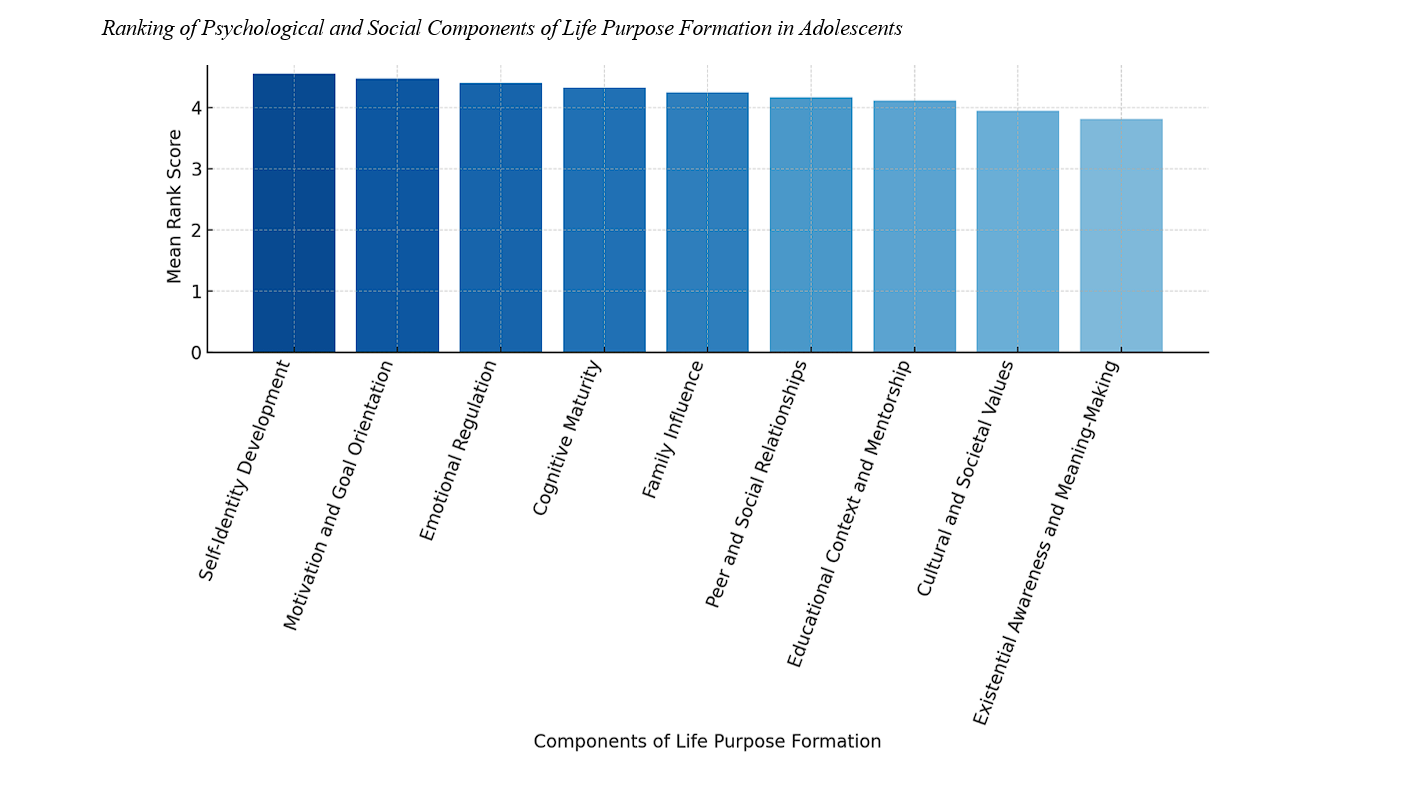
Findings: The analysis revealed statistically significant differences in the importance adolescents attributed to various life purpose components (χ² = 64.37, p < 0.001). Self-Identity Development received the highest mean rank (4.56), followed by Motivation and Goal Orientation (4.48) and Emotional Regulation (4.41). Cognitive Maturity (4.33) and Family Influence (4.25) also demonstrated strong relevance, while Peer and Social Relationships (4.17) and Educational Context and Mentorship (4.12) held moderate positions. Cultural and Societal Values (3.95) and Existential Awareness and Meaning-Making (3.82) were ranked lower, indicating that adolescents prioritize internal psychological mechanisms over external sociocultural influences in constructing their sense of purpose.
Conclusion: The study concludes that life purpose formation in adolescents is primarily driven by internal psychological processes—especially identity, motivation, and emotional regulation—supported by social contexts such as family and education. Strengthening these components through targeted educational and counseling programs can enhance adolescents’ psychological well-being and long-term goal orientation.
Downloads
References
Ajarni, A., Zakaria, R., Zahara, M., Abdullah, A., & Maidar, M. (2025). Depression Among Adolescents Living in Orphanages in Central Aceh District, Indonesia. Malahayati International Journal of Nursing and Health Science, 8(5), 630-637. https://doi.org/10.33024/minh.v8i5.819
Dwivedi, P. M., & Chandra, S. (2024). Impact of Life Skills Training on Psychological Well-Being of Adolescents. Int. J. Emerg. Knowl. Stud., 03(11), 967-970. https://doi.org/10.70333/ijeks-03-11-015
Fan, W., Li, Y., Li, M., & Zhang, L. f. (2022). The Relationship Between Adolescents’ Psychosocial Development and Life Satisfaction: A Cross-Lag Study. Environment and Social Psychology, 6(1). https://doi.org/10.18063/esp.v6.i1.1391
Fernandes, G., & Lemos, S. M. A. (2022). Quality of Life and Self-Perceived Health of Adolescents in Middle School. Codas, 34(6). https://doi.org/10.1590/2317-1782/20212021046
Gostoli, S., Raimondi, G., Rafanelli, C., & Gremigni, P. (2024). Attention-Deficit/Hyperactivity Disorder and Unhealthy Lifestyle in Adolescence: Unforeseen Role of Allostatic Overload and Psychological Well-Being. Healthcare, 12(10), 956. https://doi.org/10.3390/healthcare12100956
Hermaini, U., Nasution, F., Safitri, R. A., Rahma, Q. A., & Hasibuan, H. M. (2023). Perkembangan Fisik Anak Dan Psikososial Remaja. Observasi, 2(1), 11-19. https://doi.org/10.61132/observasi.v2i1.49
Hidayah, N. (2025). Perilaku Remaja Pengguna Gadget: Studi Dan Analisis Pada Teori Sosiologi Pendidikan. Anwarul, 5(3), 499-519. https://doi.org/10.58578/anwarul.v5i3.6465
Ji, Y., Cheng, Y., Ting, Y., Zhang, J., & Liu, Q. (2024). The Association Between Social Support and Trying Smoking Among Rural Adolescents in Rural Western China: The Intermediary Role of Mental Health Problems and Life Satisfaction. Nicotine & Tobacco Research, 27(6), 1109-1115. https://doi.org/10.1093/ntr/ntae211
Kaltiala‐Heino, R., Heino, E., Marttunen, M., & Fröjd, S. (2023). Family Characteristics, Transgender Identity and Emotional Symptoms in Adolescence: A Population Survey Study. International journal of environmental research and public health, 20(4), 2948. https://doi.org/10.3390/ijerph20042948
Lathifah, H., & Prastiwi, Y. (2025). Adolescent Identity Formation Under Terminal Illness: A Psychosocial Education Approach. J. Found. Learn. Child Dev, 1(02), 35-41. https://doi.org/10.53905/childdev.v1i02.7
Mohamed, N. F., Manan, N. A., Muhd Fadlin Muhammad Firdaus, C., Rahmatullah, B., Wahab, R. A., Baharudin, S. N. A., Govindasamy, P., & Abdulla, K. (2023). The Prevalence of Internet Gaming Disorders and the Associated Psychosocial Risk Factors Among Adolescents in Malaysian Secondary Schools. Clinical Child Psychology and Psychiatry, 28(4), 1420-1434. https://doi.org/10.1177/13591045231164870
Mustika, I., Andyarini, E. N., & Hadi, M. I. (2023). Assistance for Adolescents in Preventing Stunting During the First 1000 Days of Life Through the Formation of 'REDAKZI PENTING' (Health and Nutrition-Aware Adolescents Caring for Stunting) in Tambak Oso Waru Village, Sidoarjo. Engagement Jurnal Pengabdian Kepada Masyarakat, 7(2), 320-336. https://doi.org/10.29062/engagement.v7i2.1530
Olutola, F. B., Olutola, A. T., Mustapha, W. S., & Adejuwon, G. A. (2023). Influence of Psychosocial Factors on Quality of Life Among in-School Adolescents. Quality of Life (Banja Luka) - Apeiron, 24(1-2). https://doi.org/10.7251/qol2301030o
Oxana, P. (2021). Psychological Profile of Adolescent`s Personality With a High Level of Psychosocial Adaptation. Univers Pedagogic(2(70)), 80-93. https://doi.org/10.52387/1811-5470.2021.2.13
Öztürk, F. Ö., & Ayaz‐Alkaya, S. (2021). Internet Addiction and Psychosocial Problems Among Adolescents During the COVID-19 Pandemic: A Cross-Sectional Study. Archives of Psychiatric Nursing, 35(6), 595-601. https://doi.org/10.1016/j.apnu.2021.08.007
Putri, E. R. (2023). Krisis Identitas Agama Pada Usia Remaja. Bayani, 3(1), 39-51. https://doi.org/10.52496/bayaniv.3i.1pp39-51
Rahayu, A., Rohmah, N., Nurrachmawati, A., Permana, L., Agustini, R. T., Fikri, M., & Feriyanti, A. (2025). Relationship Between Psychosocial and Consumption Patterns Among High School Adolescents in the National Capital City Buffer Area. J.MenHealth, 4(2), 94-101. https://doi.org/10.56922/mhc.v4i2.1181
Ramawat, V. K., Bisnoi, D., Kumar, P., & Soni, H. B. (2022). Psychosocial Problems Among the Adolescence of Working and Non- Working Mothers. GFNPSS-International Journal of Multidisciplinary Research, 3(3), 967-969. https://doi.org/10.46376/ijmr/3.5.2022.967-969
Shofa, D. A., Anggraeni, B. A. U., Abida, A. N., Husna, N. F., Dewi, K. P., Aswandani, A., Aunurrahman, M. R. A., & Adni, A. (2024). Bipolar Disorder in Adolescents: Clinical Manifestations, Causes, and Comprehensive Management Strategies. Jurnal Biologi Tropis, 24(1b), 210-219. https://doi.org/10.29303/jbt.v24i1b.7973
Shrestha, B. L., Gautam, S., Shrestha, J. T. M., & Shrestha, S. (2021). Psychosocial Problems Among the Adolescent School Students of Dhulikhel Municipality. Kathmandu University Medical Journal, 19(3), 366-370. https://doi.org/10.3126/kumj.v19i3.49718
Straton, E., Anifowoshe, K., Moore, H., Streisand, R., & Jaser, S. S. (2024). Associations of Coping Strategies With Glycemic and Psychosocial Outcomes Among Adolescents With Type 1 Diabetes Experiencing Diabetes Distress. Annals of Behavioral Medicine, 58(9), 628-633. https://doi.org/10.1093/abm/kaae028
Tadayoni, M., Salehi, S., Soltani, A., & Jannati, A. M. (2022). The Role of Psychological Well-Being and Life Expectancy in Social Anxiety of Girls Living in Welfare Centers in Tehran in 2018: A Descriptive Study. Journal of Rafsanjan University of Medical Sciences, 21(3), 293-310. https://doi.org/10.52547/jrums.21.3.293
Vanderhaegen, J., Prikken, S., Laere, E. V., Lemiere, J., Claes, L., Moons, P., Uyttebroeck, A., Jacobs, S., & Luyckx, K. (2023). Identity Formation and General and Cancer-Specific Functioning in Adolescent and Emerging Adult Survivors of Childhood Cancer: A Longitudinal Study Into Directionality of Effects. Annals of Behavioral Medicine, 57(9), 722-732. https://doi.org/10.1093/abm/kaac075
Downloads
Additional Files
Publication Timeline
- Submitted
- Revised
- Accepted