Prioritization of Personality and Environmental Predictors of Emotional Dysregulation among High School Students
DOI:
https://doi.org/10.61838/kman.jayps.4636Keywords:
Emotional dysregulation, impulsivity, neuroticism, family dysfunction, adolescenceAbstract
Objective: This study aimed to identify, categorize, and prioritize personality and environmental predictors of emotional dysregulation among Malaysian high school students using a sequential exploratory mixed-method design.
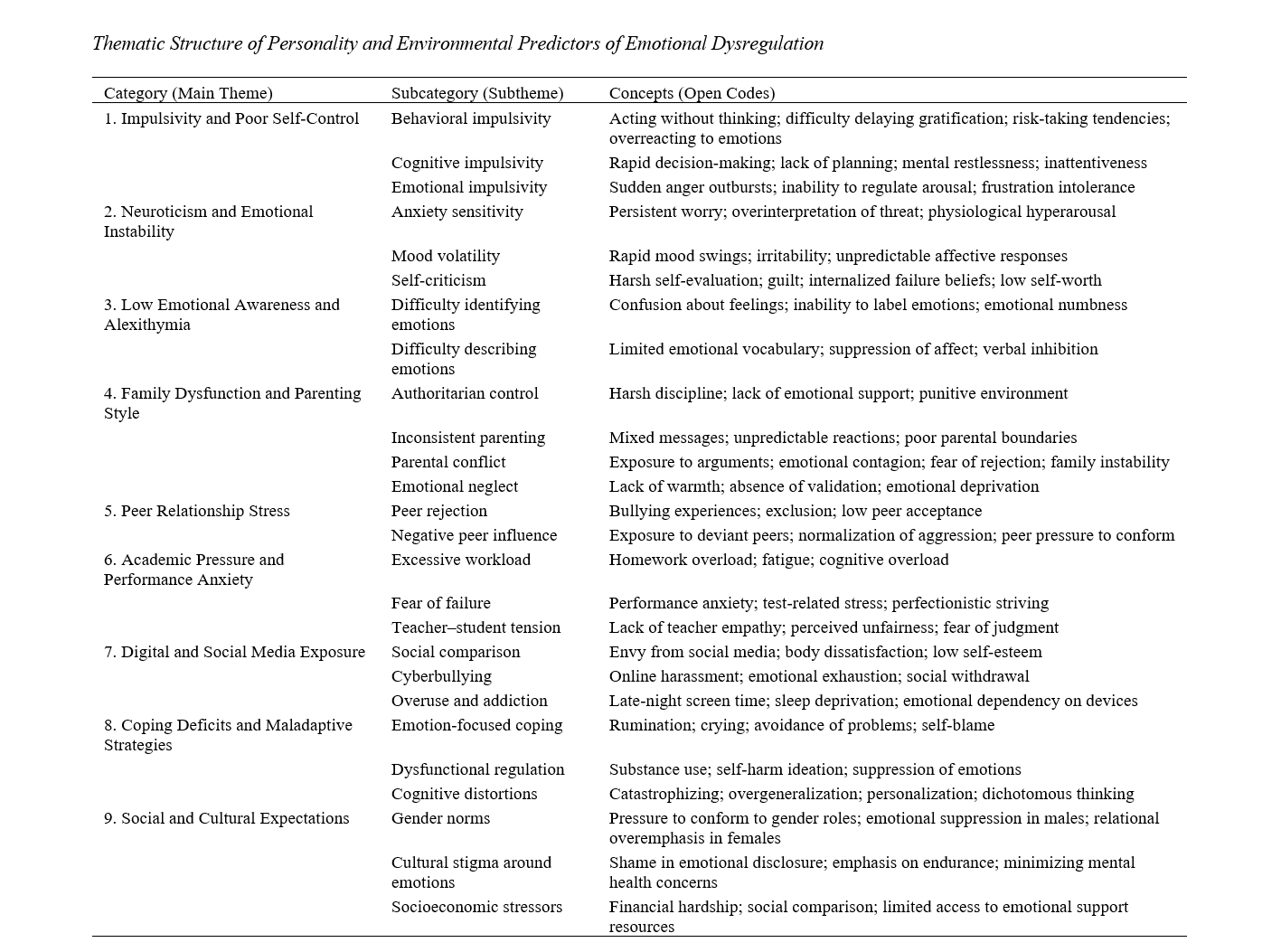
Methods and Materials: A sequential exploratory mixed-method approach was employed in two distinct phases. The first phase involved a qualitative thematic analysis through an extensive literature review conducted until theoretical saturation, using NVivo 14 for coding and theme development. Nine main categories of predictors were identified: impulsivity and poor self-control, neuroticism, low emotional awareness, family dysfunction, peer stress, academic pressure, digital exposure, coping deficits, and social-cultural expectations. The second phase used a quantitative ranking design with 180 Malaysian students aged 15–18 years, selected via stratified random sampling. A structured Likert-scale questionnaire based on the qualitative themes was administered. Reliability and validity were confirmed, and data were analyzed using SPSS version 26 through descriptive and inferential statistics.
Findings: Results indicated that personality-based factors were the strongest predictors of emotional dysregulation, with impulsivity and poor self-control (M = 4.63) ranked highest, followed by neuroticism and emotional instability (M = 4.51) and low emotional awareness and alexithymia (M = 4.42). Among environmental predictors, family dysfunction and parenting style (M = 4.37) and peer relationship stress (M = 4.28) were most influential. The lowest-ranked predictor was social and cultural expectations (M = 3.82). Statistical comparisons revealed significant mean differences (p < 0.05) between personality and environmental domains, confirming that internal dispositional factors exert a stronger influence on emotional dysregulation than contextual stressors.
Conclusion: The findings underscore that impulsivity, emotional instability, and family dysfunction are key determinants of adolescent emotional dysregulation. These insights emphasize the need for school-based interventions and family-centered programs that enhance emotional awareness, impulse control, and supportive communication within cultural contexts.
Downloads
References
Aguayo–González, M., Leyva‐Moral, J. M., Giménez‐Díez, D., Colom‐Cadena, A., Martínez, I., Watson, C., Bordas, A., Casabona, J., & Folch, C. (2023). The Impact of COVID-19 on Adolescents’ Mental Health in Catalonia (Spain): A Qualitative Study. The Journal of School Nursing, 41(2), 284-292. https://doi.org/10.1177/10598405231194542
Andersson, H., Aspeqvist, E., Dahlström, Ö., Svedin, C. G., Jönsson, L., Landberg, Å., & Zetterqvist, M. (2022). Emotional Dysregulation and Trauma Symptoms Mediate the Relationship Between Childhood Abuse and Nonsuicidal Self-Injury in Adolescents. Frontiers in Psychiatry, 13. https://doi.org/10.3389/fpsyt.2022.897081
Chen, J., Feleppa, C., Sun, T., Sasagawa, S., Smithson, M., & Leach, L. (2024). School Refusal Behaviors: The Roles of Adolescent and Parental Factors. Behavior Modification, 48(5-6), 561-580. https://doi.org/10.1177/01454455241276414
Chiang, S. C., Bai, S., Mak, H. W., & Fosco, G. M. (2024). Dynamic Characteristics of Parent–adolescent Closeness: Predicting Adolescent Emotion Dysregulation. Family Process, 63(4), 2243-2257. https://doi.org/10.1111/famp.12978
Chiang, S. C., Chen, W. C., & Wu, P. Y. (2023). Daily Association Between Parent−adolescent Relationship and Life Satisfaction: The Moderating Role of Emotion Dysregulation. Journal of adolescence, 95(6), 1168-1178. https://doi.org/10.1002/jad.12184
Crumly-Goodwin, B., & Samek, D. R. (2024). Contextualizing the Development of Emotion Regulation in Early Adolescence: Results From the ABCD Study. The Journal of Early Adolescence. https://doi.org/10.1177/02724316241307564
Dibaj, I. S., Tørmoen, A. J., Klungsøyr, O., Haga, E., & Mehlum, L. (2023). Trajectories and Predictors of Change in Emotion Dysregulation and Deliberate Self-Harm Amongst Adolescents With Borderline Features. Clinical Child Psychology and Psychiatry, 29(2), 407-423. https://doi.org/10.1177/13591045231177374
Fisher-Fox, L., Whitener, M., Wu, W., Cyders, M. A., & Zapolski, T. C. B. (2024). Urgency as a Predictor of Change in Emotion Dysregulation in Adolescents. Frontiers in Psychiatry, 15. https://doi.org/10.3389/fpsyt.2024.1451192
Friedman, G., & Mezulis, A. H. (2025). Adolescent Impulsivity and Emotion Dysregulation: The Moderating Role of Parental Socialization of Negative Emotions. Psychological Reports. https://doi.org/10.1177/00332941241312315
Gasol, X., Haro, M. V. N., Fernández‐Felipe, I., García‐Palacios, A., Suso‐Ribera, C., & Gasol-Colomina, M. (2022). Preventing Emotional Dysregulation: Acceptability and Preliminary Effectiveness of a DBT Skills Training Program for Adolescents in the Spanish School System. International journal of environmental research and public health, 19(1), 494. https://doi.org/10.3390/ijerph19010494
Gong, J., & Popescu, A. C. (2024). Predicting Aggressive Behavior From Exposure to Violence and Emotion Dysregulation in Adolescents. Jayps, 5(7), 163-171. https://doi.org/10.61838/kman.jayps.5.7.18
King, S. A., Hubbard, S., Teeters, J. B., & Brausch, A. M. (2023). A Longitudinal Examination of Alcohol Use and Emotion Dysregulation in Adolescence. Experimental and Clinical Psychopharmacology, 31(2), 414-422. https://doi.org/10.1037/pha0000624
Liu, J., Gao, Y., Liang, C., & Liu, X. (2022). The Potential Addictive Mechanism Involved in Repetitive Nonsuicidal Self-Injury: The Roles of Emotion Dysregulation and Impulsivity in Adolescents. Journal of Behavioral Addictions, 11(4), 953-962. https://doi.org/10.1556/2006.2022.00077
Lokita, K. E., Siahaan, F. M. M., & Widyasari, P. (2021). The Mediating Effect of Emotion Regulation on the Mindfulness and Impulsivity of High School Students. Psikohumaniora Jurnal Penelitian Psikologi, 6(2), 199-214. https://doi.org/10.21580/pjpp.v6i2.8953
McQuade, J. D. (2022). ADHD Symptoms, Peer Problems, and Emotion Dysregulation as Longitudinal and Concurrent Predictors of Adolescent Borderline Personality Features. Journal of Attention Disorders, 26(13), 1711-1724. https://doi.org/10.1177/10870547221098174
Mittermeier, S., Seidel, A., Scheiner, C., Kleindienst, N., Romanos, M., & Buerger, A. (2024). Emotional Dysregulation and Its Pathways to Suicidality in a Community-Based Sample of Adolescents. Child and adolescent psychiatry and mental health, 18(1). https://doi.org/10.1186/s13034-023-00699-4
Pedrini, L., Rossi, R., Magni, L. R., Lanfredi, M., Meloni, S., Ferrari, C., Macis, A., Lopizzo, N., Zonca, V., & Cattaneo, A. (2021). Emotional Regulation in Teens and Improvement of Constructive Skills (EmoTIConS): Study Protocol for a Randomized Controlled Trial. Trials, 22(1). https://doi.org/10.1186/s13063-021-05886-2
Peñacoba, C., Balandin, A., Estévez, A., Olave, L., Momeñe, J., María Dolores del Rocío Chávez, V., Muñiz, J. A., & Díez, I. I. (2024). Alcohol Abuse and Physical Violence Towards a Partner: How Can We Attenuate the Relationship? A Study on Emotional Dysregulation in Adolescents. Behavioral Sciences, 14(10), 875. https://doi.org/10.3390/bs14100875
Rachma, A., & Hendrawan, D. (2025). Pathway Linking Executive Function Problems and Non-Suicidal Self-Injury Among Adolescents: The Mediating Role of Emotion Dysregulation. Psikohumaniora Jurnal Penelitian Psikologi, 10(1), 43-58. https://doi.org/10.21580/pjpp.v10i1.23353
Rens, S. M. v., Lemelin, C., Kloosterman, P. H., Summerfeldt, L. J., & Parker, J. D. A. (2024). Bullying in High School Youth: Relationships With Trait Emotional Intelligence. Canadian Journal of School Psychology, 40(1), 61-75. https://doi.org/10.1177/08295735241311080
Rosharudin, N. A., Hoesni, S. M., Muhammad, N. A., & Ali, M. M. (2023). The Effects of Parental Care and Autonomy on Adolescents’ Emotion Dysregulation in Peninsular Malaysia. E-Bangi Journal of Social Science and Humanities, 20(3). https://doi.org/10.17576/ebangi.2023.2003.19
Singh, P. (2022). Emotion Regulation Difficulties, Perceived Parenting and Personality as Predictors of Health-Risk Behaviours Among Adolescents. Current Psychology, 42(15), 12896-12911. https://doi.org/10.1007/s12144-021-02536-3
Trompeter, N., Bussey, K., Forbes, M. K., Hay, P., Goldstein, M., Thornton, C., Basten, C., Heruc, G., Roberts, M., Byrne, S. M., Griffiths, S., Lonergan, A., & Mitchison, D. (2022). Emotion Dysregulation and Eating Disorder Symptoms: Examining Distinct Associations and Interactions in Adolescents. Research on Child and Adolescent Psychopathology, 50(5), 683-694. https://doi.org/10.1007/s10802-022-00898-1
Türk, F., & Koçyiğit, B. (2025). The Relationship Between Fear of Missing Out and Loneliness Among Adolescents in the Digital Age: The Mediating Roles of Emotion Dysregulation and Social Media Addiction. Malaysian Online Journal of Educational Technology, 13(1), 19-36. https://doi.org/10.52380/mojet.2025.13.1.566
Ucuz, I., Çiçek, A. U., Celik, M. K., Akan, M., Kesriklioglu, E., Güngör, S., & Özcan, Ö. (2023). Emotional Dysregulation and Temperament-Character Traits in Adolescents With Functional Neurological Symptom Disorder (Conversion Disorder). The Journal of Nervous and Mental Disease, 212(3), 152-158. https://doi.org/10.1097/nmd.0000000000001746
Whitener, M., Khazvand, S., Carson, I., Martin, A., Salyers, M. P., Cyders, M. A., Aalsma, M. C., & Zapolski, T. C. B. (2025). Acceptability and Efficacy of an Adapted School-Based Dialectical Behavioral Therapy Skills Group for Adolescents: A Qualitative Perspective. Inquiry the Journal of Health Care Organization Provision and Financing, 62. https://doi.org/10.1177/00469580251314279
Zapolski, T. C. B., Whitener, M., Khazvand, S., Crichlow, Q., Revilla, R., Salgado, E., Aaslma, M. C., Cyders, M. A., Salyers, M. P., & Wu, W. (2021). Implementation of Dialectical Behavioral Therapy for Adolescents (DBT-A) Skills Group in High Schools for at-Risk Youth: Going 4 Goals Protocol. https://doi.org/10.21203/rs.3.rs-482308/v1
Zapolski, T. C. B., Whitener, M., Khazvand, S., Crichlow, Q., Revilla, R., Salgado, E. F., Aalsma, M. C., Cyders, M. A., Salyers, M. P., & Wu, W. (2021). Implementation of a Brief Dialectical Behavioral Therapy Skills Group in High Schools for at-Risk Youth: Protocol for a Mixed Methods Study (Preprint). https://doi.org/10.2196/preprints.32490
Zapolski, T. C. B., Whitener, M., Khazvand, S., Crichlow, Q., Revilla, R., Salgado, E. F., Aalsma, M. C., Cyders, M. A., Salyers, M. P., & Wu, W. (2022). Implementation of a Brief Dialectical Behavioral Therapy Skills Group in High Schools for at-Risk Youth: Protocol for a Mixed Methods Study. Jmir Research Protocols, 11(5), e32490. https://doi.org/10.2196/32490
Downloads
Additional Files
Publication Timeline
- Submitted
- Revised
- Accepted