Exploring the Formation of the Socio-Cultural Trauma of Fear of Marriage in Men Using the Grounded Theory Method
DOI:
https://doi.org/10.61838/kman.jayps.4564Keywords:
trauma, marriage, fear, social factors, cultural conditionsAbstract
Objective: This study aimed to explore the social and cultural trauma underlying the fear of marriage among young men, identifying its causal, contextual, and consequential dimensions through a grounded theory approach.
Methods and Materials: The research adopted a qualitative design based on Strauss and Corbin’s systematic grounded theory methodology. Seventeen male participants aged 20–49 years from Shahr-eza were selected through purposive and snowball sampling. Data were collected through semi-structured interviews and analyzed using a three-stage coding process—open, axial, and selective coding. The analytical framework sought to extract categories related to causal conditions, contextual settings, strategies, and outcomes linked to fear of marriage. Theoretical saturation was achieved when no new data emerged from additional interviews.
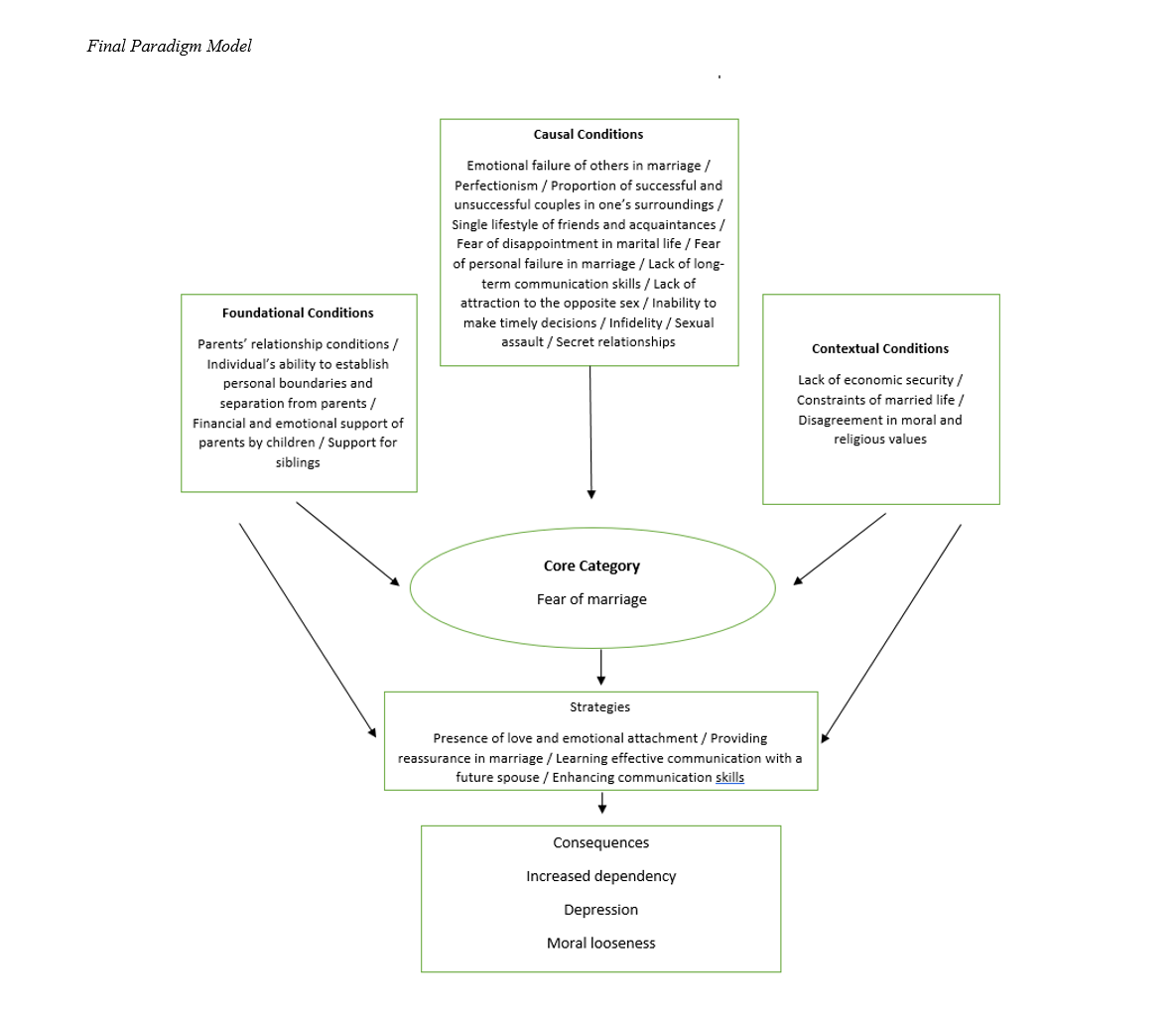
Findings: Analysis revealed that fear of marriage in men emerges from the interaction of psychological, familial, and socio-economic factors. Causal conditions included fear of emotional failure, perfectionism, lack of long-term communication skills, and exposure to unsuccessful marital models. Contextual conditions encompassed economic insecurity, family dysfunction, and moral or religious incompatibility between potential partners. Foundational conditions involved intergenerational trauma, inadequate parental support, and difficulties in establishing personal boundaries. Strategic responses included efforts toward financial independence, learning effective communication, and seeking emotional reassurance in potential relationships. The primary consequences observed were depression, increased dependency, and moral looseness, indicating deep-rooted psychosocial distress linked to cultural contradictions between traditional expectations and modern individualistic values.
Conclusion: The study concludes that fear of marriage among men represents a multifaceted sociocultural trauma shaped by the conflict between traditional family expectations and contemporary socio-economic realities. Addressing this issue requires integrated psychosocial, educational, and policy-based interventions that foster emotional competence, economic stability, and cultural adaptation.
Downloads
References
Afra, H. (2020). Sociological Determination of the Relationship Between Individualism and Family Changes in the City of Bojnurd Kashan University, Faculty of Humanities].
Aghasi, M., & Fallah Minbashi, F. (2015). Iranian Youth Attitudes Towards Marriage, Spouse Selection, and Family Formation. Women's Research Journal, 6(1). https://womenstudy.ihcs.ac.ir/article_1694.html
Ahmadi, F. (2023). The Relationship Between Father-Daughter Communication and Attachment Style to Father with Criteria for Spouse Selection, Attitudes, and Pre-Marriage Fears Psychology Department, Rahman Higher Education Institute].
Banarizadeh, M. (2024). Exploring Social Processes in the Formation of Single Living: A Study of Single Men in Ahvaz Faculty of Economics and Social Sciences, Shahid Chamran University of Ahvaz].
Boto-Garcia, D., & Perali, F. (2023). Exploring the relationship between marital control mechanisms and preferences for separation: The role of fear of commitment. arXiv preprint. https://arxiv.org/abs/2302.14133
Cantekin, Ö. F., & Kunduracı, N. F. (2024). Marriage anxiety of university students in terms of family belonging and parental attitude. International Journal of Religion, 5(3), 377-385. https://doi.org/10.61707/k0ghk087
Ismailpour, K., & Nour Mohammadi Aheri, S. (2022). Development and Validation of a Fear of Marriage Questionnaire for Female Students. New Psychological Research(65), 11-20. https://psychologyj.tabrizu.ac.ir/article_13466.html
Khani, S. (2023). Increasing Divorce or Stagnation of Marriage? A Reflection on the Trends in Marriage and Divorce in Iran during the Last 15 Years. Journal of Social Continuity and Change (JSCC), 2(1), 25-43. https://doi.org/10.22034/jscc.2023.19288.1053
Niakani, S. S. (2022). Comparing Love Styles, Marriage Stability, Fear of Intimacy, and Empathy in Traditional and Modern Marriages Master's Thesis, General Psychology, Feyz-al-Islam Higher Education Institute, Faculty of Humanities].
Noorouzi, I. (2024). Qualitative Study of Social Trauma: Conceptual Space, Causes, and Consequences Faculty of Law and Social Sciences, Tabriz University].
Parastandeh, S. (2021). A Sociological Study of Collective Memory and Cultural War Songs in Ilam Province Kashan University, Faculty of Humanities].
Parker, G., Durante, K. M., Hill, S. E., & Haselton, M. G. (2022). Why women choose divorce: An evolutionary perspective. Current opinion in psychology, 43, 300-306. https://doi.org/10.1016/j.copsyc.2021.07.020
Ren, J. (2022). Analysis of the psychological factors of contemporary youth's fear of marriage in China. International Journal of Frontiers in Sociology, 4(13), 31-34. https://doi.org/10.25236/IJFS.2022.041305
Schwartz, C. R., & Han, H. (2015). The reversal of the gender gap in education and trends in marital dissolution. American Sociological Review, 79(4), 605-629. https://doi.org/10.1177/0003122414539682
Vafaeinezhad, F., Koraei, A., & Pasha, R. (2023). Comparison of the Effect of Premarital Education with Selection Method and Knowledge and Olson's Approach on Communication Beliefs of Students' Fear of Marriage. Razi Journal of Medical Sciences, 29(10), 193-202. https://www.magiran.com/paper/2551461
Vafaeinezhad, F., Koraei, A., & Pasha, R. (2023). Comparison of the effect of premarital education with the selection method and Knapp and Vangelisti's approach on communication beliefs and fear of marriage in students. Razi Journal of Medical Sciences, 29(10), 193-202. https://www.magiran.com/paper/2551461/comparison-of-the-effect-of-premarital-education-with-selection-method-and-knowledge-and-el-sun-s-approach-on-communication-beliefs-of-students-fear-of-marriage?lang=en
Wenqing, Y., Panting, H., Wang, Y., & Mengting, L. (2024). Analysis of the Reasons for Contemporary Young Women's Fear of Marriage and Pregnancy—Based on Bengbu. Academic Journal of Humanities & Social Sciences, 7(2). https://doi.org/10.25236/ajhss.2024.070204
Winfield, T. P. (2022). Vulnerable research: Competencies for trauma and justice-informed ethnography. Journal of Qualitative Sociology, 51(2). https://doi.org/10.1177/08912416211017254
Downloads
Additional Files
Publication Timeline
- Submitted
- Revised
- Accepted