Youth Perceptions of Friendship Loyalty: Uncovering Psychological Components Through Narratives
DOI:
https://doi.org/10.61838/kman.jayps.4498Keywords:
Friendship loyalty, Adolescence, Narrative inquiry, Qualitative researchAbstract
Objective: This study aimed to explore how adolescents and young adults perceive and construct the meaning of friendship loyalty, focusing on its emotional, behavioral, and psychological components.
Methods and Materials: A qualitative narrative design was employed, involving 21 participants aged 16–24 from Germany. Participants were recruited through purposeful sampling to ensure diversity in age, gender, and educational background. Data were collected using semi-structured interviews, with open-ended questions addressing experiences of trust, betrayal, and support in friendships. Interviews were audio-recorded, transcribed verbatim, and analyzed thematically using NVivo 14 software. Data collection continued until theoretical saturation was reached, ensuring comprehensiveness of the findings. Rigor was enhanced through peer debriefing, audit trails, and reflexive memo writing.
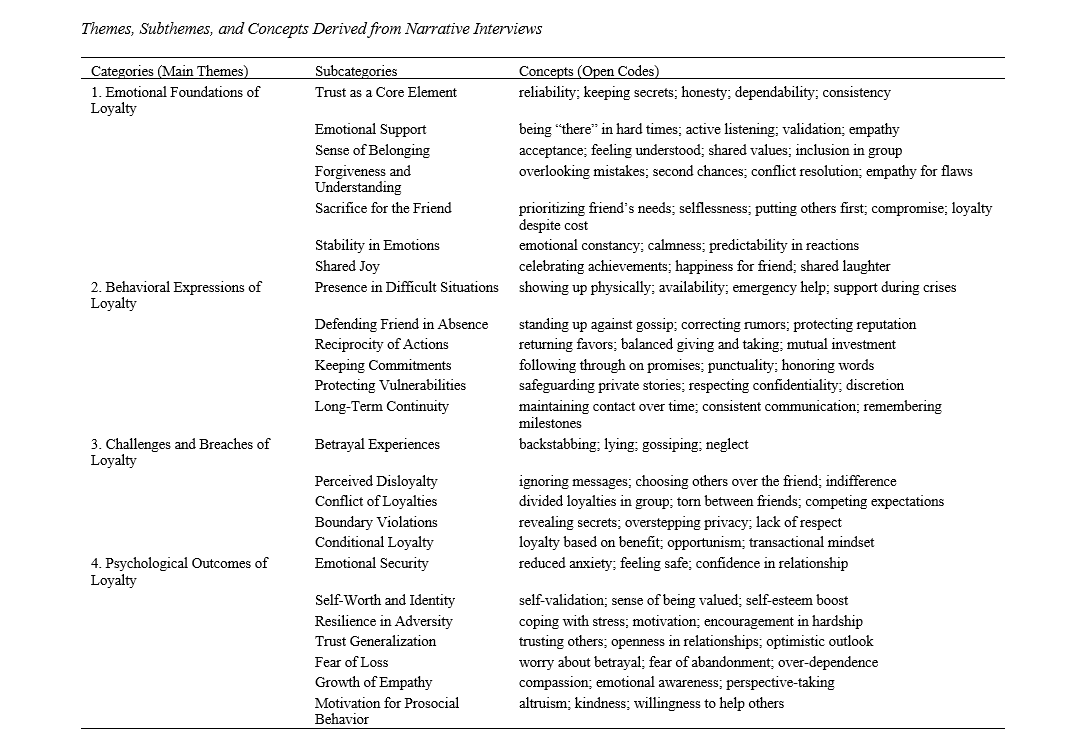
Findings: Analysis revealed four main themes: (1) Emotional Foundations of Loyalty (trust, emotional support, belonging, forgiveness, sacrifice, stability, shared joy), (2) Behavioral Expressions of Loyalty (presence in adversity, defense in absence, reciprocity, keeping commitments, protecting vulnerabilities, long-term continuity), (3) Challenges and Breaches of Loyalty (betrayal, neglect, conflicting loyalties, boundary violations, conditional loyalty), and (4) Psychological Outcomes of Loyalty (emotional security, self-worth, resilience, generalized trust, fear of loss, empathy, prosocial motivation). Participants’ narratives emphasized loyalty as both a protective and fragile construct, capable of fostering resilience and self-worth while also producing vulnerability when breached.
Conclusion: The findings demonstrate that friendship loyalty among adolescents is a multidimensional phenomenon, deeply embedded in emotional ties, behavioral practices, and developmental outcomes. Loyalty acts as both a stabilizing force and a source of vulnerability, influencing identity, resilience, and trust. These insights underscore the importance of fostering loyal friendships through educational, parental, and community interventions, particularly in an era where digital interactions increasingly shape loyalty norms.
Downloads
References
Beristain, C. M., & Wiener, J. (2020). Friendships of Adolescents With Attention-Deficit/Hyperactivity Disorder. Canadian Journal of School Psychology, 35(4), 266-279. https://doi.org/10.1177/0829573520936469
Bowker, J. C., Weingarten, J. P., Etkin, R. G., & Dirks, M. A. (2024). When Best Friendships End: Young Adolescents' Responses to Hypothetical Best Friendship Dissolution and Associations With Real-Life Friendship Outcomes. Frontiers in Developmental Psychology, 2. https://doi.org/10.3389/fdpys.2024.1369085
Calhoun, C. D., Helms, S. W., Heilbron, N., Rudolph, K. D., Hastings, P. D., & Prinstein, M. J. (2014). Relational Victimization, Friendship, and Adolescents' Hypothalamic–pituitary–adrenal Axis Responses to an in Vivo Social Stressor. Development and Psychopathology, 26(3), 605-618. https://doi.org/10.1017/s0954579414000261
Dryburgh, N. S. J., Martin‐Storey, A., Craig, W., Holfeld, B., & Dirks, M. A. (2024). Quantifying Toxic Friendship: A Preliminary Investigation of a Measure of Victimization in the Friendships of Adolescents. Journal of interpersonal violence, 40(7-8), 1800-1823. https://doi.org/10.1177/08862605241265418
Flanagan, C. A., & Pykett, A. (2024). Foundations of Loyalty in Child and Adolescent Development. 18-41. https://doi.org/10.1093/oso/9780197612644.003.0002
Forgeron, P., Chambers, C. T., Cohen, J., Dick, B., Finley, G. A., & Lamontagne, C. (2018). Dyadic Differences in Friendships of Adolescents With Chronic Pain Compared With Pain-Free Peers. Pain, 159(6), 1103-1111. https://doi.org/10.1097/j.pain.0000000000001191
Forgeron, P., Dick, B., Chambers, C. T., Cohen, J., Lamontagne, C., & Finley, G. A. (2022). Are They Still Friends? Friendship Stability of Adolescents With Chronic Pain: 1-Year Follow-Up. Frontiers in Pain Research, 2. https://doi.org/10.3389/fpain.2021.767236
Graber, R., Turner, R. N., & Madill, A. (2015). Best Friends and Better Coping: Facilitating Psychological Resilience Through Boys’ and Girls’ Closest Friendships. British Journal of Psychology, 107(2), 338-358. https://doi.org/10.1111/bjop.12135
Kharimah, U., Prasetyawati, W., & Sary, M. P. (2018). Association Between Friendship Quality and Depression Among High School Students in Jakarta. https://doi.org/10.2991/uipsur-17.2018.5
Kim, J., & Kim, M. (2022). Rise of Social Media Influencers as a New Marketing Channel: Focusing on the Roles of Psychological Well-Being and Perceived Social Responsibility Among Consumers. International journal of environmental research and public health, 19(4), 2362. https://doi.org/10.3390/ijerph19042362
Lindsey, E. W. (2025). Parent–Child Dyadic Synchrony, Prosocial and Aggressive Behavior With Peers, and Friendship Quality in Early Adolescence. Psychology International, 7(1), 22. https://doi.org/10.3390/psycholint7010022
Lodder, G. M. A., Scholte, R. H. J., Goossens, L., & Verhagen, M. (2015). Loneliness in Early Adolescence: Friendship Quantity, Friendship Quality, and Dyadic Processes. Journal of Clinical Child & Adolescent Psychology, 46(5), 709-720. https://doi.org/10.1080/15374416.2015.1070352
Mahirah, A. H., & Tondok, M. S. (2024). Responsive Parenting and Friendship Quality in Adolescents: Interpersonal Communication Skills as a Mediator. Bulletin of Counseling and Psychotherapy, 6(2). https://doi.org/10.51214/00202406933000
Markovic, A., & Bowker, J. C. (2017). Friends Also Matter: Examining Friendship Adjustment Indices as Moderators of Anxious-Withdrawal and Trajectories of Change in Psychological Maladjustment. Developmental Psychology, 53(8), 1462-1473. https://doi.org/10.1037/dev0000343
Martin, M., Davies, P. T., & Cummings, E. M. (2017). Distinguishing Attachment and Affiliation in Early Adolescents’ Narrative Descriptions of Their Best Friendship. Journal of Research on Adolescence, 27(3), 644-660. https://doi.org/10.1111/jora.12305
Pamacheche, R., & Duh, H. I. (2021). Personal-Loyalty and Pricing Benefits From Hairstylist-Client Commercial Friendship. Journal of Research in Marketing and Entrepreneurship, 23(2), 235-250. https://doi.org/10.1108/jrme-03-2020-0026
Qu, W., Li, K., & Wang, Y. (2021). Early Adolescents' Parent–child Communication and Friendship Quality: A Cross-Lagged Analysis. Social Behavior and Personality an International Journal, 49(9), 1-10. https://doi.org/10.2224/sbp.10697
Rowsell, H. C., Ciarrochi, J., Heaven, P. C. L., & Deane, F. P. (2013). The Role of Emotion Identification Skill in the Formation Of male and Female Friendships: A Longitudinal Study. Journal of adolescence, 37(2), 103-111. https://doi.org/10.1016/j.adolescence.2013.11.005
Saraswati, K., & Suleeman, J. (2018). Resilience and Friendship Quality Among Late Adolescents From Intact, Divorced, and Remarried Families. https://doi.org/10.2991/uipsur-17.2018.48
Suwandi, J., & Astuti, P. (2023). The Influence of Social Media Influencer Attributes, Perceived Friendship, Psychological Well-Being on Customer Loyalty on the Instagram Application. Formosa Journal of Sustainable Research, 2(4), 811-830. https://doi.org/10.55927/fjsr.v2i4.3540
Zalk, M. v., Zalk, N. V., Kerr, M., & Stattin, H. (2014). Influences Between Online–Exclusive, Conjoint and Offline–Exclusive Friendship Networks: The Moderating Role of Shyness. European Journal of Personality, 28(2), 134-146. https://doi.org/10.1002/per.1895
Downloads
Additional Files
Publication Timeline
- Submitted
- Revised
- Accepted
Issue
Section
License

This work is licensed under a Creative Commons Attribution-NonCommercial 4.0 International License.