The Effect of Life Skills on Students’ Deviant Behaviors with the Mediating Role of Psychological Capital
DOI:
https://doi.org/10.61838/kman.jayps.4471Keywords:
Life skills, Deviant behaviors, Psychological capital, Adolescents, Structural equation modelingAbstract
Objective: This study aimed to examine the effect of life skills on students’ deviant behaviors, with a particular focus on the mediating role of psychological capital.
Methods and Materials: This descriptive-survey and applied research was conducted on a statistical population comprising all male and female lower- and upper-secondary school students in Rudsar during the 2024–2025 academic year. Using the Krejcie and Morgan table, a sample of 384 students was selected through stratified random sampling. Data were collected using the Jessor and Jessor Deviant Behavior Questionnaire (1977), the World Health Organization Life Skills Questionnaire (1997), and the Luthans Psychological Capital Questionnaire (2007), all rated on a five-point Likert scale. The reliability of the instruments was confirmed using Cronbach’s alpha, and their content and construct validity were verified through expert review and confirmatory factor analysis. Data analysis involved descriptive statistics and inferential techniques, including the Kolmogorov–Smirnov Test for normality, and structural equation modeling and path analysis using SPSS and SmartPLS software.
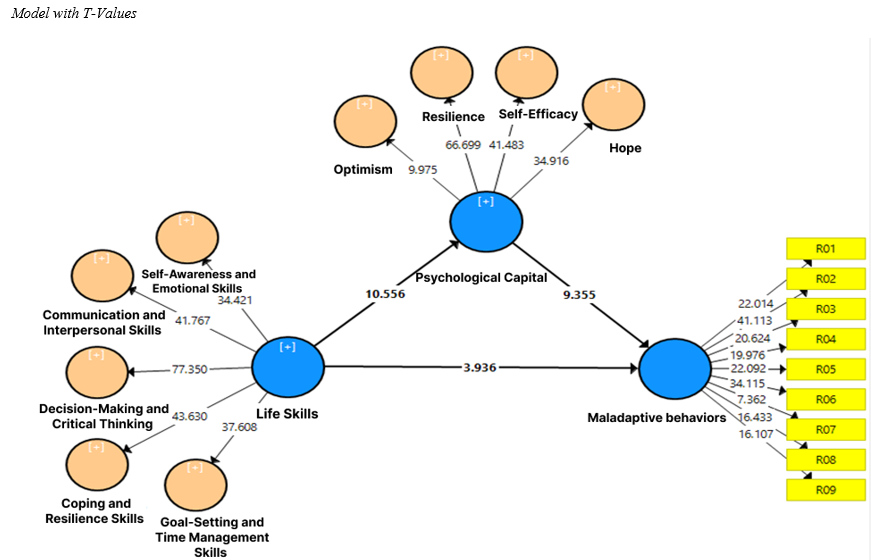
Findings: The results showed that life skills had a significant positive effect on psychological capital (β = 0.471, t = 10.556, p < 0.05) and a significant negative direct effect on deviant behaviors (β = -0.195, t = 3.936, p < 0.05). Psychological capital had a significant negative effect on deviant behaviors (β = -0.427, t = 9.355, p < 0.05). Moreover, psychological capital played a significant partial mediating role in the relationship between life skills and deviant behaviors, with an indirect effect of β = -0.201 (t = 6.983, p < 0.05).
Conclusion: Life skills reduce deviant behaviors both directly and indirectly by enhancing psychological capital, indicating the necessity of interventions that simultaneously foster psychosocial competencies and positive psychological resources in adolescents.
Downloads
References
Azadi Pour, G., & Shoqi, B. (2023). The Effect of Cognitive Flexibility on Subjective Well-being with the Mediation of Wisdom in Second-grade High School Students in Paveh City. Journal of New Ideas in Psychology, 18(22), 1-11. https://www.magiran.com/paper/2702522/the-effect-of-cognitive-flexibility-on-mental-well-being-with-mediation-role-of-wisdom-in-the-second-year-high-school-students-of-paveh-city$?lang=en
Chen, D. J., & Lim, V. K. G. (2012). Strength in adversity: The influence of psychological capital on job search. Journal of Organizational Behavior, 33(6), 811-839. https://doi.org/10.1002/job.1814
Fallah, E., Birjandi, M., Rashidi, K., & Almasian, M. (2021). Impact of Life Skills Training on Adolescents' Inclination to Risky Behaviors: A Randomized Controlled Clinical Trial. Iranian journal of psychiatry and behavioral sciences, 15(3), e111264. https://doi.org/10.5812/ijpbs.111264
Ghadiri Nyari, M., & Meshkbid Haghighi, M. (2022). The Effectiveness of Life Skills Training on Psychological Distress and Promoting Psychological Capital in Patients with Diabetes in Gilan Province. Journal of New Ideas in Psychology, 15(19), 1-17. https://jnip.ir/browse.php?a_id=850&slc_lang=en&sid=1&printcase=1&hbnr=1&hmb=1
Jessor, R., & Jessor, S. L. (1977). Problem Behavior and Psychosocial Development: A Longitudinal Study of Youth. Academic Press. https://books.google.com/books/about/Problem_Behavior_and_Psychosocial_Develo.html?id=dIkoAQAAMAAJ
Kanengoni, H., Ngarambe, C. N., & Buitendach, J. H. (2018). Psychological capital and work behaviour-related outcomes among South African church ministers. South African Journal of Psychology, 48(4), 488-500. https://doi.org/10.1177/0081246317729571
Kounkroo, N. (2025). Developing 21st century life skills and career competencies among university students: a case study of Buddhist University in Thailand. Insights in Modern Education (I-ME), 2(1), 1-7. https://doi.org/10.1002/asi.24750
Larni, M. (2025). Comparison of the Effectiveness of Life Skills Training and Mindfulness Skills on Risky Behaviors and Psychopathological Symptoms in Female High School Students of Varamin. Jayps, 6(2), 15-23. https://doi.org/10.61838/kman.jayps.6.2.3
Larni, M., Sotoudeh, N., Jahan, F., & Asadzadeh, H. (2021). The Effectiveness of Life Skills Training on High-risk Behaviors and Psychopathological Symptoms in Female Students. Management Studies on Police Training, 14(53), 11-32. https://www.magiran.com/paper/2362809/the-effectiveness-of-life-skills-training-on-high-risk-behaviors-and-morbid-symptoms-of-female-students?lang=en
Luthans, F., Avolio, B. J., Avey, J. B., & Norman, S. M. (2007). Psychological Capital: Measurement and Relationship with Performance and Satisfaction. Personnel psychology, 60(3), 541-572. https://doi.org/10.1111/j.1744-6570.2007.00083.x
Moreno-Montero, E., Ferradás, M. d. M., & Freire, C. (2024). Personal Resources for Psychological Well-Being in University Students: The Roles of Psychological Capital and Coping Strategies. European Journal of Investigation in Health, Psychology and Education, 14(10), 2686-2701. https://doi.org/10.3390/ejihpe14100177
Ortega-Maldonado, A., & Salanova, M. (2018). Psychological capital and performance among undergraduate students: The role of meaning-focused coping and satisfaction. Teaching in Higher Education, 23(4), 390-402. https://doi.org/10.1080/13562517.2017.1391199
Rahimi, A., Khorramabadi, Y., Navabi, Y., & Moein, R. (2016). Investigating the Effect of Life Skills Training on Reducing Risk Behaviors in At-Risk Male High School Students. Pajouheshan-e Scientific Journal, 15(1), 43-51. https://psj.umsha.ac.ir/article-1-370-en.html
Saman, A., & Wirawan, H. (2024). Predicting students' soft skills: the role of psychological capital, psychological well-being and grade levels. Education + Training, 66(1), 17-34. https://doi.org/10.1108/ET-10-2022-0405
Santisi, G., Lodi, E., Magnano, P., Zarbo, R., & Zammitti, A. (2020). Relationship between Psychological Capital and Quality of Life: The Role of Courage. Sustainability, 12(13), 5238. https://doi.org/10.3390/su12135238
Sheikhan, R., Darabi, S., & Adineh, M. (2022). The Effectiveness of Life Skills Training on Loneliness, Depression, and Aggressive Behavior in Adolescents of Divorce. Family Psychological and Educational Studies, 4(7), 37-60. https://mtr.jz.ac.ir/article_187543.html
Shekofteh, M., & Shahnaz, R. (2024). Life Skills and its Impact on Personality Development. International Journal for Multidisciplinary Research, 6(3). https://doi.org/10.36948/ijfmr.2024.v06i03.22834
World Health, O. (1997). Life Skills Education in Schools: A Framework for Implementation.
Zhang, X., Huang, X., Chen, Q., Song, Y., Jiang, X., Zhou, J., Zhao, X., & Zhao, L. (2024). Analysis of deviant behaviors and family functions in the population at risk of internet addiction among primary and secondary school students in Chengdu city, Sichuan province of China. Frontiers in Public Health, 12, 1498466. https://doi.org/10.3389/fpubh.2024.1498466
Downloads
Additional Files
Publication Timeline
- Submitted
- Revised
- Accepted
Issue
Section
License
Copyright (c) 2025 Masoumeh Karimi Bibalan (Author); Mohammad Ali Nasimi (Corresponding Author)

This work is licensed under a Creative Commons Attribution-NonCommercial 4.0 International License.