When Home Is Loud: Strategies of Coping with Sensory Overload in Adolescents
DOI:
https://doi.org/10.61838/kman.jayps.4434Keywords:
Adolescence, Sensory overload, Coping strategies, Family dynamicsAbstract
Objective: This study aimed to explore the coping strategies employed by adolescents when experiencing sensory overload in noisy and overstimulating home environments.
Methods and Materials: A qualitative design was adopted to capture adolescents’ lived experiences. Twenty-five adolescents aged 13–18 years from Greece were recruited through purposive sampling. Semi-structured interviews were conducted, focusing on experiences of sensory overload, its emotional and behavioral consequences, and the strategies used to manage these challenges. Interviews continued until theoretical saturation was reached, transcribed verbatim, and analyzed using thematic analysis with NVivo 14 software. Reflexivity and peer debriefing were applied to enhance trustworthiness.
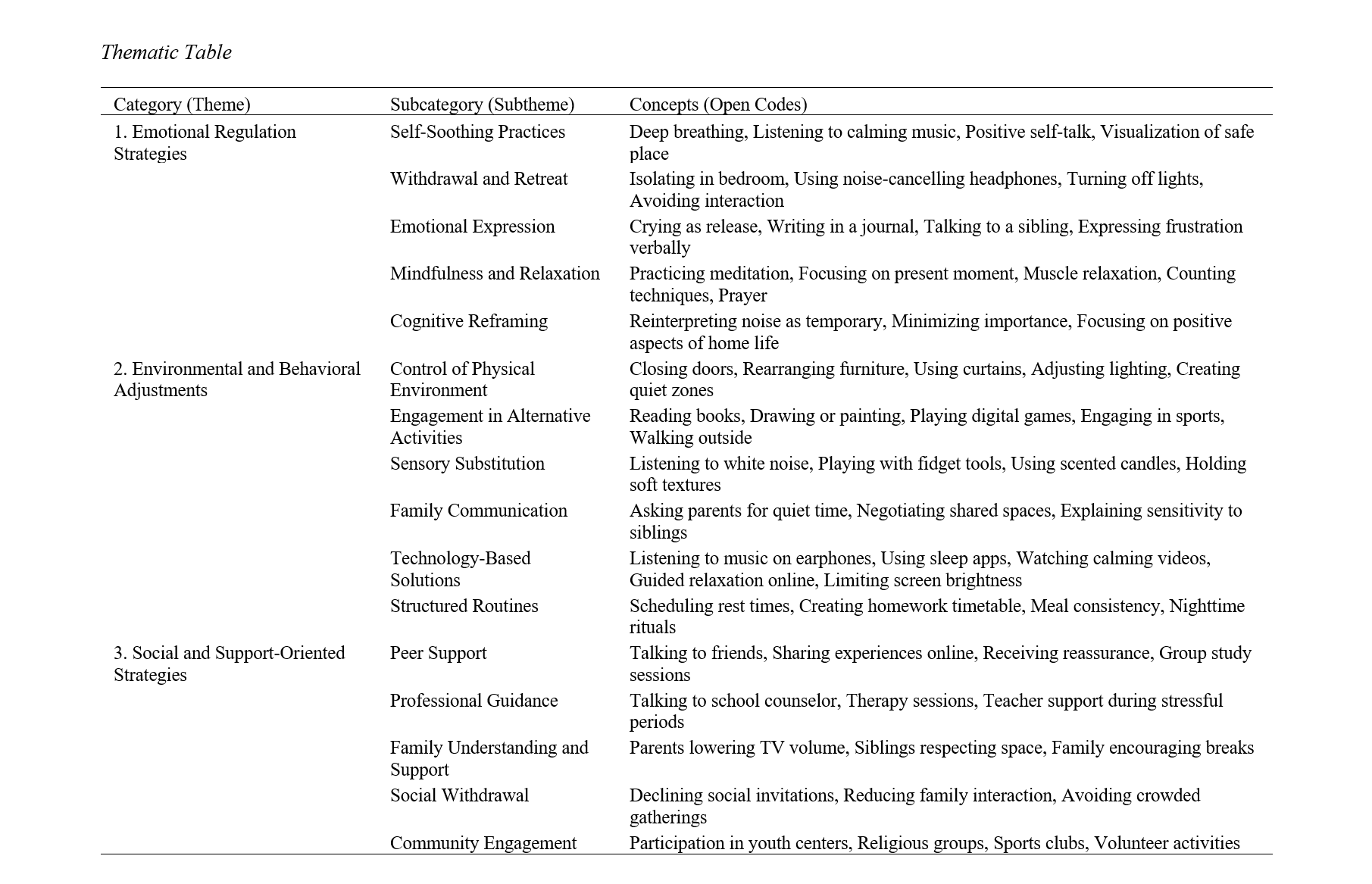
Findings: Three overarching themes emerged: emotional regulation strategies, environmental and behavioral adjustments, and social and support-oriented strategies. Emotional regulation strategies included self-soothing, withdrawal, mindfulness, and cognitive reframing. Environmental and behavioral adjustments encompassed control of the physical environment, engagement in alternative activities, use of technology, and structured routines to reduce overstimulation. Social and support-oriented strategies highlighted the importance of peer validation, family understanding, professional guidance, and community engagement. While some adolescents adopted adaptive strategies such as mindfulness and family communication, others relied on avoidance or social withdrawal.
Conclusion: The study underscores that adolescents employ a wide spectrum of coping mechanisms, ranging from personal regulation techniques to reliance on family and community support. Findings highlight the need for interventions that integrate individual coping skill development with family- and community-level supports.
Downloads
References
Asmussen, K. (2020). Interventions for Parents of Adolescents. 1-14. https://doi.org/10.1002/9781119171492.wecad411
Barakat, A. H. A., El-Salihen, F. A. A., Khalifa, A. M., & Ibrahim, F. M. (2023). Sensory Integrative Intervention: Outcomes of Motor, Cognitive and Social Skills Among Children With Attention Deficit Hyperactivity Disorders. Egyptian Journal of Health Care, 14(3), 726-738. https://doi.org/10.21608/ejhc.2023.321172
Berry, L., Crone, M. R., Mathews, S., & Reis, R. (2025). “She Is a Mother, but Still Childish”. Exploring Adult Caregivers’ Perspectives on Adolescent Parenting. Child and Adolescent Social Work Journal. https://doi.org/10.1007/s10560-025-01020-2
Berry, L., Mathews, S., Reis, R., & Crone, M. R. (2021). Mental Health Effects on Adolescent Parents of Young Children: Reflections on Outcomes of an Adolescent Parenting Programme in South Africa. Vulnerable Children and Youth Studies, 17(1), 38-54. https://doi.org/10.1080/17450128.2021.1954737
Bhengu, P., Ndwandwe, D., Kuodi, P., Tamuzi, J. L., Wiysonge, C. S., Mazingisa, A. V., Mavundza, E. J., Cooper, S., Katoto, P. D., & Shey, M. (2025). A Comparative Analysis of Parent-Centered Versus Parent-Adolescent Dyad Interventions to Enhance HPV Vaccination Uptake in Children and Adolescents: Protocol for Systematic Review and Meta-Analysis. F1000research, 14, 56. https://doi.org/10.12688/f1000research.146725.1
Breivik, I., Josephsson, S., & Lidström, H. (2019). Wearing a Ball Vest in Everyday Activities: Experiences From Adolescents With Neuropsychiatric Disorders, Their Parents and Teachers. Asian Journal of Occupational Therapy, 15(1), 53-62. https://doi.org/10.11596/asiajot.15.53
Cardamone-Breen, M. C., Jorm, A. F., Lawrence, K., Rapee, R. M., Mackinnon, A., & Yap, M. B. H. (2018). A Single-Session, Web-Based Parenting Intervention to Prevent Adolescent Depression and Anxiety Disorders: Randomized Controlled Trial. Journal of medical Internet research, 20(4), e148. https://doi.org/10.2196/jmir.9499
Cherewick, M., Daniel, C., Shrestha, C. C., Giri, P., Dukpa, C., Cruz, C. M., Roshan, P., & Matergia, M. (2023). Psychosocial Interventions for Autistic Children and Adolescents Delivered by Non-Specialists in Low- And Middle-Income Countries: A Scoping Review. Frontiers in psychology, 14. https://doi.org/10.3389/fpsyg.2023.1181976
Dumproff, B. M., & Dowdy, A. (2023). Effects and Social Validation of Remote Parent Training and Implementation of the Cool Versus Not Cool Behavior Intervention. Journal of Positive Behavior Interventions, 26(4), 218-229. https://doi.org/10.1177/10983007221150829
Fischer, K., Larsen, H., Alithe, L. v. d. A., & Overbeek, G. (2022). The Role of Sensory Processing Sensitivity in the Longitudinal Associations Between Relationship Qualities With Parents and Peers and Externalizing Behavior in Adolescence. Journal of Social and Personal Relationships, 39(8), 2549-2571. https://doi.org/10.1177/02654075221083962
Goldberg, A., & Scharf, M. (2020). How Do Highly Sensitive Persons Parent Their Adolescent Children? The Role of Sensory Processing Sensitivity in Parenting Practices. Journal of Social and Personal Relationships, 37(6), 1825-1842. https://doi.org/10.1177/0265407520911101
Hammud, G., Avital-Magen, A., Jabareen, H., Adler-Tsafir, R., & Engel‐Yeger, B. (2025). The Relations Between Sensory Modulation, Hyper Arousability and Psychopathology in Adolescents With Anxiety Disorders. Children, 12(2), 187. https://doi.org/10.3390/children12020187
Hart, L. C., Tilburg, M. A. v., Campbell, R. A. A., Faldowski, R. A., Nazareth, M., Ndugga, M., Coltrane, C., & Ferris, M. (2019). Association of Youth Health Care Transition Readiness to Role Overload Among Parents of Children With Chronic Illness. Child Care Health and Development, 45(4), 577-584. https://doi.org/10.1111/cch.12683
Hulle, C. A. V., Lemery‐Chalfant, K., & Goldsmith, H. H. (2017). Parent-Offspring Transmission of Internalizing and Sensory Over-Responsivity Symptoms in Adolescence. Journal of abnormal child psychology, 46(3), 557-567. https://doi.org/10.1007/s10802-017-0300-y
Miller, D., Schoen, S., Schmitt, C. M., & Porter, L. M. (2023). Adolescents’ and Adults’ Perceptions of Sensory-Based Interventions: A Qualitative Analysis. American Journal of Occupational Therapy, 77(5). https://doi.org/10.5014/ajot.2023.050198
Oshima, F., Mandy, W., Seto, M., Hongo, M., Tsuchiyagaito, A., Hirano, Y., Sutoh, C., Guan, S., Nitta, Y., Ozawa, Y., Kawasaki, Y., Ohtani, T., Masuya, J., Takahashi, N., Sato, N., Nakamura, S., Nakagawa, A., & Shimizu, E. (2023). Cognitive Behavior Therapy for Autistic Adolescents, awareness and Care for My Autistic Traits Program: A Multicenter Randomized Controlled Trial. BMC psychiatry, 23(1). https://doi.org/10.1186/s12888-023-05075-2
Pine, A., Baumann, M. G., Modugno, G., & Compas, B. E. (2024). Parental Involvement in Adolescent Psychological Interventions: A Meta-Analysis. Clinical Child and Family Psychology Review, 27(3), 1-20. https://doi.org/10.1007/s10567-024-00481-8
Reigstad, K., Gunlicks‐Stoessel, M., Westervelt, A., & Gearity, A. R. (2022). Healthy Emotions and Relationships With Teens—a Guide for Parents: An Intervention Development Study of a Parent-Based Intervention for Adolescents With Depression. Clinical Child Psychology and Psychiatry, 27(3), 586-597. https://doi.org/10.1177/13591045221078416
Rodríguez, E. M. L., Pascual, R. C., Sanclemente, M. P., Martín, P., Gil‐Lacruz, M., & Gil-Lacruz, A. I. (2022). The Influence of ASD Severity on Parental Overload: The Moderating Role of Parental Well-Being and the ASD Pragmatic Level. Children, 9(6), 769. https://doi.org/10.3390/children9060769
Scheydt, S., Müller‐Staub, M., Frauenfelder, F., Nielsen, G. H., Behrens, J., & Needham, I. (2017). Sensory Overload: A Concept Analysis. International journal of mental health nursing, 26(2), 110-120. https://doi.org/10.1111/inm.12303
Scripps, E., Sutherland, D., Langdon, P. E., Hastings, R. P., & Gray, K. M. (2025). Supporting Parents of Adolescents With Intellectual Disabilities: A Systematic Review of Interventions. Journal of Applied Research in Intellectual Disabilities, 38(1). https://doi.org/10.1111/jar.70004
Shaw, S., Simao, S. C., Jenner, S., Lawrence, W., Woods‐Townsend, K., Vogel, C., Farrell, D., Inskip, H., Baird, J., Morrison, L., Barker, M., & Strömmer, S. (2021). Parental Perspectives on Negotiations Over Diet and Physical Activity: How Do We Involve Parents in Adolescent Health Interventions? Public Health Nutrition, 24(9), 2727-2736. https://doi.org/10.1017/s1368980021000458
Throuvala, M. A., Griffiths, M. D., Rennoldson, M., & Kuss, D. J. (2021). Perceived Challenges and Online Harms From Social Media Use on a Severity Continuum: A Qualitative Psychological Stakeholder Perspective. International journal of environmental research and public health, 18(6), 3227. https://doi.org/10.3390/ijerph18063227
Trew, S. (2024). Made to Feel Different: Families Perspectives on External Responses to Autism and the Impacts on Family Well-Being and Relationships. Autism, 28(8), 2120-2139. https://doi.org/10.1177/13623613231221684
Zhang, Y., Huang, J., & Wang, Y. (2019). Parent–adolescent Communication and Chinese Adolescents’ Self-Esteem: A Cross-Lagged Model. Social Behavior and Personality an International Journal, 47(10), 1-11. https://doi.org/10.2224/sbp.8416
Downloads
Additional Files
Publication Timeline
- Submitted
- Revised
- Accepted
Issue
Section
License

This work is licensed under a Creative Commons Attribution-NonCommercial 4.0 International License.