Forgiveness as a Mediator between Peer Conflict and Emotional Wellbeing in Adolescents
DOI:
https://doi.org/10.61838/kman.jayps.4423Keywords:
Adolescents, Peer Conflict, Forgiveness, Emotional WellbeingAbstract
Objective: This study aimed to examine the mediating role of forgiveness in the relationship between peer conflict and emotional wellbeing among adolescents in Indonesia.
Methods and Materials: A descriptive correlational research design was employed with a sample of 391 secondary school students selected using stratified random sampling based on the Krejcie and Morgan table. Emotional wellbeing was measured with the Warwick-Edinburgh Mental Wellbeing Scale (WEMWBS), forgiveness with the Heartland Forgiveness Scale (HFS), and peer conflict with the Peer Conflict Scale (PCS). Data were analyzed using SPSS version 27 to compute descriptive statistics and Pearson correlations, and Structural Equation Modeling (SEM) with AMOS version 21 to test the hypothesized mediation model. Model fit was assessed using χ², df, χ²/df, GFI, AGFI, CFI, TLI, and RMSEA indices.
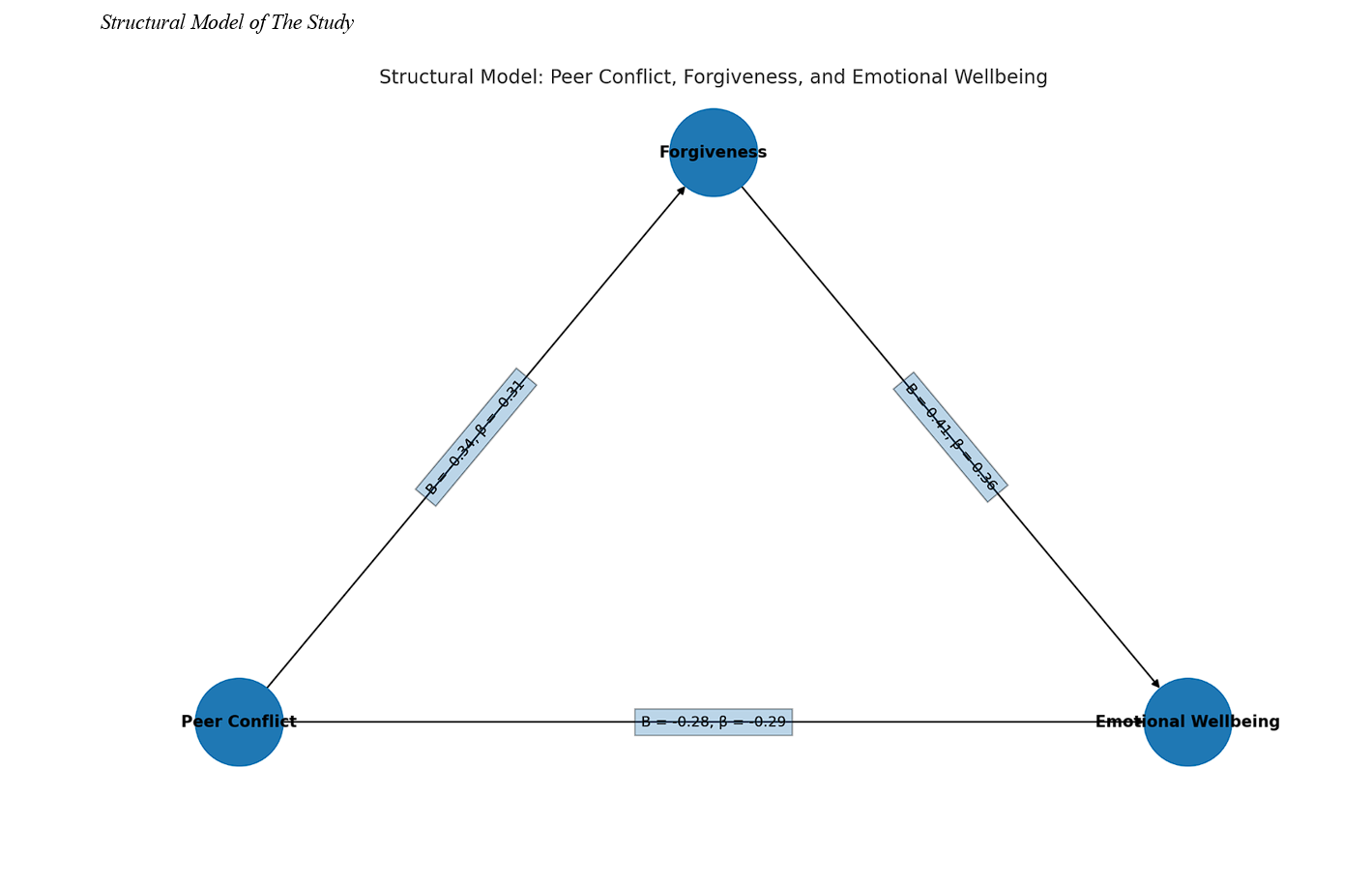
Findings: Results indicated that peer conflict was negatively correlated with emotional wellbeing (r = –.36, p = .003) and forgiveness (r = –.29, p = .006), while forgiveness was positively correlated with emotional wellbeing (r = .42, p = .001). The SEM results showed a good model fit (χ² = 114.27, df = 58, χ²/df = 1.97, GFI = .94, AGFI = .91, CFI = .96, TLI = .95, RMSEA = .049). Direct effects revealed that peer conflict significantly predicted lower emotional wellbeing (β = –.29, p = .001) and forgiveness (β = –.31, p = .002). Forgiveness significantly predicted higher emotional wellbeing (β = .36, p = .001). Importantly, forgiveness mediated the relationship between peer conflict and emotional wellbeing with a significant indirect effect (β = –.11, p = .007), confirming partial mediation.
Conclusion: The findings highlight forgiveness as a crucial psychological mechanism that reduces the detrimental effects of peer conflict on adolescent emotional wellbeing. Incorporating forgiveness-focused interventions in schools may help adolescents manage conflicts constructively and maintain healthier emotional outcomes.
Downloads
References
Aji, N. P. (2025). The Role of Adaptive Emotion Regulation in Mediating the Correlation Between Forgiveness and Students’ Levels of Depressive Symptoms. Counsenesia Indonesian Journal of Guidance and Counseling, 6(1), 111-123. https://doi.org/10.36728/cijgc.v6i1.4995
Brudek, P., Steuden, S., & Kaleta, K. (2023). Wisdom and Wellbeing in Polish Older Adults: The Mediating Role of Forgiveness. Frontiers in psychology, 14. https://doi.org/10.3389/fpsyg.2023.1163113
Cornish, M. A., Meyer, J., Short, K. A., Harris, L., Hunter, E. A., & Quadlander, E. (2022). Forgiveness and Wellbeing After Spinal Cord Injury: Perceived Stress and Adaptation to Disability as Mediators. Rehabilitation Psychology, 67(4), 556-566. https://doi.org/10.1037/rep0000459
Davison, J., Bunting, B., & Stewart‐Knox, B. (2023). The Mediating Effect of Food Choice Upon Associations Between Adolescent Health-Related Quality of Life and Physical Activity, Social Media Use and Abstinence From Alcohol. Health and Quality of Life Outcomes, 21(1). https://doi.org/10.1186/s12955-023-02129-7
Gao, Q., & Lee, H. (2023). Impact of Supervisor’s Abusive Supervision on Subordinate’s Work-Family Conflict: The Moderating Effects of Forgiveness Motives. Korean Academy of Management, 31(4), 85-115. https://doi.org/10.26856/kjom.2023.31.4.85
Hinduja, P. (2021). Forgiveness: Concept, Its Application in Personal and Professional Life. Pakistan Journal of Educational Research, 4(4). https://doi.org/10.52337/pjer.v4i4.329
Ho, M. Y., Tongeren, D. R. V., & You, J. (2020). The Role of Self-Regulation in Forgiveness: A Regulatory Model of Forgiveness. Frontiers in psychology, 11. https://doi.org/10.3389/fpsyg.2020.01084
Jain, S. K., & Arya, M. (2024). Role of Conflict Resolution and Forgiveness in Predicting Marital Satisfaction. Shodhkosh Journal of Visual and Performing Arts, 5(1). https://doi.org/10.29121/shodhkosh.v5.i1.2024.4508
Kane, L., Portman, R. M., Eberhardt, J., Walker, L., Proctor, E. L., Poulter, H., & O’Neill, C. (2023). Peer Supporters' Mental Health and Emotional Wellbeing Needs: Key Factors and Opportunities for Co‐produced Training. Health Expectations, 26(6), 2387-2395. https://doi.org/10.1111/hex.13836
Khalid, S., Batool, S., Zaman, S., Khattak, A. Z., & Khan, M. M. (2025). Why University Teachers Use Different Conflict Resolving Styles? Role of Emotional Empathy and Forgiveness in Gender Differences. Journal of Applied Research in Higher Education. https://doi.org/10.1108/jarhe-10-2024-0533
Koch, B. (2023). Anger and Reconciliation. Conatus, 8(2), 279-298. https://doi.org/10.12681/cjp.35255
Li, J., Mi, R., & Wang, Y. (2023). The Effect of Emotional Intelligence on Depression Among Chinese University Students: The Chain Mediating Role of Forgiveness and Psychological Resilience. Lecture Notes in Education Psychology and Public Media, 6(1), 605-611. https://doi.org/10.54254/2753-7048/6/20220565
Liu, J., Li, D., Jia, J., Liu, Y.-X., Lv, Y., & Zhai, B. (2023). Peer Victimization and Subjective Well-Being Among Chinese Adolescents: Moderated Mediation by Forgiveness and Self-Esteem. Journal of interpersonal violence, 38(11-12), 7355-7382. https://doi.org/10.1177/08862605221145721
Mróz, J., Toussaint, L., & Kaleta, K. (2024). Association Between Religiosity and Forgiveness: Testing a Moderated Mediation Model of Self-Compassion and Adverse Childhood Experiences. Religions, 15(9), 1137. https://doi.org/10.3390/rel15091137
Oguegbe, T. M., Iloke, S. E., & Udensi, C. E. (2021). Forgiveness Among Public Sector Workers: A Predictive Study of Employee Resilience, Emotional Intelligence and Loneliness at Work. Asian Research Journal of Arts & Social Sciences, 35-44. https://doi.org/10.9734/arjass/2021/v13i430222
Paleari, F. G., Danioni, F., Pelucchi, S., Lombrano, M. R., Lumera, D., & Regalia, C. (2022). The Relationship Between Self‐forgiveness and Psychological Wellbeing in Prison Inmates: The Mediating Role of Mindfulness. Criminal Behaviour and Mental Health, 32(5), 337-349. https://doi.org/10.1002/cbm.2260
Pushpalatha, A. P., Jeevakani, G. J., & Bojiah, J. (2024). An Investigation on the Lasting Impact of COVID-19 on Hope, Gratitude, and Forgiveness of College Students' Wellbeing. Journal of Engineering Education Transformations, 38(2), 135-143. https://doi.org/10.16920/jeet/2024/v38i2/24196
Russell, L. (2023). A Philosophical Mess. 45-67. https://doi.org/10.1093/oso/9780198878476.003.0004
Şahan, M., & Ceyhan, E. (2025). The Mediating Role of Forgiveness in the Relationship Between Emotion Regulation Difficulty and Relational Aggression in High School Students. Anadolu Üniversitesi Eğitim Fakültesi Dergisi, 9(2), 101-115. https://doi.org/10.34056/aujef.1487559
Schuttenberg, E. M., Sneider, J. T., Rosmarin, D. H., Cohen‐Gilbert, J. E., Oot, E. N., Seraikas, A. M., Stein, E., Maksimovskiy, A. L., Harris, S. K., & Silveri, M. M. (2022). Forgiveness Mediates the Relationship Between Middle Frontal Gyrus Volume and Clinical Symptoms in Adolescents. Frontiers in human neuroscience, 16. https://doi.org/10.3389/fnhum.2022.782893
Sun, W., Zheng, Z., Jiang, Y., Tian, L., & Ping, F. (2021). Does Goal Conflict Necessarily Undermine Wellbeing? A Moderated Mediating Effect of Mixed Emotion and Construal Level. Frontiers in psychology, 12. https://doi.org/10.3389/fpsyg.2021.653512
Yuniardita, M. I. (2024). Kematangan Emosi Dengan Pemaafan Pada Remaja. Cognicia, 3(1). https://doi.org/10.22219/cognicia.v3i1.2145
Downloads
Additional Files
Publication Timeline
- Submitted
- Revised
- Accepted
Issue
Section
License

This work is licensed under a Creative Commons Attribution-NonCommercial 4.0 International License.