Prediction of Sleep Disorders Based on Psychological Distress, Meta-Worry, and Emotional Dysregulation in Adolescent Girls
DOI:
https://doi.org/10.61838/kman.jayps.4396Keywords:
sleep disorders, psychological distress, meta-worry, emotional dysregulationAbstract
Objective: The aim of the present study was to predict sleep disorders based on psychological distress, meta-worry, and emotional dysregulation in adolescent girls.
Methods and Materials: The research method was descriptive-correlational. The statistical population consisted of all adolescent girls studying in upper secondary schools in Tehran during the first semester of the 2024–2025 academic year, totaling 87,222 individuals. Based on the rule of Tabachnick and Fidell (2007), a sample of 300 participants was considered and selected using a multistage cluster random sampling method. To collect data, the study employed the Sleep Disorders Questionnaire by Baisy et al. (1989), the Psychological Distress Scale by Lovibond and Lovibond (1995), the Meta-Worry Questionnaire by Wells (2005), and the Emotional Dysregulation Questionnaire by Børberg et al. (2016). Statistical analyses were conducted using SPSS version 27.
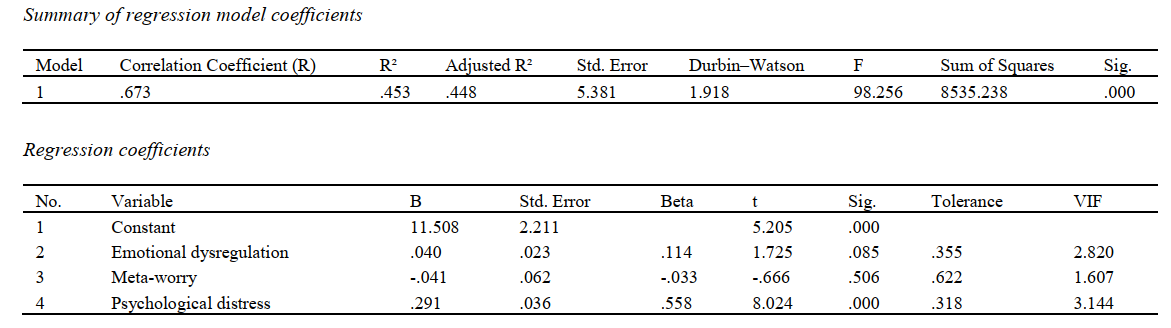
Findings: The results of data analysis showed that 45.3% of the variance in sleep disorders was predicted by psychological distress, meta-worry, and emotional dysregulation. In addition, a positive and significant relationship was found between psychological distress and sleep disorders, with an effect coefficient of 0.645. A negative and significant relationship was found between meta-worry and sleep disorders, with an effect coefficient of -0.422. Furthermore, emotional dysregulation had a positive and significant relationship with sleep disorders, with an effect coefficient of 0.576. Stress was positively and significantly associated with sleep disorders, with an effect coefficient of 0.669. Anxiety also showed a positive and significant relationship with sleep disorders, with an effect coefficient of 0.630. Finally, depression had a positive and significant relationship with sleep disorders, with an effect coefficient of 0.450.
Conclusion: Based on the findings, it can be concluded that psychological distress, meta-worry, and emotional dysregulation play a significant role in predicting sleep disorders and explain a considerable portion of their variance. Therefore, interventions targeting these psychological variables may help improve sleep quality and enhance individuals’ mental health.
Downloads
References
Askari, A., Hajloo, N., & Basharpoor, S. (2023). The role of depression and social anxiety in predicting quality of life and sleep quality with the mediation of internet addiction University of Mohaghegh Ardabili, Faculty of Educational Sciences and Psychology]. Ardabil.
Benedetto, L., Schipilliti, I., & Ingrassia, M. (2022). Coping Strategies and Meta-Worry in Adolescents' Adjustment during COVID-19 Pandemic. In New Research in Mental Health. https://doi.org/10.5772/intechopen.106258
Cheah, Y. K., Kee, C. C., Lim, K. K., & Cheong, Y. L. (2024). Demographic, lifestyle, social, and psychological factors associated with worry-related sleep problems among school-going adolescents in Timor-Leste. Journal of Child and Adolescent Psychiatric Nursing, 37(2), e12468. https://doi.org/10.1111/jcap.12468
Cheong, Y. L., Lim, K. K., Kee, C. C., & Cheah, Y. K. (2024). Emotional dysregulation and sleep problems: A transdiagnostic approach in youth. Clinics and Practice, 14(3), 74. https://doi.org/10.3390/clinpract14030074
Clancy, F., Prestwich, A., Caperon, L., Tsipa, A., & O'Connor, D. B. (2020). The association between worry and rumination with sleep in non-clinical populations: a systematic review and meta-analysis. Health Psychology Review, 14(4), 427-448. https://doi.org/10.1080/17437199.2019.1700819
Fallahi, V., Narimani, M., & Atadokht, A. (2021). Psychometric properties of the short form of the Difficulties in Emotion Regulation Scale (DERS-16) in a group of Iranian adolescents. Journal Of Shahid Sadoughi University Of Medical Sciences, 29(5), 3721-3735. https://doi.org/10.18502/ssu.v29i5.6772
Gholedadri-Zadeh, S., & Mousavi, A. (2020). The relationship of intrusive thoughts (rumination, worry, obsessive thoughts) to the sleep quality of high school students with sleep disorders in Bandar Lengeh county Islamic Azad University, Bandar Lengeh Branch, Department of Educational Sciences]. Bandar Lengeh.
Harb, F., Wart, A. G., Brzezinski, J., deRoon‐Cassini, T. A., & Larson, C. L. (2025). Subtypes of Childhood Maltreatment and Posttraumatic Stress Disorder Symptoms in an Adult Trauma Sample: The Mechanistic Role of Sleep. Psychological Trauma Theory Research Practice and Policy, 17(2), 353-362. https://doi.org/10.1037/tra0001716
Karimi-Rad, S., Zahraei, S., & Hosseini, A. (2022). The relationship between anxiety and depression symptoms with the sleep quality of students during the COVID-19 outbreak Alzahra University, Faculty of Educational Sciences and Psychology]. Tehran.
Khalfi, S., & Rasoulzadeh, B. (2021). Determining the effectiveness of a positive psychology-based approach on modifying perceived stress, psychological distress, and improving the academic efficacy of students with dyslexia University of Isfahan, Faculty of Educational Sciences and Psychology]. Isfahan.
Li, X., Tu, L., & Jiang, X. (2022). Childhood maltreatment affects depression and anxiety: The mediating role of benign envy and malicious envy. Frontiers in Psychiatry, 13, 924795. https://doi.org/10.3389/fpsyt.2022.924795
Li, Y., Ermakov, V., Wang, Y., Wei, L., Ma, M., Chi, H., Sun, C., Tang, H., Zhong, L., Li, J., Wei, K., Sha, Z., Fan, C., & Jiao, M. (2025). Sleep Disturbances Among Older Adults From the Russian Far East Experiencing Social Loss: Is There a Sex Difference? BMC public health, 25(1). https://doi.org/10.1186/s12889-025-22078-8
Lifshin, U., & Mikulincer, M. (2021). Further evidence for motivated helplessness in the context of the COVID-19 outbreak: The case of Argentina before and during the pandemic. The Journal of Social Psychology, 161(4), 452-465. https://doi.org/10.1080/00224545.2021.1918618
Masbahi, M., & Saraei, A. (2022). The relationship between self-criticism and negative emotions with sleep disorders Mokhberegan Motahar Institute of Higher Education, Department of Psychology]. Tehran.
Meng, L., Lin, X., Du, J., & Lu, X. (2022). How Can Employees Break Free From Helplessness in Critical Work Incidents? International Journal of Stress Management, 29(3), 213-223. https://doi.org/10.1037/str0000264
Menzies, R. E., Brown, J., & Marchant, J. (2025). “To Die, To Sleep”: A Systematic Review and Meta-Analysis of the Relationship Between Death Anxiety and Sleep. Journal of anxiety disorders, 103001.
Mousavi, N., & Ghorbani, S. (2022). Predicting sleep disorders based on dark personality traits, emotional schemas, and negative automatic thoughts among students Payame Noor University of Isfahan Province, Najafabad Payame Noor Center]. Najafabad.
Naranji-Kaho, A., & Rajabpour-Farkhani, S. (2023). Investigating the mediating role of anger and psychological distress in the relationship between sexual satisfaction and attitude toward extramarital relationships in women referring to counseling centers Hakim Nezami Institute of Higher Education, Faculty of Humanities]. Qom.
Partinen, M. (2021). Sleep research in 2020: COVID-19-related sleep disorders. The Lancet Neurology, 20(1), 15-17. https://doi.org/10.1016/S1474-4422(20)30456-7
Saalwirth, C., & Leipold, B. (2021). Well-being and sleep in stressful times of the COVID-19 pandemic: Relations to worrying and different coping strategies. Stress and Health, 37(5), 973-985. https://doi.org/10.1002/smi.3057
Sakakini, R. J., Terjesen, M. D., & Reyes-Ruiz, M. (2020). Treatment of sleep disorders in children and adolescents: A rational-emotive, cognitive-behavioral approach. In Rational-Emotive and Cognitive-Behavioral Approaches to Child and Adolescent Mental Health: Theory, Practice, Research, Applications (pp. 331-350). https://doi.org/10.1007/978-3-030-53901-6_16
Seah, T. H. S., Eckstrand, K., Gupta, T., Jensen, L. W. C., Brodnick, Z. M., Horter, C., Gregory, A. M., Franzen, P. L., Marshal, M. P., & Forbes, E. E. (2025). Sleep Disturbance and Social Reward Processing as Characteristics Linking Minority Victimization and Suicidal Ideation in Youth. Frontiers in Neuroscience, 18. https://doi.org/10.3389/fnins.2024.1475097
Sharifian, N., & Khodarahimi, S. (2023). Developing a model of sleep quality in students based on depression with the mediating role of anxiety sensitivity among students in Behbahan city. The 8th National Conference on Modern Research in the Field of Educational Sciences and Psychology of Iran, Tehran.
Shi, C., Wang, S., Tang, Q., Liu, X., & Li, Y. (2022). Cross-lagged relationship between anxiety, depression, and sleep disturbance among college students during and after collective isolation. Frontiers in Public Health, 10, 1038862. https://doi.org/10.3389/fpubh.2022.1038862
Silva-Santos, L. C., Carvalho, S. M., & Faro, A. (2022). Meta-worry, anxiety, and depression in the coronavirus 2019(COVID-19) pandemic: Brazil, June 2020. Salud mental, 45(4), 151-158. https://doi.org/10.17711/SM.0185-3325.2022.021
Solmaz, S., İnan, M., & Şahi̇n, M. (2025). The Moderating Effects of Physical Activity on Social Anxiety and Sleep Disturbance: Managing Gaming Disorder in Young E-Sports Players. Frontiers in Public Health, 13. https://doi.org/10.3389/fpubh.2025.1544044
Talebi-Ashelaghi, S., & Ghodrati-Mirkohi, M. (2022). Investigating academic stress with depression and sleep disorders in quarantined first-grade high school female students during the COVID-19 epidemic in Mianeh county Payame Noor University of Qazvin Province, Qazvin Payame Noor Center]. Qazvin.
Uccella, S., Cordani, R., Salfi, F., Gorgoni, M., Scarpelli, S., Gemignani, A., Geoffroy, P. A., De Gennaro, L., Palagini, L., Ferrara, M., & Nobili, L. (2023). Sleep Deprivation and Insomnia in Adolescence: Implications for Mental Health. Brain Sciences, 13(4), 569. https://doi.org/10.3390/brainsci13040569
Ulrich, A. K., Full, K. M., Cheng, B., Gravagna, K., Nederhoff, D., & Basta, N. E. (2021). Stress, anxiety, and sleep among college and university students during the COVID-19 pandemic. Journal of American College Health, 71(5), 1323-1327. https://doi.org/10.1080/07448481.2021.1928143
Yang, C. C., Llamas-Díaz, D., Bahena, Y. A., Cabello, R., Dahl, R. E., & Magis-Weinberg, L. (2023). Emotion regulation difficulties and sleep quality in adolescence during the early stages of the COVID-19 lockdown. Journal of affective disorders, 338, 92-99. https://doi.org/10.1016/j.jad.2023.05.036
Yang, H., Wang, Z., Elhai, J. D., & Montag, C. (2022). The relationship between adolescent emotion dysregulation and problematic technology use: Systematic review of the empirical literature. Journal of Behavioral Addictions, 11(2), 290-304. https://doi.org/10.1556/2006.2022.00038
Yu, C., Liu, Z., Su, T., Li, Z., Jiang, Z., Zhong, W., & Xiao, Z. (2024). The effect of anxiety on sleep disorders in medical students: a moderated mediation model. Frontiers in psychology, 15, 1338796. https://doi.org/10.3389/fpsyg.2024.1338796
Ziniti, A., Froehle, A. W., & Edwards, B. A. (2025). Identifying Factors Associated with Sleep Disorders and Treatment Avoidance among Collegiate Student-Athletes. Journal of Sports Medicine and Allied Health Sciences, 10(3), 5. https://doi.org/10.25035/jsmahs.10.03.05
Downloads
Additional Files
Publication Timeline
- Submitted
- Revised
- Accepted
Issue
Section
License
Copyright (c) 2025 Mahla Abidi (Author); Mansooreh Fazilati (Corresponding Author)

This work is licensed under a Creative Commons Attribution-NonCommercial 4.0 International License.