Identifying the Cultural and Contextual Barriers to Help-Seeking Behavior for Mental Health in Adolescents
DOI:
https://doi.org/10.61838/kman.jayps.4351Keywords:
adolescents, mental health, help-seeking behavior, cultural barriers, stigmaAbstract
Objective: This study aimed to explore and identify the cultural, interpersonal, and structural barriers that influence help-seeking behavior for mental health among adolescents in Taiwan.
Methods and Materials: A qualitative research design was employed, using semi-structured individual interviews to capture adolescents’ experiences and perspectives on help-seeking for mental health concerns. Participants were 24 adolescents aged 13–18 years, recruited through purposive sampling from urban and suburban areas of Taiwan. Inclusion criteria included current school enrollment, fluency in Mandarin Chinese, and willingness to discuss mental health experiences. Data collection continued until theoretical saturation was achieved. Interviews lasted 45–75 minutes and were audio-recorded, transcribed verbatim, and translated into English for analysis. Thematic analysis was conducted following Braun and Clarke’s six-step process, using NVivo 14 software to facilitate coding and theme development. Trustworthiness was enhanced through member checking, peer debriefing, and maintaining an audit trail.
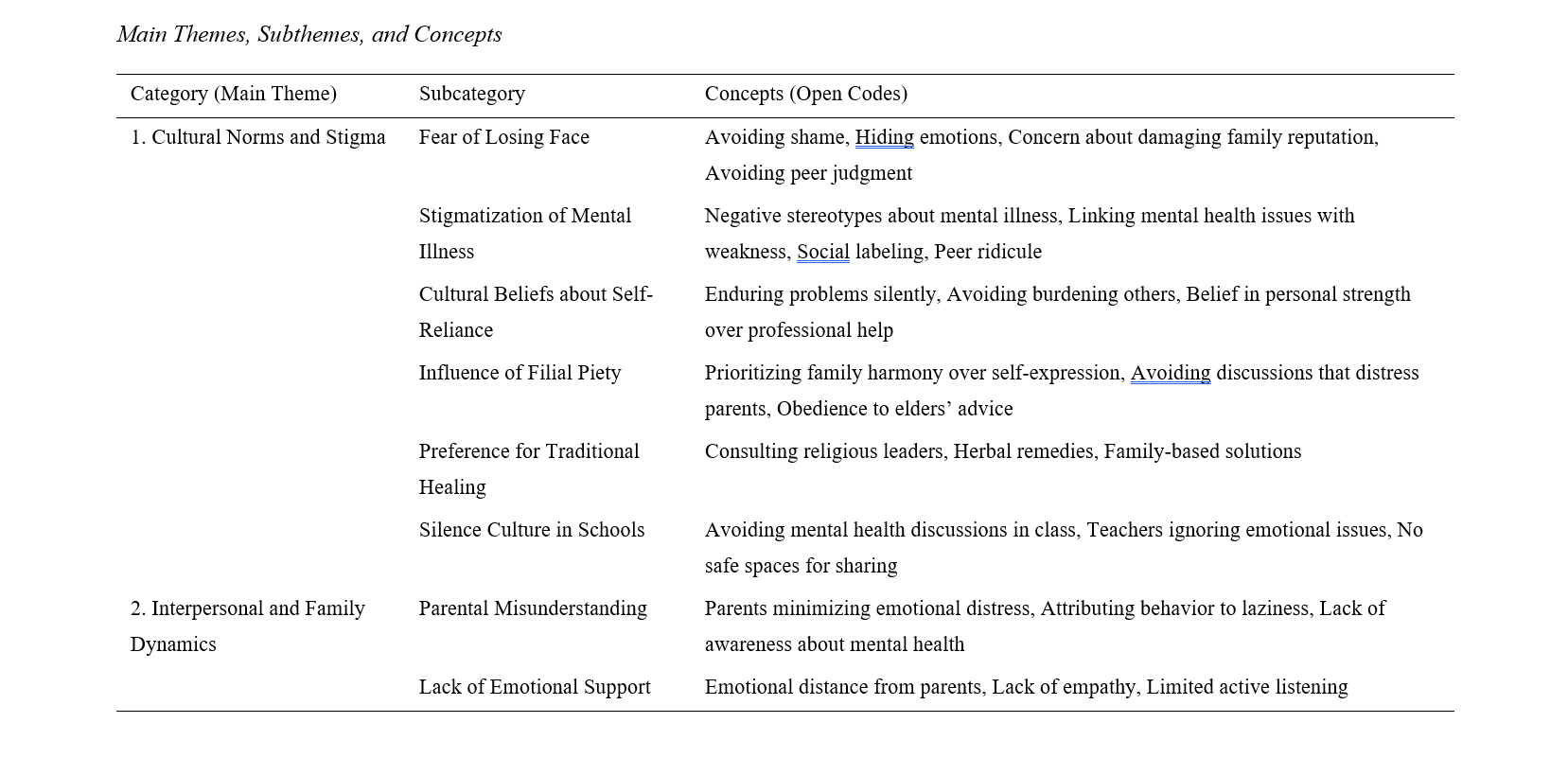
Findings: Analysis revealed three main themes: (1) Cultural Norms and Stigma, encompassing fear of losing face, stigmatization of mental illness, beliefs in self-reliance, filial piety, preference for traditional healing, and a silence culture in schools; (2) Interpersonal and Family Dynamics, including parental misunderstanding, lack of emotional support, communication barriers, peer pressure, and overprotective parenting; and (3) Structural and Accessibility
Conclusion: Help-seeking behavior among Taiwanese adolescents is shaped by intersecting cultural, relational, and systemic barriers that require culturally grounded, multi-level interventions. Addressing stigma, enhancing parental and school support, improving service accessibility, and integrating culturally relevant practices are essential for improving adolescent mental health outcomes in this context.
Downloads
References
Abdel‐Baki, A., Morisseau‐Guillot, R., Côté, H., Deschênes, J., Doré‐Gauthier, V., & Lévesque, I. (2021). Why and How Should We Care About Homeless Youth Suffering From Severe Mental Illnesses? , 339-364. https://doi.org/10.1093/med/9780198842668.003.0024
Bassi, E. M., Bright, K., Norman, L., Pintson, K., Daniel, S., Sidhu, S. S., Gondziola, J., Bradley, J. A., Fersovitch, M., Stamp, L. K., Moskovic, K., LaMonica, H. M., Iorfino, F., Gaskell, T., Tomlinson, S., Johnson, D. W., & Dimitropoulos, G. (2024). Perceptions of Mental Health Providers of the Barriers and Facilitators of Using and Engaging Youth in Digital Mental-Health-Enabled Measurement Based Care. Digital Health, 10. https://doi.org/10.1177/20552076241253093
Carroll, I. C., Senior, C. J., Davenport, M. A., Foster, C. S., Diaz-LePage, A., Hughes‐Reid, C., & Hatchimonji, D. R. (2025). Racial Match: Black Youth and Pediatric Integrated Primary Care. Clinical Practice in Pediatric Psychology, 13(1), 3-10. https://doi.org/10.1037/cpp0000526
Close, J., Schmal, S., Essick, E., Scott, D., & Shankar, M. (2023). Specialized Instructional Support Personnel (SISP): A Promising Solution for North Carolina’s Youth Mental Health Crisis. North Carolina Medical Journal, 84(5). https://doi.org/10.18043/001c.87524
Dimitropoulos, G., Bassi, E. M., Bright, K., Gondziola, J., Bradley, J., Fersovitch, M., Stamp, L. D., LaMonica, H. M., Iorfino, F., Gaskell, T., Tomlinson, S., & Johnson, D. W. (2023). Implementation of an Electronic Mental Health Platform for Youth and Young Adults in a School Context Across Alberta, Canada: Thematic Analysis of the Perspectives of Stakeholders (Preprint). https://doi.org/10.2196/preprints.49099
Douglas, C., Richardson, L., & Evans, Y. N. (2023). Utilization of Mental Health Services Among Black Adolescents During the COVID-19 Pandemic: A Narrative Review of the Literature. Current Pediatrics Reports, 11(1), 7-12. https://doi.org/10.1007/s40124-023-00282-7
Graves, J. M., Abshire, D. A., Mackelprang, J. L., Klein, T., González, C., Parrott, K., Eti, D. U., Ferris, J. G., Chacon, C. M., & Beck, A. E. (2024). Adult Perceptions of Mental Health Access Barriers Facing Youth in Rural Washington State: A Group Concept Mapping Study. The Journal of Rural Health, 41(1). https://doi.org/10.1111/jrh.12866
Gyan, C., Chowdhury, F., & Yeboah, A. S. (2023). Adapting to a New Home: Resettlement and Mental Health Service Experiences of Immigrant and Refugee Youth in Montreal. Humanities and Social Sciences Communications, 10(1). https://doi.org/10.1057/s41599-023-01572-7
Habtu, Y., Kaba, M., & Mekonnen, H. (2021). What Do Service Providers in Southern Ethiopia Say About Barriers to Using Youth-Friendly Sexual and Reproductive Health Services for Adolescents?: Qualitative Study. Reproductive Health, 18(1). https://doi.org/10.1186/s12978-021-01092-0
Hawke, L. D., Sheikhan, N. Y., MacCon, K., & Henderson, J. (2021). Going Virtual: Youth Attitudes Toward and Experiences of Virtual Mental Health and Substance Use Services During the COVID-19 Pandemic. BMC Health Services Research, 21(1). https://doi.org/10.1186/s12913-021-06321-7
Hews‐Girard, J., Cullen, E., Dimitropoulos, G., & Iyer, S. N. (2025). Mental Health Providers Perceptions and Experiences of Peer Support in Youth Mental Health Care. International Journal of Integrated Care, 25, 407. https://doi.org/10.5334/ijic.icic24463
Islam, F., Qasim, S., Ali, M. A., Hynie, M., Shakya, Y., & McKenzie, K. (2022). South Asian Youth Mental Health in Peel Region, Canada: Service Provider Perspectives. Transcultural Psychiatry, 60(2), 368-382. https://doi.org/10.1177/13634615221119384
Jackson, S., Colvin, A. D., & Bullock, A. N. (2019). Strategies to Address Mental Health Challenges of Foster Youth Transitioning to College. Best Pract Ment Health, 15(1), 20-31. https://doi.org/10.70256/474802ocdaqp
Kourgiantakis, T., Markoulakis, R., Lee, E., Hussain, A., Lau, C., Ashcroft, R., Goldstein, A. L., Kodeeswaran, S., Williams, C. C., & Levitt, A. (2023). Access to Mental Health and Addiction Services for Youth and Their Families in Ontario: Perspectives of Parents, Youth, and Service Providers. International Journal of Mental Health Systems, 17(1). https://doi.org/10.1186/s13033-023-00572-z
Lesmana, M. H. S., & Chung, M. H. (2024). Mediating Roles of Perceived Stigma and Mental Health Literacy in the Relationship Between School Climate and Help-Seeking Behavior in Indonesian Adolescents. PLoS One, 19(5), e0298017. https://doi.org/10.1371/journal.pone.0298017
Libon, J., Alganion, J., & Hilario, C. (2022). Youth Perspectives on Barriers and Opportunities for the Development of a Peer Support Model to Promote Mental Health and Prevent Suicide. Western Journal of Nursing Research, 45(3), 208-214. https://doi.org/10.1177/01939459221115695
Lyon, A. R., Dopp, A. R., Brewer, S. K., Kientz, J. A., & Munson, S. A. (2020). Designing the Future of Children’s Mental Health Services. Administration and Policy in Mental Health and Mental Health Services Research, 47(5), 735-751. https://doi.org/10.1007/s10488-020-01038-x
Salami, B., Denga, B., Taylor, R., Ajayi, N., Jackson, M., Asefaw, M., & Salma, J. (2021). Access to Mental Health for Black Youths in Alberta. Health Promotion and Chronic Disease Prevention in Canada, 41(9), 245-253. https://doi.org/10.24095/hpcdp.41.9.01
Sandsgård-Hilmarsen, E., Ree, E., Salamonsen, A., & Viksveen, P. (2025). Exploring Mental Health Literacy Among Youths With Background as Asylum-Seekers and Refugees: A Systematic Review. Frontiers in Psychiatry, 16. https://doi.org/10.3389/fpsyt.2025.1538946
Sherk, J. (2024). Exploring the Functionality of Mental Health Services in Northern Ontario and How It Compares to Indigenous Youth Understandings of Thriving and Wellness. https://doi.org/10.32920/25212998.v1
Smith, J. V., Nevill, R. E. A., DeGuzman, P. B., Menezes, M., & Mazurek, M. O. (2025). Sociodemographic Factors Associated With Autistic Youth’s Psychotherapy Service Use. Administration and Policy in Mental Health and Mental Health Services Research. https://doi.org/10.1007/s10488-025-01448-9
Vázquez, A., Culianos, D., Gudiño, O. G., Flores, C. M. N., Barrett, T. S., & Rodríguez, M. M. D. (2024). Dimensions of Caregiver Strain May Partially Mediate the Relationship Between Youth Symptomology and Counseling Utilization Among Latinxs. PLoS One, 19(4), e0302575. https://doi.org/10.1371/journal.pone.0302575
Vázquez, A., Flores, C. M. N., María de la Caridad, A., & Rodríguez, M. M. D. (2021). Latinx Caregivers’ Perceived Need for and Utilization of Youth Telepsychology Services During the Coronavirus Pandemic. Journal of Latinx Psychology, 9(4), 284-298. https://doi.org/10.1037/lat0000192
Vázquez, A., Rodríguez, M. M. D., Cadenas, G. A., Barrett, T. S., & Flores, C. M. N. (2024). Barriers to Accessing Telepsychology Services Questionnaire: Structure and Language-Based Performance in a Sample of Latinx Caregivers. Psychological Services, 21(1), 50-64. https://doi.org/10.1037/ser0000804
Viksveen, P., Ree, E., Bjønness, S., Hansen, K. L., Meldahl, L. G., Krijger-Plagnol, L., Relton, C., Cornaglia, F., Berg, S. H., Riska, S. H., Røislien, J., Aase, K., & Salamonsen, A. (2024). Improving Digital Mental Health Services With and for National Minority, Indigenous and Refugee Youth in Norway: The InvolveMENT Research Project Protocol (Preprint). https://doi.org/10.2196/preprints.64531
Villatoro, A. P., DuPont‐Reyes, M. J., Phelan, J. C., & Link, B. G. (2022). “Me” Versus “Them”: How Mental Illness Stigma Influences Adolescent Help-Seeking Behaviors for Oneself and Recommendations for Peers. Stigma and Health, 7(3), 300-310. https://doi.org/10.1037/sah0000392
Downloads
Additional Files
Publication Timeline
- Submitted
- Revised
- Accepted
Issue
Section
License

This work is licensed under a Creative Commons Attribution-NonCommercial 4.0 International License.