Structural Modeling of Hope Based on Time Perspective Components with the Mediating Role of Perceived Social Support in Students
DOI:
https://doi.org/10.61838/kman.jayps.4342Keywords:
Time perspectives, hope for life, perceived social supportAbstract
Objective: This study aimed to investigate the structural relationships between time perspective dimensions and hope for life in university students, focusing on the mediating role of perceived social support.
Methods and Materials: The research employed a descriptive–correlational design using structural equation modeling. The statistical population comprised university students in Tehran during the 2019–2020 academic year, from which 584 participants (55.1% female, 44.9% male) were selected through multistage random cluster sampling. Participants completed the Zimbardo Time Perspective Inventory (ZTPI), Snyder’s Adult Hope Scale, and the Multidimensional Scale of Perceived Social Support (MSPSS). Data analysis was conducted using SPSS and AMOS software. Model fit was evaluated with χ²/df, CFI, TLI, and RMSEA indices. The mediating effects of perceived social support were tested through bootstrapping with 5,000 resamples at a 95% confidence interval.
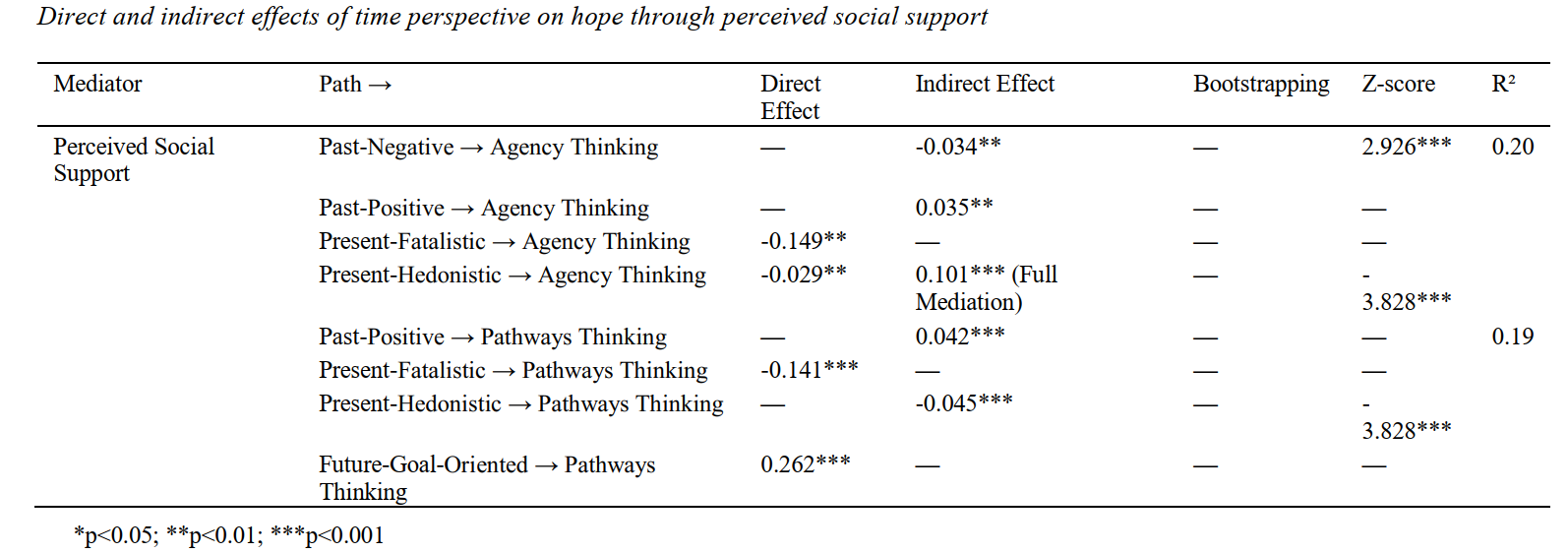
Findings: Results indicated that Past-Negative (β = –0.034, p < 0.01) and Past-Positive (β = 0.035, p < 0.01) orientations indirectly predicted agency thinking via perceived social support. Present-Fatalistic orientation had a direct negative effect on both agency (β = –0.149, p < 0.05) and pathways thinking (β = –0.141, p < 0.01). Present-Hedonistic orientation indirectly predicted agency (β = 0.101, p < 0.01) and pathways thinking (β = –0.045, p < 0.01) through perceived social support. Future-Goal-Oriented perspective had a direct positive effect on pathways thinking (β = 0.262, p < 0.01).
Conclusion: The findings highlight that time perspective dimensions influence hope for life both directly and indirectly through perceived social support. Positive temporal orientations, when supported by strong social networks, enhance motivational and strategic components of hope, while negative orientations, particularly Present-Fatalistic, undermine these aspects.
Downloads
References
Alizadeh, S., Mohamadinia, M., & Zimbardo, P. (2016). A model of the relationship between dimensions of time perspective and marital satisfaction considering the mediating effects of psychological well-being. [Journal Name], 12(46), 197-214. https://search.ebscohost.com
Anagnostipoulos, F., & Griva, F. (2012). Exploring Time Perspective in Greek Young Adults: Validation of the Zimbardo Time Perspective Inventory and Relationships with Mental Health Indicators. Social Indicatory Research, 106(1SP - 41), 59. https://doi.org/10.1007/s11205-011-9792-y
Arnold, K. M., McDermott, K. B., & Szpunar, K. K. (2011). Individual differences in time perspective predict auto noetic experience. Consciousness and Cognition, 20(3), 712-719. https://doi.org/10.1016/j.concog.2011.03.006
Bahadori Khosroshahi, J., & Hashemi Nosratabadi, T. (2012). The relationship between hope, resilience, and psychological well-being in students. Psychology Clinic Journal, 6(22), 41-50. https://www.sid.ir/fileserver/jf/33413935501
Birkas, B., & Csatho, A. (2015). Size the day: The time perspectives of the Dark Triad. Personality and individual differences, 86, 318-320. https://doi.org/10.1016/j.paid.2015.06.035
Braitmman, A. L., & Henson, J. M. (2015). The impact of time perspective latent profiles on college drinking: A multidimensional approach. Substance Use & Misuse, 50(5), 664-673. https://doi.org/10.3109/10826084.2014.998233
Budak, S. E., & Kaatsız, M. A. A. (2024). The Effect of Perceived Social Support and Spiritual Care Needs in Predicting Hope in Oncology Patients. Cancer Nursing. https://doi.org/10.1097/ncc.0000000000001370
Carelli, M. G., Wiberg, B., & Wiberg, M. (2011). Development and construct validation of the Swedish Zimbardo time perspective inventory. European Journal of Psychological Assessment, 27(4), 220-227. https://doi.org/10.1027/1015-5759/a000076
Ghodampour, A., Mansouri, L., & Bakedeli Nasrabadi, H. (2016). The role of social support dimensions in predicting employment among primary school teachers in Ahvaz. Women and Culture Journal, 9(33), 63-75. http://journal.ihepsa.ir
Guo, Y., Chen, Z., & Feng, T. (2017). The effect of Future time perspective on delay discounting is mediated by the gray matter volume of vmPFC. Neuropsychologia, 102, 229-336. https://doi.org/10.1016/j.neuropsychologia.2017.06.021
He, Y., Wang, R., Mo, L., & Feng, L. (2024). Mediating Effects of Perceived Social Support on the Relationship Between Comfort and Hope in Hospitalized Patients With Acute Ischemic Stroke. Journal of nursing management, 2024(1). https://doi.org/10.1155/2024/6774939
Hu, W. (2022). Academic self‐efficacy and academic performance among high school students: A moderated mediation model of academic buoyancy and social support. Psychology in the Schools, 59(5), 885-899. https://doi.org/10.1002/pits.22653
Kong, F., & You, X. (2013). "Loneliness and Self-Esteem as Mediators between Social Support and Life Satisfaction in Late Adolescence.". Social Indicators Research, 110(1), 271-279. https://doi.org/10.1007/s11205-011-9930-6
Kwok, S. Y., Gu, M., & Lai, K. Y. (2024). A longitudinal study of perceived social support from friends and hope in adolescents: emotional intelligence as the mediator. Current Psychology, 43(25), 21518-21529. https://doi.org/10.1007/s12144-024-05875-z
Mohammadi, M., Danesh , E., & Taghilou , S. (2016). Predicting hope based on religious orientation and time perspective. Applied Psychology, 10(3), 157-174. https://apsy.sbu.ac.ir/article_96589_00c0a26722f781136fdd582e12b87c7e.pdf
Mohammadian, N., Sepehrian Azar, F., Badalpour, N., & Norouzzadeh, S. (2016). The relationship between hope, happiness, and marital satisfaction. Health and Care Journal, 18(1). https://journals.co.za/doi/abs/10.10520/EJC-c42c200c4
Nakahara, J. (2013). Effects of social activities outside the home on life satisfaction among elderly people living alone. International Journal of Psychological Studies, 5(1), 112. https://doi.org/10.5539/ijps.v5n1p112
Omidian, M., & Hemmati, H. (2016). Time perspective among male and female students at Yazd University. Tehran, Iran.
Osullivan, G. (2010). The Relationship between Hope, Eustress, self-Efficacy, and Life Satisfaction among Undergraduates. Springer Science Business Media V. V. https://link.springer.com/article/10.1007/s11205-010-9662-z
Pasha, A., & Amini, S. (2010). The effect of reality therapy on hope for life and anxiety among spouses of martyrs. Find Psychology Journal, 9(37), 37-51. https://frooyesh.ir/article-1-3635-en.html
Przepiorka, A., & Malgorzata Sobol, K. (2020). People with Positive Time Perspective Are More Grateful and Happier: Gratitude Mediates the Relationship between Time Perspective and Life Satisfaction. Journal of Happiness Studies. https://doi.org/10.1007/s10902-020-00221-z
Sepehrian Azar, F., Mohammadi, N., Badalpour, N., & Norouzzadeh, S. (2016). The relationship between hope, happiness, and marital satisfaction. Health and Care, 18(1). https://doi.org/10.5812/ircmj.23839
Siu, N. Y. F., Lam, H. H. Y., Le, G. G. Y., & Przepiork, A. m. (2014). Time perception and time Perspective differences between adolescents and adults. Acts Psychological, 151(3), 222-229. https://doi.org/10.1016/j.actpsy.2014.06.013
Taghilo, S., & Latifi, H. (2016). The mediating role in the relationship between time perspective and psychological distress. Clinical Psychology: Theory and Practice, 10(39). https://link.springer.com/article/10.1007/s12144-022-03203-x
Tehrani, H., Rakhshani, T., Zadeh, C. S., & Hosseini, S. M. (2013). Analying the relationship between job stress to mental health, personality type and stressful life events of the nurses occupied in Tehran 115 emergency. Iranian Red Crescent Medical Journal, 15(3), 272-273. https://doi.org/10.5812/ircmj.1917
Zhang, M., Wu, Y., Ji, C., & Wu, J. (2022). The role of perceived social support and stress in the relationship between hope and depression among Chinese shadow education tutors: a serial mediation model. International journal of environmental research and public health, 19(6), 3348. https://doi.org/10.3390/ijerph19063348
Downloads
Additional Files
Publication Timeline
- Submitted
- Revised
- Accepted
Issue
Section
License
Copyright (c) 2025 Vahed Ghahremanzadeh Aghabagher (Author); Seyed Abolghasem Mehrinejad (Corresponding Author); Nemat Sotodehasl, Hassan Asadzadeh Dahraei (Author)

This work is licensed under a Creative Commons Attribution-NonCommercial 4.0 International License.